

Quick answer: Whether to sell or rent your Savannah home comes down to three numbers: your usable equity after closing costs, your true cap rate after every expense, and your tolerance for long-distance landlording. Rent when the property still returns 5–6%+ after all costs and you may return to Coastal Georgia; sell when you have significant equity with a better use for it, a sub-4–5% net cap rate, or no desire to manage a rental from afar.
I work with a lot of PCS families and a lot of homeowners thinking about a transition. The question is almost never, “Is renting profitable?” The real question is, “Do the three numbers add up for your situation?” Here are the three. Your usable equity. Your true cap rate after every expense is counted. And your willingness to own a rental from hundreds, or even thousands, of miles away.
I’ve learned that most people focus on just one of those numbers. That’s where expensive mistakes begin.
Bottom line, never assume. You can’t expect what you don’t inspect.
Why This Is One of the Highest-Stakes Decisions a Coastal Georgia Homeowner Makes
Selling your home is more than a financial transaction. Renting it out is more than collecting a monthly check. Either choice can help build your long-term wealth, or quietly cost you thousands if the decision is based on assumptions instead of facts.
That’s why I never tell someone they should always rent or always sell. There isn’t a universal answer.
Every week I sit down with homeowners across Savannah, Pooler, Richmond Hill, Wilmington Island, Rincon, Port Wentworth, Hinesville, and Tybee Island who are wrestling with the same question.
“Should I keep my home as a rental?”
Most already have an opinion before we start running the numbers.
Some believe real estate always appreciates, so keeping the property feels like the obvious move. Others have heard rental income is “passive,” while another group assumes cashing out immediately is the safest choice.
Those are opinions.
A decision this important deserves math.
One of the biggest mistakes I see is letting emotions outweigh financial reality. A family may love the home because they raised their kids there. A military couple may feel attached because it was the first house they bought after arriving in Coastal Georgia. Those memories matter personally, but they don’t change whether the property actually performs as an investment.
The opposite happens too.
Someone hears horror stories about bad tenants or midnight repair calls and decides renting is automatically a bad idea. Sometimes those stories are true. Sometimes they’re exaggerated. Either way, someone else’s experience shouldn’t determine your financial future.
The right answer starts with objective information.
Before we even compare renting versus selling, I want to know what the home is worth today. Not what a national estimate says. Not what the neighbor hopes their house is worth. Your home’s current market value.
That’s why I recommend starting with a free Coastal Georgia home value calculator. Once we know today’s realistic value, we can calculate what you would actually walk away with after paying off the mortgage, closing costs, and other selling expenses.
Then we compare that number with realistic rental performance after taxes, insurance, maintenance, vacancy, repairs, capital reserves, and professional property management.
Only then does the picture become clear.
I’ve seen both paths work extremely well.
A military couple with a Rincon home PCS’d out of Georgia but decided to keep their property. Before they left, we coordinated a professional property manager, established local maintenance contacts, and built a reliable support team. Years later, after another deployment and another duty station, that home was still generating income because everything had been planned correctly from the start.
I’ve also worked with veteran sellers who owned both a Savannah home and a Hinesville rental. They reached a point where they simply didn’t want to be landlords anymore. Maintenance calls, tenant turnover, and long-distance ownership no longer fit the life they wanted. Selling both properties gave them simplicity and peace of mind.
Neither decision was wrong.
Both were right because the numbers supported them.
That’s why I always tell clients that the default answer is usually the wrong answer.
If you’re also wondering whether should you sell your Savannah home in 2026, don’t let headlines make the decision for you. Your equity, your goals, and your property’s performance matter far more than national predictions.
The Three Numbers You Need First
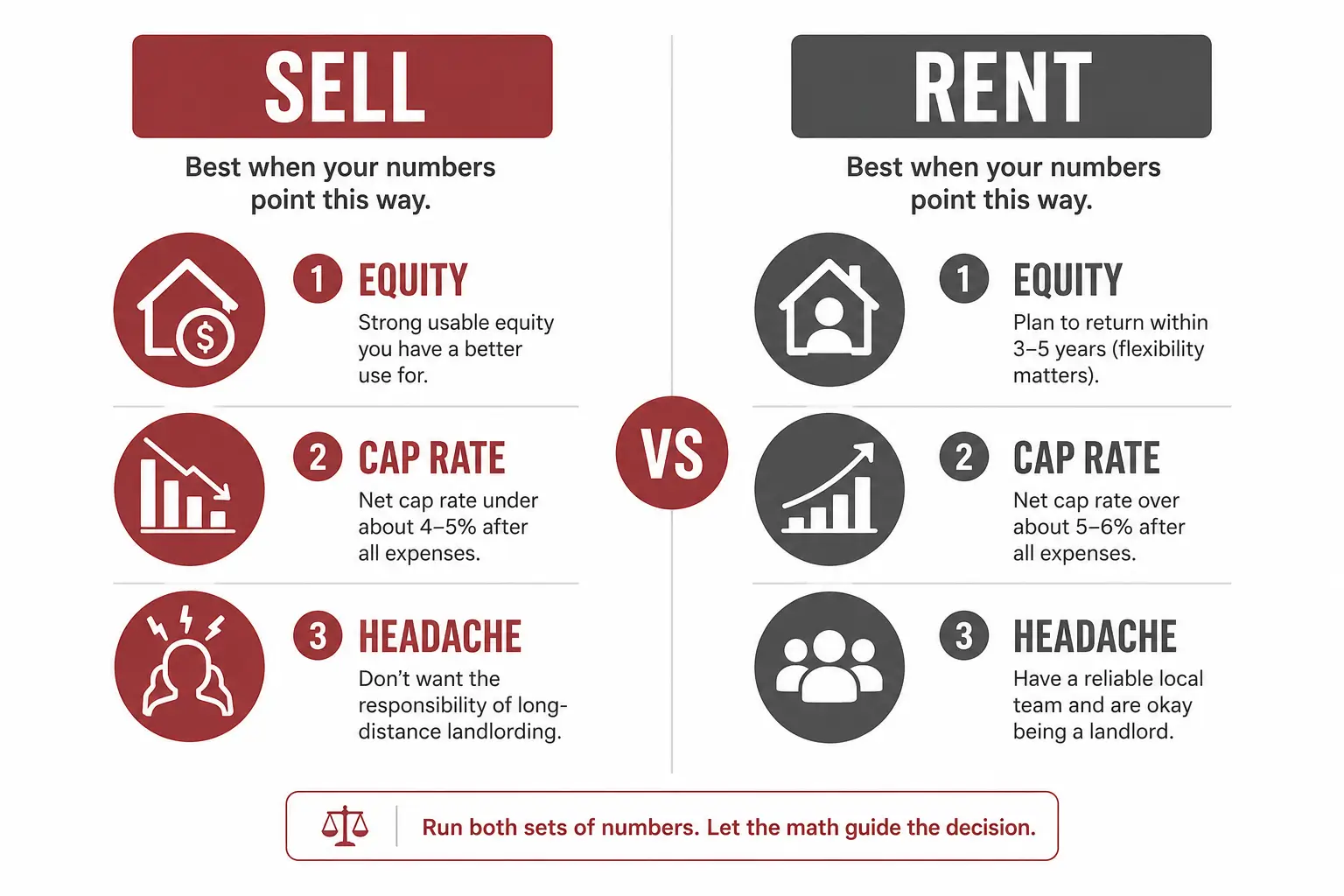
Every rent-versus-sell conversation begins with three calculations.
Without these, you’re guessing.
With them, you’re making a business decision.
1. Usable Equity
Many homeowners know roughly what they think their house is worth.
Far fewer know how much money they would actually receive after closing.
Those are two very different numbers.
Usable equity is what remains after paying off your mortgage, commissions, closing costs, prorated taxes, and any seller concessions negotiated during the transaction.
That number creates options.
Significant equity might become the down payment on your next home. It could eliminate high-interest debt, increase retirement savings, or provide financial flexibility during a PCS move.
On the other hand, limited equity changes the conversation.
I recently worked with an active-duty seller whose move was required because of military orders. After calculating the net sheet, there simply wasn’t enough equity for renting to make financial sense. We carefully structured the transaction, coordinated with the buyer’s side, and got the move across the finish line.
Sometimes the numbers make the decision for you.
That’s why I tell every homeowner to stop asking what their home is worth.
Start asking what they’ll actually keep.
2. True Cap Rate
This is where many rental calculators become misleading.
They compare annual rent to home value while conveniently ignoring most ownership expenses.
That’s not investing.
That’s wishful thinking.
A true cap rate starts with annual rental income, then subtracts operating expenses such as property taxes, insurance, maintenance, vacancy, capital improvements, repairs, and professional property management.
Only after every realistic expense has been accounted for should you compare that net operating income against today’s market value.
The result tells you how effectively your property performs as an investment.
Many homeowners are surprised by what they discover.
A rental that looked fantastic on paper suddenly becomes average once every expense is included.
That doesn’t automatically mean you should sell.
It simply means you’re finally comparing reality instead of optimism.
Market trends also matter. Savannah home values have appreciated over time, but appreciation alone shouldn’t be your investment strategy. Rental performance and long-term goals matter just as much.
3. Your Appetite for Being a Long-Distance Landlord
This isn’t a spreadsheet calculation, but it belongs in every rent-versus-sell discussion.
Managing a rental from another state is completely different from owning one ten minutes away.
Even with a great property manager, you’ll still make major decisions.
You’ll approve repairs.
Review monthly statements.
Handle insurance questions.
Replace HVAC systems.
Decide whether to renew leases.
Respond when unexpected expenses happen.
Some homeowners are perfectly comfortable with that responsibility.
Others want a clean break and the freedom that comes from selling.
Neither answer is wrong.
But pretending you’ll enjoy long-distance ownership when you already know you won’t usually leads to frustration.
The best rental owners are prepared for the responsibility before the first tenant ever moves in.
Because successful rentals aren’t built on hope.
They’re built on systems, realistic expectations, and numbers that actually work.
The “Sell” Case (When the Math Says Sell)
There are plenty of situations where selling is the stronger financial move. That can surprise people because real estate is often talked about as something you should hold forever.
The truth is that not every house is meant to become a long-term rental. Sometimes the highest return comes from selling, putting your equity to work elsewhere, and moving on.
I’ve helped plenty of homeowners make that decision with confidence because the numbers left very little room for debate.
You Have Significant Equity and a Better Use for It
Equity sitting inside a home isn’t automatically working for you.
If selling allows you to eliminate debt, make a stronger down payment on your next home, increase your emergency savings, or invest elsewhere, that equity suddenly becomes active instead of locked away.
I often remind clients that equity has opportunity cost.
Keeping a property simply because you own it isn’t a strategy.
Ask yourself:
- Will this equity improve my financial position elsewhere?
- Does selling reduce financial stress?
- Am I holding the property because it makes sense, or because I’m emotionally attached?
One repeat-client couple in Coastal Georgia went back and forth for weeks about renting. We walked through every scenario together.
Eventually they realized they weren’t excited about becoming landlords. They wanted simplicity, flexibility, and cash available for their next chapter.
Once they reached that conclusion, the decision became easy.
Clarity beats analysis.
Your Net Cap Rate Falls Below About 4 to 5 Percent
Many homeowners only look at monthly cash flow.
Positive cash flow feels good.
But positive cash flow doesn’t automatically mean you’re getting a strong return.
If your property’s true net cap rate falls below roughly 4 to 5 percent after every realistic expense, it may not be the best use of your capital.
That doesn’t mean the property is “bad.”
It simply means your equity might work harder elsewhere.
This is especially true if your home’s value has appreciated substantially over the past several years. Higher values can actually reduce investment efficiency if rental income hasn’t increased at the same pace.
That is why I always compare today’s value, not the value when you originally bought the property.
Your investment should be measured against what the home is worth now.
Not what you paid for it.
You’ll Be Living More Than 500 Miles Away
Distance changes everything.
Owning a rental across town is one thing.
Owning one from Texas, Colorado, Germany, or another duty station is something else entirely.
Every repair becomes a phone call.
Every contractor becomes someone you have to trust remotely.
Every emergency depends on somebody else showing up.
Can it work?
Absolutely.
But only if you’re prepared.
If you already know you don’t want those responsibilities, forcing yourself into long-distance landlording rarely ends well.
I would rather see someone sell confidently than spend years regretting a rental they never wanted to manage.
Sometimes peace of mind has value too.
The “Rent” Case (When the Math Says Rent)
Renting can absolutely be the right move.
I’ve seen homeowners build meaningful long-term wealth by keeping the right property under the right circumstances.
Notice those last two words.
The right circumstances.
Renting isn’t automatically the smarter choice because values may continue rising.
It’s the smarter choice when the property performs well as a business.
You Expect to Return to Savannah Within Three to Five Years
Military families often fit this situation.
A PCS assignment doesn’t always mean you’ll never live in Coastal Georgia again.
Many service members eventually rotate back to Hunter Army Airfield, Fort Stewart, or another nearby assignment.
Keeping the home can preserve flexibility while allowing you to benefit from future appreciation and mortgage paydown.
If you’re buying again after PCS orders, it’s also important to understand how your VA eligibility works.
I recommend reading VA second-tier entitlement explained before making assumptions about your next purchase.
Many military families are surprised to learn they may still have options.
Your Net Cap Rate Stays Above About 5 to 6 Percent
Healthy rentals survive real-world expenses.
That means the property still performs after paying a professional property manager, covering maintenance, budgeting for vacancy, replacing appliances, and preparing for larger repairs over time.
If the numbers remain strong after those costs, renting deserves serious consideration.
This isn’t about squeezing every possible dollar from the property.
It’s about building an investment that remains healthy for years instead of months.
Strong investments continue working when unexpected expenses appear.
Weak investments depend on everything going perfectly.
Real life rarely cooperates with perfect spreadsheets.
You Have a Reliable Local Team
Good rentals are rarely managed by one person.
They’re supported by a team.
That usually includes:
- A professional property manager.
- Reliable maintenance contractors.
- An HVAC company.
- A plumber.
- An electrician.
- A trusted Realtor who understands the local market.
One military couple with a Rincon home followed exactly that approach before leaving Georgia.
Every contact was established before the moving truck pulled away.
Years later, the property was still producing income because they built systems instead of relying on luck.
That’s the difference between owning a rental and operating one successfully.
A great team reduces stress.
It also protects the value of your investment over time.
The PCS-Specific Timing Trap (Military Families)
Military moves create opportunities, but they also create deadlines. Some of those deadlines aren’t obvious until it’s too late.
I’ve seen families make decisions based entirely on the next assignment without considering what happens two, three, or five years later.
The military gives you enough uncertainty already. Your housing decision shouldn’t create more.
Two areas deserve special attention before deciding to rent instead of sell.
Section 121 Capital Gains Exclusion and PCS Extensions
One of the biggest advantages available to homeowners is the capital gains exclusion under Section 121 of the Internal Revenue Code.
In general, if you’ve owned and lived in your home as your primary residence for at least two of the last five years before selling, you may qualify to exclude a significant amount of capital gains from federal taxes. Military members on qualified extended duty may also qualify for additional time under special suspension rules.
The important point is simple.
That tax benefit does not stay available forever.
Every year you continue renting the property can affect your future tax position if you wait too long to sell.
I’ve had conversations with military homeowners who assumed they could rent indefinitely and still receive the same tax treatment years later.
That’s a risky assumption.
Before deciding to keep your home, review the IRS Publication 523 guidance for selling your home and speak with a qualified tax professional who understands military relocations.
Good timing can preserve thousands of dollars.
Poor timing can quietly erase part of your equity.
VA Loan Entitlement When You Buy Again
Another question I hear almost weekly is:
“Can I keep this house and still use my VA loan again?”
Sometimes the answer is yes.
Sometimes it isn’t.
It depends on how much entitlement remains available, how much is tied to your existing loan, your new purchase price, and your eligibility for second-tier entitlement.
Too many military families assume they have to sell simply because they already have a VA loan.
Others assume they never have to sell.
Neither assumption is always correct.
Before making your decision, read my guide on VA second-tier entitlement explained. I also recommend reviewing the VA Lenders Handbook so you understand how entitlement works before shopping for your next home.
This is also where having an agent who understands military relocation services can save a lot of frustration. The housing decision at your current duty station directly affects the one waiting at the next.
The goal isn’t simply keeping a house.
The goal is preserving flexibility.
The Hybrid Play (Rent Now, Sell Later) and When It Backfires
A hybrid strategy sounds appealing.
Rent the home for a few years.
Build equity.
Let someone else pay down the mortgage.
Then sell later.
Sometimes that works beautifully.
Sometimes it creates a series of problems that homeowners never saw coming.
The biggest mistake is assuming that waiting automatically improves the outcome.
Markets move.
Interest rates change.
Inventory rises and falls.
Buyer demand shifts.
A home that rents easily today may face more competition tomorrow.
Likewise, a property that would have sold quickly this year could require price reductions if market conditions soften later.
One Coastal Georgia business owner I worked with wasn’t convinced either option was right.
Instead of asking, “Should I sell?”
He asked a better question.
“Should I test the market?”
We listed the property while continuing to evaluate rental performance. The response from buyers gave him valuable information without forcing an immediate long-term commitment.
Sometimes gathering better information is the smartest first step.
Property management is another variable.
A great property manager protects your investment.
A poor one quietly damages it.
I’ve seen situations where deferred maintenance, weak tenant screening, slow communication, and inconsistent inspections turned what should have been a profitable rental into an expensive headache.
The property manager represents your investment every day you’re not there.
Choose carefully.
The third issue is timing.
The longer you rent, the more attention you should pay to tax rules and your long-term exit strategy. Waiting too long could reduce or eliminate tax advantages that may have been available if you had sold earlier.
Every year should include a fresh review.
Don’t make a ten-year decision and ignore it for the next decade.
Decision Framework: Five Questions to Answer in Order
When clients ask whether they should sell or rent, I don’t start with market predictions.
I start with questions.
Answer these honestly, and the right path usually becomes much clearer.
- How much usable equity will you actually receive if you sell?
Not estimated equity.
Real equity.
Calculate your projected net proceeds after paying off your mortgage and all selling expenses. If you don’t know that number, you’re making a decision without the most important piece of information.
You can also see what your Savannah home could sell for before building your net sheet.
- Does the rental still produce a healthy return after every expense?
Run conservative numbers.
Include vacancy.
Include maintenance.
Include management.
Include capital improvements.
Optimistic spreadsheets create disappointing investments.
- Where will you live over the next five years?
Military families especially should think beyond the next PCS.
If there’s a realistic chance you’ll return to Coastal Georgia, keeping the property may deserve stronger consideration.
If not, selling may create greater flexibility.
- Do you actually want to be a landlord?
This sounds simple, but it’s one of the most overlooked questions.
Some people enjoy owning rental property.
Others don’t.
Neither answer is wrong.
Just be honest with yourself.
- Which option gives you more freedom?
Money matters.
So does peace of mind.
The best financial decision is often the one that supports both your long-term wealth and the lifestyle you actually want.
I’ve watched homeowners delay making this decision for months because they kept searching for certainty.
Eventually, they realized there wasn’t a perfect answer.
There was simply a better answer based on today’s facts.
That’s enough.
Because clarity beats analysis every time.
Frequently Asked Questions
Should I sell my Savannah home or rent it out when I PCS?
Start with your usable equity, true rental return, and your next duty station plan. Renting may be the better choice if the property generates solid net income after management, maintenance, vacancy, taxes, insurance, and repairs. Selling may make more sense if you have significant equity to put toward your next home or you simply don’t want the responsibility of being a long-distance landlord.
What is a good cap rate for a Savannah rental?
A true net cap rate of around 5 to 6 percent or higher is generally a strong starting point. Include property management, maintenance, vacancy, taxes, insurance, and repair reserves in your calculations before deciding whether to keep the property.
Can I keep my VA loan and buy another home at my next duty station?
Possibly. Many military buyers can use remaining VA loan entitlement to purchase another primary residence. Your eligibility depends on available entitlement, loan balance, lender requirements, and your next purchase price.
How does the capital gains exclusion work if I rent my home before selling?
Many homeowners qualify for the Section 121 capital gains exclusion after living in the home as their primary residence for at least two of the previous five years. Qualified military service may extend that timeline under IRS rules.
What does a Savannah property manager cost?
Property management fees vary by company and service level. In addition to monthly management fees, owners should consider leasing fees, maintenance coordination, inspections, vacancy costs, and lease renewal charges when evaluating rental performance.
How long should I plan to hold a Savannah rental?
Many homeowners benefit from reviewing the property over a three to five year horizon, especially during military PCS cycles. Reevaluate the investment annually based on rental performance, expenses, tax considerations, and local market conditions.
Is renting out my Coastal Georgia home worth the headache?
Renting can be worthwhile when the property generates healthy net returns and you have a dependable local property management team. The decision should be based on financial performance, long-term goals, and your willingness to manage rental ownership.
Final Thoughts
There isn’t a one-size-fits-all answer to the rent versus sell question.
I’ve helped military families successfully keep their homes as long-term rentals through multiple PCS moves. I’ve also helped veteran homeowners sell because they were ready to simplify their lives. I’ve worked with clients who tested the market before deciding, and others whose tight equity made the decision for them.
Every one of those choices was the right one because it was backed by real numbers instead of assumptions.
If you’re thinking about making a move, start with accurate information. Use the free Coastal Georgia home value calculator to get an instant estimate, then let’s put together a detailed Comparative Market Analysis and compare your likely sale proceeds against realistic rental performance.
Call me at 912-351-8935. We’ll run both scenarios, answer your questions, and let the math guide the decision. Bottom line, never assume. You can’t expect what you don’t inspect.




Join The Discussion