
By Alex Rodino, U.S. Army veteran (Capt.) · Licensed GA REALTOR® #443565 · MRP
Updated August 24, 2026 · About 17 minutes
TL;DR: New construction homes in Savannah GA are concentrated west toward Pooler and Bloomingdale, south in Richmond Hill, and north in Effingham County. A new build offers warranty coverage and more choice, but it costs time and upgrade money. Registering your own agent on the first builder visit is the highest-leverage move you can make.
Where the new construction actually is
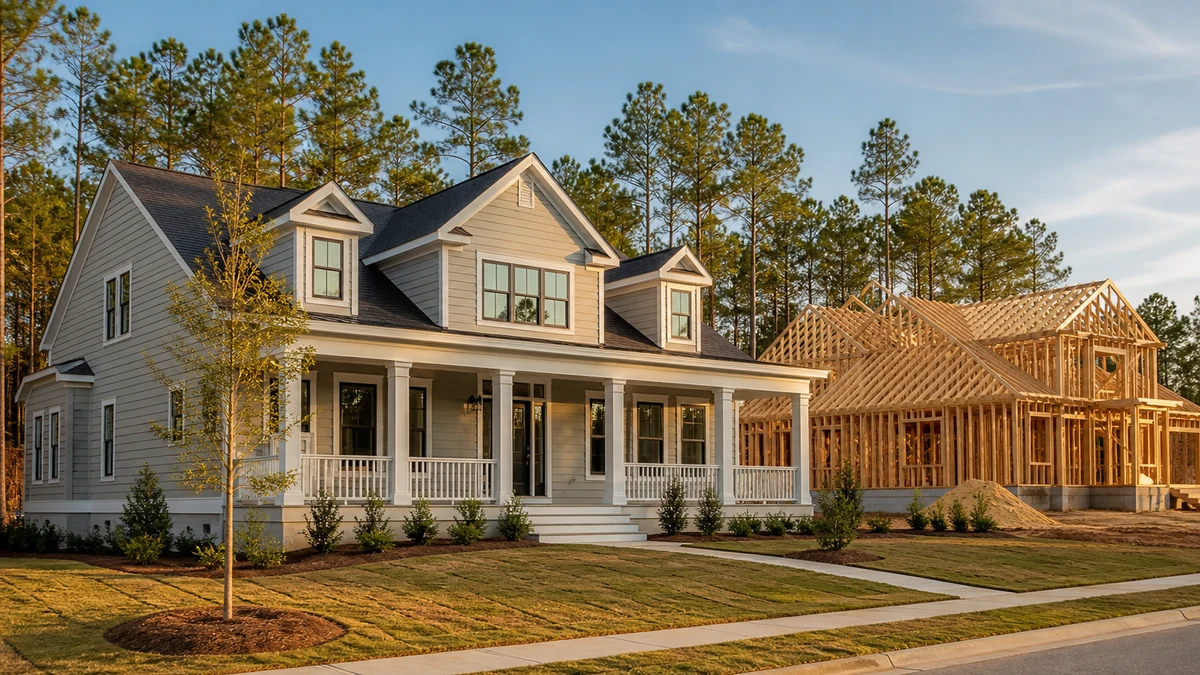
Most large new-home communities sit outside Savannah’s historic core: west Chatham and Pooler, Richmond Hill in Bryan County, and the Rincon and Guyton side of Effingham County. Port Wentworth has another pocket, while in-city and Hutchinson Island choices are smaller and more site-specific.
Pooler and Savannah Quarters
New construction in Pooler GA includes active inventory in Savannah Quarters, where Lennar currently markets its Arbor collections, plus Landmark 24 communities such as Harmony and Forest Lakes. Start with the live Savannah Quarters homes for sale page, then use my Pooler area guide to compare the daily logistics. Base price is only the opening number here, especially when a homesite, club membership, or upgrade package is involved.
West Chatham toward New Hampstead and Bloomingdale
K. Hovnanian is selling Aspire at New Hampstead and Oakwood at New Hampstead, while Lennar lists Edgewater at New Hampstead. Landmark 24 also markets Brookline in the Savannah Highlands and an Oakwood collection in Bloomingdale. Stanley Martin has announced Brunson Station, with townhomes and single-family homes planned, but buyers should confirm the current release and construction stage before treating any announced phase as available inventory.
Richmond Hill and Bryan County
Pulte, Centex, and Del Webb list homes at Heartwood, while Pulte also lists Waterways. Landmark 24 lists Wexford. These are Bryan County locations, so compare commute direction, closing timeline, HOA or club obligations, and lot characteristics rather than choosing from a model-home finish alone. My Richmond Hill guide covers the area without turning this process guide into another suburb survey.
Rincon, Guyton, and Effingham County
Effingham County is where buyers often find community development spreading beyond the tighter Chatham footprint. D.R. Horton lists Laurel Grove in Guyton, and availability changes by release. The right comparison is practical: drive time, homesite size, utilities, community dues, and whether a completed home or an unreleased lot matches your move date. See the live Rincon area guide for local context.
Port Wentworth, in-city Savannah, and Hutchinson Island
D.R. Horton lists Rice Hope in Port Wentworth, and Landmark 24 lists Rice Creek. Inside Savannah, Dream Finders lists Hidden Pointe townhomes and Meadow Lakes single-family homes. The Isling at Savannah Harbor is an active Hutchinson Island project with single-family, villa, and duplex plans across phases. These choices are not interchangeable, so verify the exact address, flood zone, fee schedule, and release status.
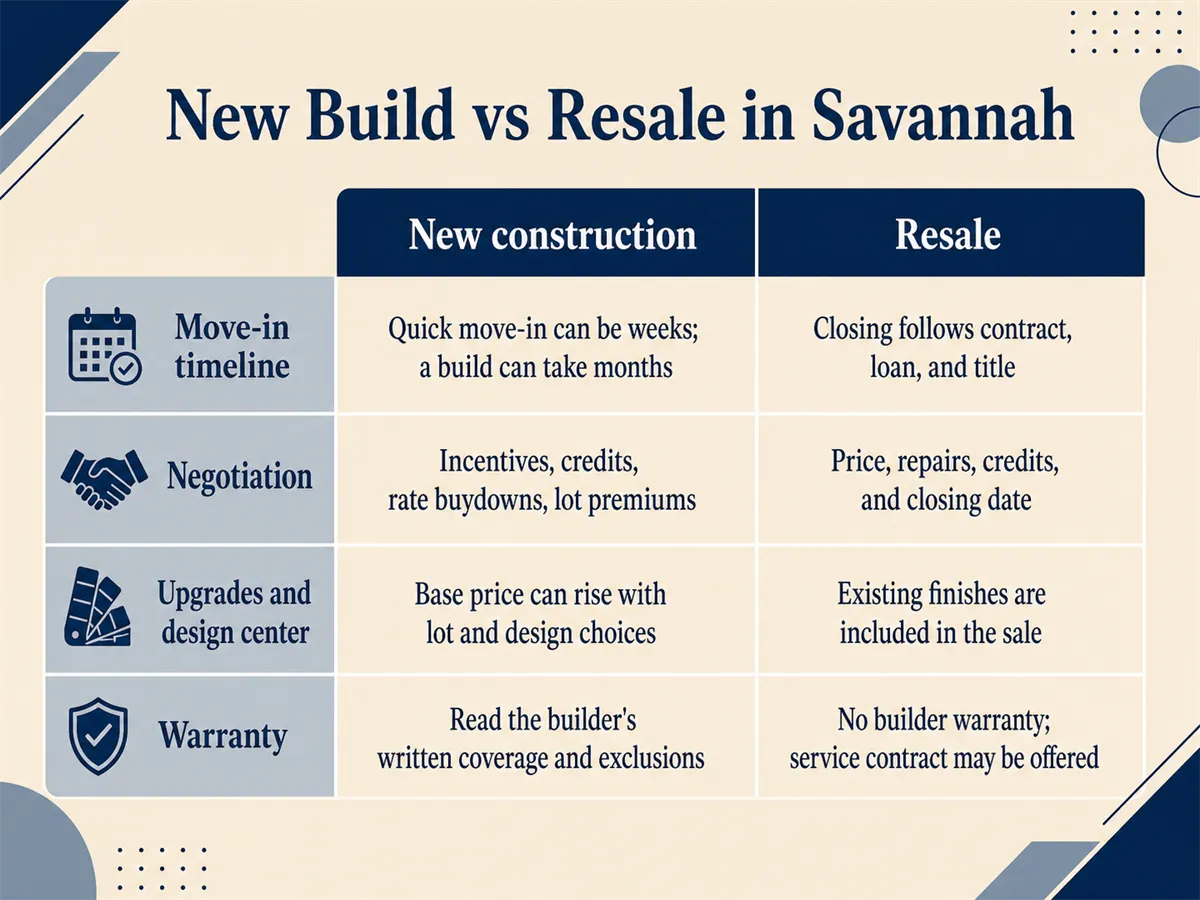
New build vs resale in the Savannah market
| Decision factor | New Construction | Resale |
|---|---|---|
| Price per square foot | Use the final contract price, including lot premium and selected upgrades, divided by finished living area. A base-price calculation hides part of the cost. | Use a comparable closed sale price divided by finished living area, then adjust for condition, renovations, and concessions. |
| Negotiation | Incentives, credits, rate buydowns, lot premiums | Price, repairs, credits, and closing date |
| Move-in timeline | Quick move-in can be weeks; a build can take months | Closing follows contract, loan, and title |
| Upgrades and design center | Base price can rise with lot and design choices | Existing finishes are included in the sale |
| Condition and repairs | Everything is new, but new does not mean defect-free. Use independent inspections and a written punch list. | Condition is visible now. Due diligence can support repair requests, credits, or acceptance as-is. |
| Warranty | Read the builder’s written coverage and exclusions | No builder warranty; service contract may be offered |
| HOA, CDD, and community fees | Review HOA, club, initiation, transfer, and any special assessment documents. Do not assume a Florida-style CDD applies in Georgia. | Established budgets and recent meeting records may show the fee history, reserves, and pending assessments. |
| Lot size and mature trees | Newer production lots can be compact, with young landscaping and limited shade. | Older areas may offer larger lots and mature trees, balanced against more exterior upkeep. |
| Property tax surprise | A preliminary bill or builder estimate may reflect land or incomplete improvements. Budget for assessment after completion. | The prior bill is useful context, but reassessment, exemptions, and millage can still change the amount. |
| Insurance and flood | Quote the finished home at the exact lot address and check FEMA and county flood data before contract deadlines expire. | Existing claims history, roof age, systems, elevation, and flood zone can affect coverage and premium. |
My honest reading is simple: new construction buys predictability on age, not certainty on total cost. Resale gives you a finished product to inspect, but it can trade design choice for near-term repair exposure. I price both from the number you will actually close at, not the number on a sign.
Who is building in Savannah right now
This is a neutral roll call, not a ranking. These builders had active Savannah-area community pages when I checked them on August 5, 2026. Advertised starting prices exclude some combinations of homesite, elevation, option, and incentive, and they can change without notice.
- Landmark 24: Savannah, Pooler, Bloomingdale, Richmond Hill, and Port Wentworth. Its build-and-price tool showed community starting points from $290,200 at Pine Barren Place to $799,400 at The Bluff at Moon River.
- Dream Finders Homes: Hidden Pointe and Meadow Lakes in Savannah. Its Savannah page showed starts of $299,990 and $308,989.
- K. Hovnanian Homes: Aspire at New Hampstead and Oakwood at New Hampstead. Its Savannah page showed the low $300s to the mid $300s.
- Lennar: Savannah Quarters in Pooler and Edgewater at New Hampstead in Savannah. Its Savannah listings showed floor-plan starts from about $302,000 to $442,000.
- PulteGroup brands: Pulte, Centex, and Del Webb at Heartwood, plus Pulte at Waterways in Richmond Hill. The Richmond Hill page showed community starts from $336,990 to $375,990.
- D.R. Horton: Rice Hope in Port Wentworth and Laurel Grove in Guyton. The Rice Hope page showed floor plans from the upper $280s to the low $400s.
For due diligence, search the builder or contractor through the Georgia Secretary of State licensing board. Then check permit and inspection records with the jurisdiction where the lot sits, including the City of Savannah permits office or the applicable county. A license and permit history are verification steps, not quality rankings.
How buying new build is different: the contract, upgrades, and timeline
The contract is not a resale routine
Builders may use their own purchase agreement and addenda rather than the familiar GAR resale form. Georgia REALTORS also publishes a separate 2026 New Construction Purchase and Sale Agreement, so identify the actual form before anyone explains it as “standard.” Builder paper can set different rules for deposits, financing, inspections, closing dates, default, dispute resolution, and delays. Earnest money and option deposits may become non-refundable when stated milestones pass. Have a Georgia real estate attorney review what you are signing. Georgia treats a real estate closing as the practice of law, according to the State Bar of Georgia.
Base price is not finished price
Build the budget in layers: base home, lot premium, structural options, design-center selections, appliances, window treatments, landscaping, fees, and financing. Ask for an included-features sheet before choosing upgrades. I have watched a buyer’s planned upgrade allowance jump at the design center because every attractive model-home finish had quietly become the mental baseline. I have also seen a lot premium appear later than the buyer expected. Put every allowance, credit, and promised selection in writing.
The schedule belongs to the contract
A completed or nearly completed home can move quickly. A dirt-start home must clear permitting, site work, inspections, trades, materials, weather, and utility coordination. The builder’s estimated date is not the same as a guaranteed closing date. Read the delay, extension, rate-lock, and outside-closing provisions, and keep a temporary-housing plan if your move date cannot flex.
Inspect before the walls close and before closing
I recommend an independent pre-drywall inspection and an independent final inspection when the contract and site rules allow them. The pre-drywall visit can document framing and rough systems before insulation covers them. The final inspection supports a precise punch list. Track incomplete items, responsible party, promised correction, and deadline in writing. The builder walkthrough teaches you the home, but it is not a substitute for your own inspector.
Read the warranty, not the headline
Coverage varies. As one current example, Lennar describes a limited 1-year workmanship, 2-year systems, and 10-year structural structure. The FTC says new-home warranties generally limit coverage by component and spell out claim procedures. Get the actual warranty document, exclusions, maintenance duties, transfer rules, claim deadlines, and dispute process before closing.
Builder incentives and the lender question
Builders often preserve headline pricing and compete with closing-cost credits, rate buydowns, or design-center dollars. Many of the strongest offers are tied to an affiliated lender and a closing deadline. That does not make the offer good or bad. It means you need a full comparison.
Get the builder-lender offer in writing, then request an outside Loan Estimate for the same loan type, term, down payment, and lock period. Compare cash to close, rate, APR, points, lender credits, mortgage insurance, and total cost over the years you expect to keep the loan. The Consumer Financial Protection Bureau recommends comparing Loan Estimates from multiple lenders. Builder contracts, incentives, and rates change weekly, so confirm every incentive in writing.
For VA buyers, new construction can add builder approval, appraisal, inspection, and completion timing to the loan plan. The VA confirms that an eligible purchase loan can build a new home. I cover the relocation side on my military relocation page.
Bring your own agent to the builder's sales office on the FIRST visit
The on-site sales agent represents the builder. Buyers can have their own representation, often without an added out-of-pocket cost when the builder’s offered co-op covers the agreed compensation. Many builders require the agent to be registered at the first contact or visit. Walking in alone can affect whether that builder will compensate your agent.
“The sales agent in the model home is paid by the builder. That is not a scandal, it is just the fact you should walk in knowing.”
Lennar’s published policy is a useful real-world example: the buyer must identify the cooperating broker during the first interaction, and the agent must accompany the initial visit for offered compensation eligibility. Policies vary by builder and community, so ask before you tour.
I read the contract addenda, price upgrades against likely resale value, push on incentives and lot premiums, arrange independent pre-drywall and final inspections, track delay clauses, and keep a written record of design-center promises. Representation terms and compensation are negotiable and disclosed in the buyer agreement. Ask both the builder and your agent how compensation works before signing anything.
Take me with you on the FIRST visit. It costs you nothing and it changes what you sign. Call 912-351-8935 or text 912-210-8967 before you register at a sales office.
New construction taxes, flood, and the costs buyers miss
Georgia assesses most property at 40% of fair market value. For 2026, Chatham County published a 10.518-mill general maintenance and operations rate, and Savannah-Chatham schools identified 17.331 mills as the current school rate. City, special district, and other components depend on the exact parcel. A builder estimate or early bill may reflect the lot or incomplete improvements, not the completed home’s later assessment.
After closing on a primary residence, file for homestead and Stephens-Day treatment with the Chatham County Board of Assessors. The county FAQ says applications may be made year-round but must be filed by April 1 for that tax year. Stephens-Day generally bases its exemption on the prior-year value plus later improvements, so new construction still needs careful first-year budgeting.
Check the exact lot in the FEMA Flood Map Service Center and confirm the flood determination with your lender and insurer. Chatham County requires floodplain development review for projects in a Special Flood Hazard Area. Its published fee for a new home or substantial improvement is $450 as of August 22, 2025. Add HOA, club, initiation, transfer, and special assessment obligations to the same cost worksheet.
Walk the models with your own agent
My bottom line: choose the area and builder only after the contract, lot, timeline, incentives, taxes, insurance, and exit value make sense together. A beautiful model is a sales tool. Your signed agreement is the deal.
Take me with you on the first visit. Call 912-351-8935 or text 912-210-8967, and we can compare the build against resale options and current Savannah Quarters homes for sale.
This article is general real estate information, not financial or legal advice. Contracts, incentives, rates, community releases, and fees change. Have the contract reviewed and confirm every material term in writing.
Frequently asked questions
Where is the most new construction near Savannah GA?
Most large new-home communities are west toward Pooler, New Hampstead, and Bloomingdale, south in Richmond Hill, and north around Rincon and Guyton. Verified examples include Savannah Quarters, Aspire and Oakwood at New Hampstead, Heartwood, Waterways, Rice Hope, and Laurel Grove. Smaller choices include Hidden Pointe, Meadow Lakes, and The Isling.
How much do new construction homes cost in Savannah GA?
Advertised community starting prices in Landmark 24’s Savannah-area build-and-price tool ranged from $290,200 to $799,400 when checked on August 5, 2026. That is one consistent base-price metric, not a market median. Lot premiums, elevations, options, fees, and incentives can move the final contract price.
Is there new construction in Pooler GA?
Yes. New construction in Pooler GA includes active offerings in Savannah Quarters plus communities such as Harmony and Forest Lakes. Inventory and builder releases change, so check the current Savannah Quarters homes for sale page and bring your agent before the first sales-office visit.
Do I need a realtor to buy a new construction home?
No law requires you to hire a Realtor, but the builder’s sales representative works for the builder. If you want your own representation, arrange it before the first contact or visit. Builder policies can make first-visit registration important to compensation eligibility. Your written buyer agreement must disclose services and negotiable compensation.
Do builders negotiate on price in Savannah?
Sometimes, but the practical lever is often an incentive rather than a lower base price. Ask for closing-cost credits, rate buydowns, design allowances, lot-premium adjustments, or move-in packages, then get every term and expiration date in writing. Compare the affiliated-lender offer against an outside Loan Estimate.
How long does it take to build a house in the Savannah area?
There is no honest single Savannah timeline. Dream Finders says a new home can take about 7 to 12 months depending on size, customization, permitting, and local conditions, while its quick move-in homes may close in 30 to 120 days. Weather, inspections, utilities, materials, and change orders can extend the schedule.
What warranty comes with a new construction home in Georgia?
The written builder warranty controls. A common structure separates shorter workmanship coverage from longer systems and structural coverage. For example, Lennar describes limited coverage of 1 year for workmanship, 2 years for systems, and 10 years for structural elements. Read the actual warranty, exclusions, maintenance duties, deadlines, and dispute process.



Join The Discussion