

Flood zone, Historic District, schools, lot, hurricane risk, and 5 more factors that move Coastal Georgia home values in 2026.
TL;DR: Your home’s value isn’t determined by square footage alone. In Coastal Georgia, buyers and appraisers look at flood zones, insurance costs, school assignments, condition, lot characteristics, Historic District regulations, nearby new construction, and local buyer demand. Online estimates are a starting point. A true valuation adjusts for the details that actually influence what someone is willing to pay.
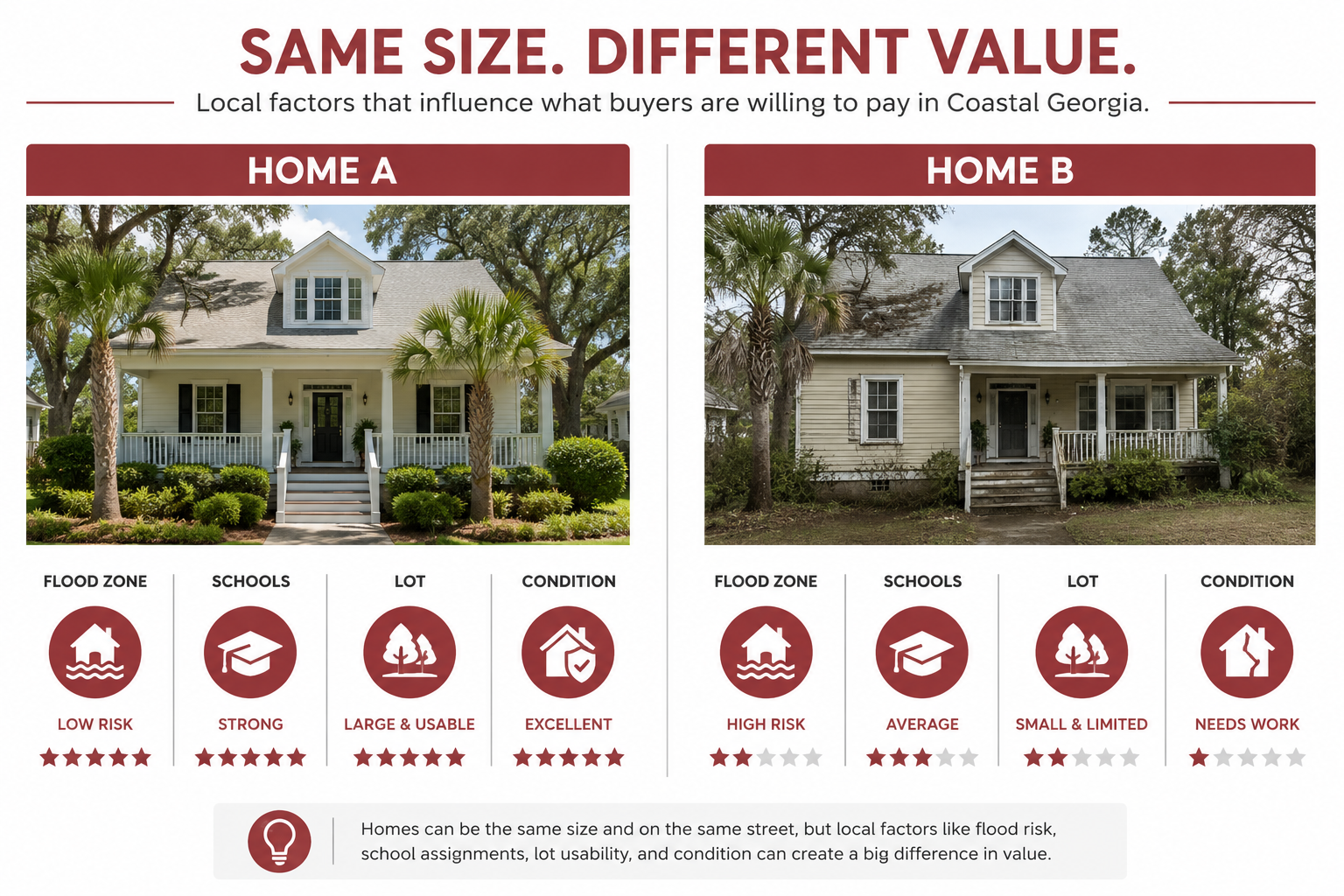
I’ve seen two Wilmington Island homes the same size on the same street sell tens of thousands apart. The buyer for the second one was not naive. The lender appraiser was not wrong. The difference was a flood zone designation a Zestimate cannot read.
That lesson comes up over and over across Savannah, Pooler, Richmond Hill, Wilmington Island, Tybee Island, Port Wentworth, Rincon, and Hinesville. Sellers naturally compare their home to the one around the corner. Online estimates do the same thing. They pull nearby sales and apply broad math.
Buyers don’t.
Appraisers don’t.
Insurance companies certainly don’t.
Every home has its own combination of strengths and weaknesses. Some increase demand. Others quietly reduce the number of qualified buyers willing to make an offer. Most of those factors never show up on a Zestimate or tax record.
Bottom line, never assume. You can’t expect what you don’t inspect.
The homes that sell for the strongest prices are usually the ones that are priced using evidence instead of assumptions.
Comparable Sales Matter. Comparable Homes Matter More.
One of the biggest pricing mistakes I see is assuming every nearby sale is a valid comparison.
It isn’t.
Professional real estate pricing isn’t about finding three homes that sold nearby. It’s about finding homes that buyers would have considered true alternatives.
Two houses can sit on the same street, have almost identical square footage, and still be worth very different amounts.
That’s because buyers compare far more than size.
Appraisers do the same thing.
What professionals actually compare
When I prepare a Comparative Market Analysis, I’m looking at factors such as:
Living area and floor plan functionality
Lot size and usability
Age of the home
Construction quality
Renovation level
Roof age
HVAC, plumbing, and electrical updates
Garage size
Waterfront or marsh views
Flood zone designation
Inspection condition
Overall curb appeal
Recent buyer demand in that specific neighborhood
Miss one or two major differences and the comparison starts falling apart.
I worked with a Midtown Savannah seller whose property was expected to sell in roughly the low $500,000 range.
Friends kept pointing to another neighborhood sale that had closed for more money.
On the surface, it looked like proof the home should be listed higher.
It wasn’t.
The neighboring property sat on a better lot. It had newer mechanical systems. The inspection report was cleaner. The kitchen and bathrooms had been updated recently, while my client’s home still reflected finishes from years earlier.
Those aren’t small details.
They’re exactly the things buyers notice when they’re touring homes on the same afternoon.
The seller initially wanted to price based on what neighbors were saying instead of what buyers were seeing.
The market gave honest feedback.
Showings slowed.
Offers never reached expectations.
After adjusting the price to reflect the property’s actual position in the market, interest increased and the home sold.
That’s why I always tell sellers this:
The algorithm doesn’t know your roof.
Your neighbor doesn’t know your inspection report.
Buyers eventually know both.
If you’re just starting your research, use the free Coastal Georgia home value calculator to establish a baseline. Then compare that estimate with a professional Comparative Market Analysis that adjusts for the details online tools simply can’t measure.
You can also read how to price your Savannah home in 2026 for a detailed look at how experienced agents adjust comparable sales.
Flood Zones and Insurance Costs Have Become Bigger Value Drivers
Flood risk has always been part of life along the Georgia coast.
What’s changed is how much buyers care about the monthly cost of owning a home.
Insurance has become a much bigger piece of that conversation.
When buyers compare two similar homes, they aren’t only looking at the purchase price anymore.
They’re asking questions like:
Will flood insurance be required?
How much will homeowners insurance cost?
Is the roof likely to create insurance problems?
Will the lender require additional documentation?
Those answers directly affect affordability.
Affordability affects demand.
Demand affects value.
Buyers verify flood information
Many homeowners don’t realize buyers frequently check flood maps before removing contingencies.
The official FEMA Flood Map Service Center makes that information publicly available.
If a property sits inside a higher-risk flood designation, buyers often request insurance quotes early in the process.
Sometimes the difference in annual insurance costs is enough to influence which home they choose.
I’ve watched two nearly identical homes receive very different buyer reactions simply because one carried noticeably lower ownership costs after insurance was factored in.
The homes themselves weren’t dramatically different.
The monthly payment was.
Insurance concerns also extend beyond flood coverage.
I recently worked with a Midtown buyer dealing with roof and insurance issues that immediately caught the attention of both the lender and the appraiser.
Nobody panicked.
We gathered documentation, coordinated with the right professionals, addressed the concerns, and kept the transaction together.
That experience reinforced an important lesson.
Professionals don’t ignore condition issues tied to insurance.
They solve them.
Roof age, prior claims, wind mitigation features, maintenance history, and overall condition all influence how buyers and insurance carriers evaluate risk.
That’s why I encourage sellers to understand these issues before putting a home on the market instead of waiting for a buyer to uncover them.
If your property falls within or near a mapped flood area, take time to understand the designation before listing.
Clear information builds buyer confidence.
Better preparation usually leads to smoother negotiations.
For a deeper explanation, read my Savannah flood zones insurance cost guide.
If you’re wondering where your property stands today, start with an instant Savannah home value estimate, then compare that estimate against recent comparable sales, current insurance costs, and your home’s unique characteristics.
Historic District Rules, Schools, and Location Can Shift Value Quickly
Location has always mattered in real estate.
In Coastal Georgia, the details inside that location often matter even more.
Two neighborhoods may sit only a few miles apart. Even two homes within the same neighborhood can appeal to very different buyers because of historic restrictions, school assignments, waterfront access, commuting patterns, or nearby development.
These aren’t small adjustments.
They’re often the reason one home attracts multiple offers while another sits on the market.
Historic District homes offer character, but they come with responsibilities
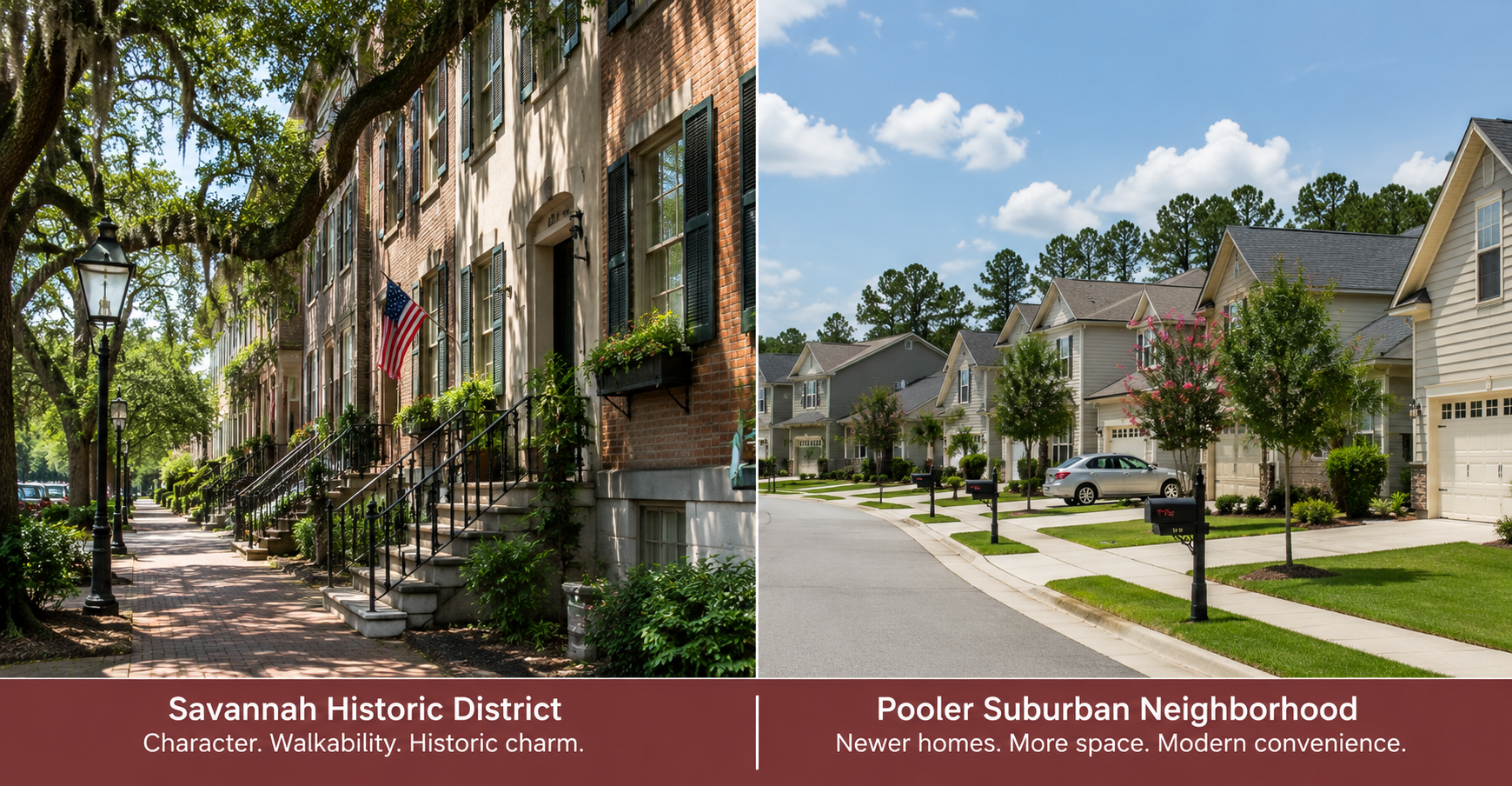
Savannah’s historic neighborhoods are some of the most desirable places to own a home in Georgia.
They also come with rules that buyers should understand before making an offer.
Properties located within the Historic District may require approval for certain exterior improvements, renovations, windows, roofing materials, fences, additions, and other visible changes. Those requirements help preserve the area’s historic character, which is exactly why many buyers are drawn there in the first place.
The City of Savannah Historic Review Board oversees many of these review processes.
For some buyers, those protections increase a home’s appeal.
For others, they represent additional planning and expense.
Neither perspective is wrong.
They’re simply different buyer profiles.
I’ve worked with clients who specifically wanted the charm, walkability, and architectural history of Savannah’s older neighborhoods. I’ve also worked with buyers who preferred fewer renovation restrictions and newer construction outside the Historic District.
Knowing which audience your home appeals to is part of pricing it correctly.
If your property falls within one of Savannah’s historic review areas, understanding the rules before listing helps prevent surprises during negotiations.
My guide to Savannah Historic District renovation rules explains how those requirements affect renovations, permits, and resale expectations.
Bottom line, historic character adds value.
Historic restrictions simply become part of the equation.
School assignments influence buyer demand
Even buyers without children often ask about schools.
Why?
Because future buyers will.
School districts influence long-term demand, and long-term demand supports property values.
Families relocating to Savannah frequently narrow their search based on attendance zones before they ever begin comparing floor plans.
That means two otherwise similar homes can attract different levels of buyer interest simply because they’re assigned to different schools.
School ratings are never the only factor that matters.
Commute times, neighborhood amenities, nearby shopping, parks, and community feel all influence purchasing decisions.
Still, school assignments consistently remain one of the first questions relocation buyers ask.
The Georgia Department of Education school report resources provide performance information that many buyers review during their research.
As a seller, you don’t control school boundaries.
You do control how well your home is positioned within its market.
Understanding what buyers value most helps create stronger pricing decisions and better marketing.
Lot Size, Condition, and Curb Appeal Still Matter
Online estimates often reduce a home to numbers.
Bedrooms.
Bathrooms.
Square footage.
Real buyers don’t.
The first impression begins before someone walks through the front door.
A larger lot.
Better privacy.
Mature live oaks.
Marsh views.
A fenced backyard.
Room for a pool.
Extra parking.
Those features aren’t always reflected accurately in automated estimates, but buyers absolutely notice them.
The same goes for condition.
Deferred maintenance doesn’t stay hidden for long.
Inspection reports have a way of bringing every overlooked repair into the conversation.
Buyers notice signals before the inspection
Experienced buyers start forming opinions almost immediately.
They’re looking for signals like:
An aging roof
Stained ceilings
Rotten trim
Older HVAC equipment
Original plumbing
Poor drainage
Foundation movement
Outdated kitchens and bathrooms
Worn flooring
Exterior maintenance issues
None of these automatically kills a sale.
Together, they influence buyer confidence.
Buyer confidence influences offers.
I often remind sellers that buyers aren’t simply purchasing today’s appearance.
They’re estimating tomorrow’s expenses.
That’s why preparation matters.
Simple improvements like fresh paint, landscaping, pressure washing, updated lighting, servicing HVAC systems, and handling deferred repairs often produce a stronger first impression than expensive remodeling projects completed just before listing.
If you’re preparing to sell, my guide on prepping a Savannah home for sale walks through the improvements that typically provide the greatest return without overspending.
One of the best investments a seller can make isn’t always another renovation.
Sometimes it’s eliminating reasons for a buyer to hesitate.
The fewer objections buyers find, the easier it becomes for them to focus on everything your home already does well.
Builder Competition, Market Trends, and the Local Economy All Influence Value
Not every pricing factor is attached to your home.
Sometimes the biggest competition is happening just down the street.
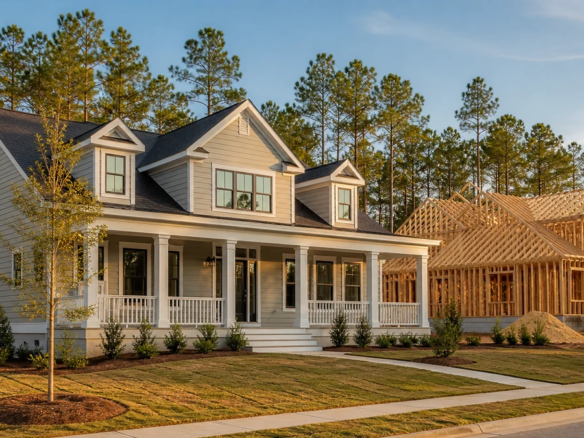
Across parts of Port Wentworth, Pooler, and other fast-growing areas of Coastal Georgia, builders continue adding new inventory. Those homes don’t just compete with one another. They compete with existing homes as well.
That’s something many sellers overlook.
New construction changes buyer expectations
I currently have a Port Wentworth listing competing with a DR Horton community nearby.
On paper, the homes offer similar square footage and layouts.
The difference isn’t always the house.
It’s the incentives.
Builders may offer closing-cost assistance, mortgage rate buy-downs, appliance packages, or upgrade credits that effectively reduce a buyer’s overall cost without lowering the advertised purchase price.
An existing homeowner usually can’t match every builder incentive.
That doesn’t mean an older home can’t compete.
It simply has to compete differently.
Established neighborhoods often offer advantages that new construction can’t duplicate, including:
Mature trees and landscaping
Larger lots
Fewer construction disruptions
Proven neighborhood character
Established schools and amenities
Custom upgrades completed over many years
Pricing has to account for all of those differences.
Ignoring nearby builder competition doesn’t make it disappear.
Understanding it helps position your home more effectively.
The broader market still matters
Even the best-maintained home doesn’t sell in isolation.
Mortgage rates, inventory levels, local employment, relocation activity, and consumer confidence all influence buyer demand.
The HUD Local Market Reports for Savannah regularly track housing conditions affecting the region.
The Federal Reserve’s Savannah Metropolitan House Price Index also illustrates how home values have changed over time.
Those reports provide useful context.
They don’t determine what your individual property is worth.
A rising market doesn’t automatically make every home worth more than the one next door.
Likewise, a slower market doesn’t eliminate demand for well-priced, well-prepared homes.
Good pricing still wins.
Hurricane History and Coastal Risk Shape Buyer Decisions
Living near the coast is one of Coastal Georgia’s greatest strengths.
It’s also something buyers evaluate carefully.
Most buyers relocating from outside the Southeast ask about hurricanes long before they ask about paint colors.
That’s understandable.
The key is separating perception from facts.
Historical storm tracks, local building standards, elevation, flood zones, insurance requirements, and property condition all contribute to how buyers assess risk.
The National Hurricane Center’s historical Atlantic hurricane data allows homeowners and buyers to review decades of storm information.
Experienced local buyers generally understand that not every storm follows the same path.
Out-of-state buyers often need more education.
That education builds confidence.
Confidence supports stronger offers.
Homes with newer roofs, impact-resistant improvements, updated windows, documented maintenance, and complete insurance records often provide buyers with additional peace of mind.
Again, the lesson is simple.
Risk doesn’t automatically reduce value.
Uncertainty does.
The more questions you answer before your home hits the market, the easier it becomes for buyers to move forward with confidence.
What Actually Determines Your Home’s Value?
After years of helping buyers and sellers across Coastal Georgia, I’ve found that most pricing mistakes come from focusing on one factor instead of all of them together.
No single characteristic determines value.
It’s the combination that matters.
A home’s value is influenced by:
Comparable sales
Flood zone designation
Insurance costs
Roof and overall condition
Lot size and usability
Waterfront or marsh views
School assignments
Historic District regulations
Builder competition
Local housing supply
Buyer demand
Mortgage rate environment
Neighborhood reputation
Renovation quality
Inspection results
That’s why online estimates often miss the mark.
They can estimate square footage.
They can’t evaluate buyer psychology.
They can’t see deferred maintenance.
They don’t know whether your backyard backs up to protected marshland or a busy road.
They don’t understand why one side of the street sells faster than the other.
Pricing a home isn’t about guessing.
It’s about adjusting for the factors buyers, lenders, and appraisers actually use.
Bottom line, the market rewards accuracy.
Frequently Asked Questions
Does Zillow accurately estimate my home's value?
Online estimates are useful as a starting point, but they don’t evaluate condition, recent renovations, inspection findings, flood insurance costs, neighborhood competition, or buyer demand. They rely heavily on public records and nearby sales. A professional Comparative Market Analysis adjusts for the factors that buyers and appraisers actually consider before determining market value.
Does being in a flood zone always reduce home value?
Do renovations always increase resale value?
How much does condition affect appraisal value?
Should I get a professional CMA before listing?
Yes. A Comparative Market Analysis provides a far more accurate pricing strategy than relying solely on online estimates. It adjusts for neighborhood trends, condition, lot characteristics, flood risk, recent sales, and competing inventory. Starting with accurate pricing typically attracts stronger interest and reduces unnecessary time on the market.
If you’re wondering what your home is worth, don’t rely on a national algorithm alone. Start with my free Coastal Georgia home value calculator for an instant estimate, then request a personalized Comparative Market Analysis that adjusts for the factors buyers and appraisers actually use. If you’re planning to sell in 2026, I’m happy to help you price it with confidence. Call 912-351-8935 to get started.



Join The Discussion