

Last updated: July 3, 2026
TL;DR: Pricing a Savannah home in 2026 is not guesswork. It’s a four-step process: pull true comparable sales, adjust for condition and lot, factor live buyer demand by neighborhood, then choose a strategy. The biggest mistake is anchoring to a Zestimate or a neighbor’s rumor. The market will tell you the truth if you know how to listen.
I’ve had this conversation with hundreds of Savannah sellers. The number I give them is rarely the number they expected. But it’s always the number the market is willing to defend.
That’s the part that matters.
A home is worth what qualified buyers will compete for, what the comps can support, and what the market will accept in a reasonable selling window. Not what a website guessed. Not what your neighbor swears their cousin got six months ago. And not what you need to walk away with.
Pricing isn’t about optimism. It’s about evidence.
Get the price right and buyers compete. Get it wrong and you spend the next 60 days explaining why your house hasn’t sold.
Why Your Zestimate or Instant Estimate Is a Starting Point, Not a Price
I don’t hate online estimates. I actually think they’re useful.
The problem is when sellers treat them as the answer instead of the beginning of the conversation.
Automated valuation models pull from tax records, public sales data, square footage, bedroom count, lot size, and broad market trends. That works reasonably well in some markets. It works less well in Coastal Georgia.
Savannah isn’t a cookie-cutter market.
An algorithm doesn’t know that your home sits outside the flood zone while the identical house three streets away doesn’t. It doesn’t know that one block in the Historic District commands a premium while another struggles with traffic and parking issues. It doesn’t understand marsh views, short-term rental restrictions, deferred maintenance, or why buyers react emotionally to some streets and not others.
A computer also can’t walk through your front door.
It can’t smell moisture in a crawlspace. It can’t see a twenty-year-old HVAC system. It can’t tell whether your kitchen renovation was professionally done or whether it just photographs well.
That’s why I tell sellers to treat an instant home value estimate as a clue, not a conclusion.
National housing data matters. Mortgage rates matter. Broader market trends matter. But when it comes time to put a number on your home, local buyer behavior matters most.
Bottom line: use the estimate. Don’t worship it.
The internet gives you a number. The market gives you a price.
The 4-Step Framework for Pricing a Coastal Georgia Home
Step 1: Pull True Comparable Sales
Most pricing mistakes start with bad comps.
A comparable sale isn’t simply a house that sold nearby. A real comparable is a home that a buyer would have seriously considered instead of yours.
That distinction matters.
I typically start by looking at homes sold within the last 90 days whenever possible. If inventory is limited, I may go further back, but I’ll adjust for market movement.
The goal isn’t to find the highest sale.
The goal is to find the sales that tell the truth.
When evaluating comparable properties, I look at:
Sale date
Location
School district
Flood exposure
Condition
Lot characteristics
Buyer pool overlap
Days on market
Seller concessions
Financing type
Competing inventory
A Tybee Island cottage doesn’t compete with a Pooler subdivision home.
A Historic District townhouse doesn’t compete with a Southside ranch.
A Richmond Hill home with a new roof and HVAC doesn’t compete directly with a similar-sized home that needs $40,000 in deferred maintenance.
One of the biggest mistakes I see sellers make is selecting only the highest sale they can find and ignoring everything else.
That’s not pricing.
That’s wishful thinking.
The best comp package should include the sale you love, the sale you hate, and the sale buyers will probably use against you.
That’s where the real number usually lives.
Step 2: Adjust for Condition, Lot, and View
Square footage doesn’t determine value.
Buyer perception determines value.
I’ve seen two homes with nearly identical floor plans sell tens of thousands of dollars apart because one created confidence and the other created concern.
Condition is usually the biggest adjustment.
Buyers evaluate:
Roof age
HVAC age
Flooring
Windows
Kitchens
Bathrooms
Crawlspace condition
Electrical systems
Plumbing systems
Paint and maintenance
The moment buyers begin mentally calculating repairs, they’re already negotiating against your asking price.
Then comes the lot itself.
Does the home back up to woods?
Does it sit on a busy road?
Is there a marsh view?
A drainage problem?
Privacy?
Flood concerns?
All of those factors influence value.
In Coastal Georgia, flood exposure deserves special attention. Buyers don’t just consider the purchase price. They consider insurance costs, long-term risk, and future resale potential.
The same principle applies to location quality.
A quiet Savannah street shaded by mature oaks creates a different emotional response than a busy connector road.
A Wilmington Island property with marsh access attracts a different buyer than a Port Wentworth resale competing against new construction.
Price isn’t one number pulled from a spreadsheet.
It’s a range that buyers are willing to defend.
Step 3: Read Live Buyer Demand in Your Micro-Market
The Savannah market doesn’t exist.
At least not as one market.
Pooler behaves differently than Richmond Hill.
Tybee behaves differently than Midtown Savannah.
Historic District buyers behave differently than buyers in Hinesville or Rincon.
Pooler buyers may be comparing your home against builders offering incentives and rate buydowns.
Richmond Hill buyers often prioritize schools, commute times, and property condition.
Tybee buyers may focus heavily on flood insurance, rental potential, and beach access.
Historic District buyers may pay premiums for architecture and walkability while discounting deferred maintenance aggressively.
That’s why historical sales only tell part of the story.
I pay even closer attention to what’s happening right now.
The signals I watch include:
Showing volume
Online saves and favorites
Agent feedback
Second showings
Pending sales
Competing inventory
Offer timing
Seller concessions
Buyer objections
Closed sales tell us what happened.
Buyer behavior tells us what’s happening.
That’s the information that protects sellers from pricing mistakes.
Step 4: Choose Your Pricing Strategy
Once we know the comps, condition, location, and demand profile, we choose the strategy.
There are really only three options.
Price-to-sell.
This means pricing near the market’s strongest support level to generate activity quickly. This works best when timing matters or when competition is significant.
Price-to-anchor.
This means pricing confidently because the property offers something genuinely scarce or unique. That might be location, architecture, view, lot quality, or condition.
Price-to-test.
This means intentionally starting higher while agreeing beforehand how long we’ll test and exactly when we’ll adjust.
The important part is discipline.
If your strategy depends on making emotional decisions later, it’s not a strategy.
It’s hope.
And hope has probably cost Savannah homeowners more money than any market downturn ever has.
If you’re still deciding whether selling makes sense at all, start by asking a different question first: should you sell your Savannah home in 2026?
Because timing and pricing are connected.
You can’t separate one from the other. Here’s Part 2, continuing the article in Alex Rodino’s voice.
The Single Most Expensive Pricing Mistake Savannah Sellers Make
The most expensive pricing mistake I see is also the most common.
Sellers intentionally price too high to “test the market.”
I understand why. Selling your home is emotional. You want to make sure you’re not leaving money on the table. You hear stories from neighbors. You see one unusually high sale online. You start thinking, “What’s the harm in trying?”
The harm is that the market remembers.
Your first two to three weeks on the market are incredibly important. That’s when every motivated buyer, every active agent, and every saved search notification is paying attention to your property.
When those buyers decide your home is overpriced, they don’t usually come back.
I’ve seen this happen repeatedly.
One Coastal Georgia seller and I agreed on a pricing strategy before we listed. We also agreed on a reduction plan if the market didn’t respond. The response wasn’t there. Showings slowed. Feedback pointed to pricing. I recommended we follow the plan.
The seller wanted more time.
A few weeks later, after the market had already given us the answer, they agreed to the adjustment. We reduced the price and went under contract in two days.
Same house.
Same photos.
Same market.
Different price.
The lesson was simple. Pricing is a tool, not a wish.
I also worked with a Midtown Savannah seller around the $520,000 range who wanted to start above market. We eventually sold the property, but the delayed adjustments cost momentum. By the time the home sold, they walked away with less flexibility on their next purchase than they likely would have had if we had priced strategically from the beginning.
Then there was a Coastal Georgia seller who simply would not follow the data.
The asking price was unsupported by comparable sales, buyer behavior, and market conditions. After multiple conversations, I terminated the listing agreement early.
That wasn’t personal.
Pricing discipline is non-negotiable.
I’d rather lose a listing than participate in a strategy that I know will cost someone money.
Here’s the reality every seller needs to understand:
The market will tell you the truth within 14 to 21 days.
The only question is whether you’re willing to listen.
How a Real CMA Differs From an Instant Estimate
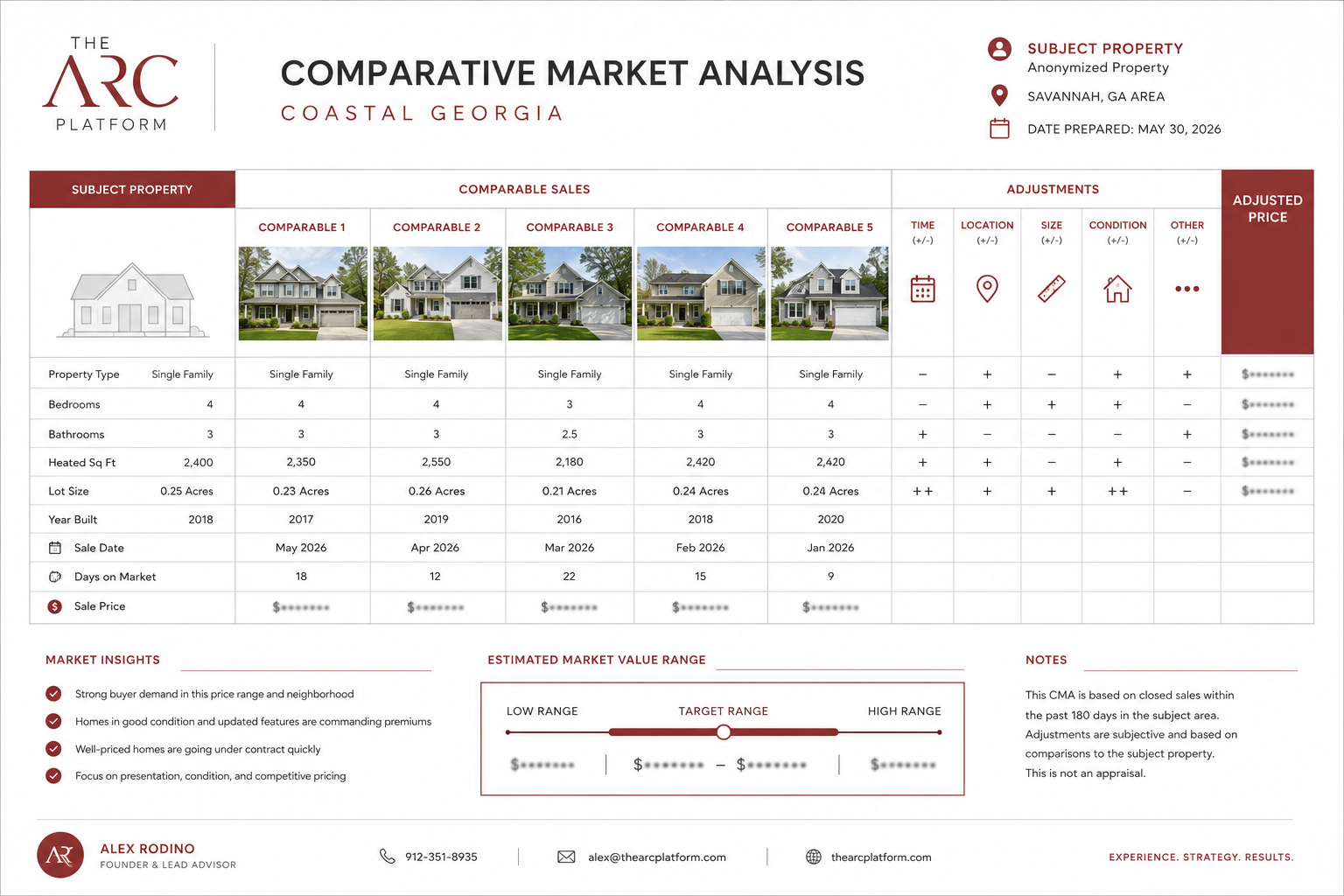
A Comparative Market Analysis isn’t a printout.
It’s an argument.
More specifically, it’s an evidence-based argument for what the market will actually support.
An instant estimate may consider:
Tax records
Square footage
Bedroom count
Bathroom count
Nearby sales
General market trends
A real CMA goes much deeper.
A proper Coastal Georgia CMA considers at least ten major factors that automated systems regularly miss:
1. Flood Zone Exposure
Flood insurance costs influence affordability, resale potential, and buyer psychology.
2. Micro-Location
Two homes located less than a mile apart can have dramatically different buyer demand profiles.
3. Street Quality
Traffic patterns, walkability, noise, and neighborhood feel all affect value.
4. Renovation Quality
Buyers don’t pay for renovation cost. They pay for renovation quality.
5. Major Systems
Roof, HVAC, plumbing, electrical, and windows all impact buyer confidence.
6. Lot Characteristics
Privacy, drainage, topography, shape, and usability matter.
7. Views
Marsh, water, golf, and preserve views can dramatically affect pricing.
8. Competing Inventory
Active listings often matter more than closed sales.
9. Seller Concessions
Many online estimates don’t account for concessions buried inside transaction data.
10. Live Buyer Behavior
Showings, online engagement, agent feedback, and pending activity provide real-time pricing intelligence.
An instant estimate answers one question:
“What might this home be worth?”
A real CMA answers a much better question:
“What price can this market actually defend?”
That’s the difference.
If you’re serious about selling, get a serious analysis.
When to Expect a Price Drop, and How to Handle It Without Panic
Price reductions aren’t failures.
Bad pricing strategies are failures.
Every home receives feedback from the market. The key is recognizing that feedback early enough to act on it.
I don’t want to wait sixty days to discover we missed the market.
I want to know within the first few weeks.
Here are the warning signs I watch closely:
Fewer than five quality showings during the second week.
Strong online traffic but weak showing conversion.
No repeat showings.
Agents repeatedly saying, “Great house, but priced high.”
No offers after three weeks.
Comparable homes going under contract while yours remains active.
Buyers consistently objecting to value rather than condition.
When multiple signals appear together, we adjust.
Not emotionally.
Strategically.
A price reduction isn’t an admission of failure. It’s a market correction.
Sometimes the adjustment is small. Sometimes it’s larger. The goal isn’t to save face.
The goal is to maximize your net proceeds.
One of the biggest mistakes sellers make is viewing a price reduction as losing.
The real loss happens when pride keeps you from responding to market feedback.
Bottom line, the market doesn’t care what you hoped to get.
It only cares what buyers are willing to pay.
Frequently Asked Questions
How accurate is Zestimate in Savannah Georgia?
Zestimate and similar valuation tools can provide a reasonable starting point, but they often miss critical local factors that affect Savannah home values. Flood zones, historic districts, marsh views, condition, renovations, lot characteristics, and neighborhood-specific demand patterns can all dramatically affect pricing. Use online estimates as an initial reference point, then validate them with a local Comparative Market Analysis before making pricing decisions.
Should I price my Savannah home above or below market?
It depends on your competition, timeline, and property characteristics. Pricing slightly below market can create urgency and multiple-offer scenarios. Pricing at market often produces the strongest balance of activity and net proceeds. Pricing above market only works when the property offers genuinely scarce features and the supporting data is strong. Starting high without a clear adjustment plan usually costs sellers money.
What is a Comparative Market Analysis (CMA)?
A Comparative Market Analysis is a professional evaluation of your home’s likely market value based on recent sales, active competition, property condition, location factors, buyer demand, and current market activity. A good CMA doesn’t simply provide a number. It provides a pricing range, supporting evidence, market context, and a strategic plan for selling.
How do I know if I priced my home too high?
The market usually provides an answer within two to three weeks. Warning signs include low showing activity, repeated buyer objections regarding price, strong online engagement but few in-person visits, competing properties going under contract first, and little or no offer activity. Market feedback is almost always more reliable than personal opinion.
How often should I adjust my price if my Savannah home is not selling?
Do showings tell me my price is right?
Showings provide important feedback, but they are only one signal. High showing activity with no offers may indicate a pricing issue or a condition issue. Low showing activity may suggest buyers are rejecting the price before visiting. The strongest indicators combine showings, agent feedback, repeat visits, online engagement, and offer activity.
Can I get a free instant home value estimate for my Savannah home?
Yes. A free instant estimate can provide a useful starting point for understanding your home’s approximate value range. However, if you’re seriously considering selling, the next step should always be a local Comparative Market Analysis that accounts for your property’s condition, location, buyer demand, and current competition.
If you’re considering selling your home anywhere in Savannah or Coastal Georgia in 2026, start with a baseline estimate, then verify it against the market. Use our free Coastal Georgia home value calculator and request a professional Comparative Market Analysis. You’ll get the number, the range, and the strategy behind it. Call 912-351-8935 if you’d like to talk through your options.



Join The Discussion