
By Alex Rodino, U.S. Army veteran (Capt.) · Licensed GA REALTOR® #443565 · MRP
Published August 13, 2026 · Last updated August 15, 2026 · About 10 minutes TL;DR: The Georgia homestead exemption reduces the taxable assessed value of an eligible primary residence. In Chatham County, the local Stephens-Day exemption can also hold the county taxable value to an adjusted base, while a new school exemption applies beginning in 2026. Apply once through the Board of Assessors, online by April 1 or in person through the 45-day assessment appeal deadline, and qualifying exemptions generally renew automatically.
Important: I am a real estate agent, not a tax professional or attorney. Exemption amounts and rules change, and no example here promises a particular saving on your bill. Confirm your situation with the Chatham County Board of Assessors at 912-652-7271 or with a qualified tax professional.
What the Georgia homestead exemption is and what it actually saves
The standard Georgia homestead exemption removes $2,000 from the assessed value used for county and school taxes on an eligible owner-occupied primary residence. Because Georgia generally assesses property at 40% of fair market value, that exemption usually saves tens of dollars by itself, not thousands.
Eligibility generally requires ownership and legal residence on January 1, with no other homestead claim. See the Georgia Department of Revenue and the state’s application guide.
The $2,000 reduction is from assessed value, not the bill. One mill equals $1 per $1,000 of taxable value. For the full mechanics, see Savannah and Chatham County property taxes.
A worked Chatham County example
This hypothetical $400,000 home uses the latest adopted Chatham millage table: 10.518 county mills and 17.331 school mills for 2025. It excludes other tax and exemption effects.
Those rates carry into the 2026 tax year. Chatham County’s official Notice and Explanation of 2026 Property Tax Increase, published July 8, 2026, sets the 2026 General Maintenance and Operations rate at 10.518 mills. The Savannah-Chatham County Public School System board held its rate at a combined 17.331 mills for FY2027, with no increase or decrease from the prior year. Both bodies still had to advertise a tax increase, because each rate sits above the rollback rate, so a higher assessment can raise your bill even when the millage itself does not move.
| Calculation | Illustrative amount |
|---|---|
| Fair market value | $400,000 |
| Assessed value at 40% | $160,000 |
| Less standard exemption | $158,000 taxable value |
| County plus school rate | 27.849 mills |
| Tax before standard exemption | $4,455.84 |
| Tax after standard exemption | $4,400.14 |
| Illustrative saving from standard exemption | $55.70 |
Standard Georgia vs Chatham County exemptions
Chatham homeowners may receive several layers of relief, but they do different jobs. The standard exemption subtracts a fixed amount, Stephens-Day protects the county taxable base, Georgia now has a mandatory inflation-based cap, and the voter-approved 2026 Chatham school exemption protects eligible value from school maintenance taxes.
| Exemption | Who qualifies | What it does | Taxes affected |
|---|---|---|---|
| Standard Georgia homestead | An owner whose legal primary residence is the property on January 1 | Subtracts $2,000 from assessed value | County and school taxes, excluding municipal school levies and bonds |
| Stephens-Day | An eligible Chatham County homestead owner | Exempts the amount by which current fair market value exceeds the adjusted base-year value. The base begins with the value for the year before the exemption is first granted, then qualifying improvements are added. | Chatham County portion. Separate city and school provisions can operate differently. |
| Georgia statewide floating cap, as amended by 2026 SB 33 | Eligible homestead owners statewide | Limits annual growth in the homestead assessed value to the statutory inflation adjustment, with additions for substantial property changes. The 2026 law repealed the prior local opt-out mechanism. | County, consolidated government, school district, and municipal ad valorem taxes, subject to the statute and other applicable exemptions |
| HB 782 Chatham school exemption | An approved Chatham homestead owner, for a homestead of no more than five acres | Exempts assessed value above the base-year assessed value. The base is the taxable year before the exemption was first granted to the most recent owner, with later improvements and added land treated separately. | Chatham County school educational taxes, excluding school bond taxes. Voters approved it in 2025, and the act took effect January 1, 2026. |
| City of Savannah HTRG | Homeowners who already had an approved Savannah homestead exemption for tax year 2023 | Provided a one-time reduction of up to $18,000 in assessed value in 2023 | City of Savannah taxes for 2023 only. This is historical, not a new 2026 exemption. |
Official sources: the Board of Assessors, 2026 SB 33, HB 782, 2025 election results, and Savannah’s HTRG page.
Over a decade of rising values, Stephens-Day can make the county portion grow more slowly than market value. It does not freeze the bill: improvements, millage changes, and other tax portions still matter.
Senior, disabled, and veteran exemptions
Georgia offers additional income-tested exemptions for some homeowners age 62 or 65, plus a separate exemption for qualifying disabled veterans and certain survivors. No statewide rule says every senior stops paying school tax at a particular age, and local options can differ, so eligibility should be confirmed before filing.
Age 62 school-tax exemption
Georgia provides up to $10,000 off assessed value for school taxes and bonds when the homeowner is at least 62 and combined prior-year income is no more than $10,000. The Department of Revenue lists exclusions for certain retirement, pension, and disability income.
Age 62 floating county exemption
A separate state option protects qualifying natural assessment increases above $10,000 for county taxes when the homeowner is at least 62 and household income does not exceed $30,000. It excludes school and municipal taxes and replaces another county homestead exemption.
Age 65 state exemption
Georgia provides homeowners age 65 or older a $4,000 county exemption when combined prior-year income does not exceed $10,000, subject to listed retirement-income exclusions. Ask the Board whether Chatham alternatives fit your household.
Disabled veterans and surviving spouses
A qualifying disabled veteran may receive an exemption equal to the greater of $32,500 or the maximum amount that may be granted to a disabled veteran under 38 U.S.C. Section 2102. The Georgia Department of Revenue publishes that federal ceiling and currently lists the amount as $121,812 for 2025, adding that property value above the exemption stays taxable. The Department has not yet posted a 2026 figure, so confirm the amount in force for your tax year before you count on it.
Because that ceiling tracks a federal figure that can be adjusted, treat the 2025 amount as the last confirmed number rather than a promise for 2026. When you file, ask the Chatham County Board of Assessors which exemption amount it is applying to your tax year.
An unremarried surviving spouse or minor children may continue the exemption when the home remains their homestead. As an Army veteran, I flag this benefit for military households and recommend bringing VA documentation. My military loan guide covers financing separately.
How to file in Chatham County
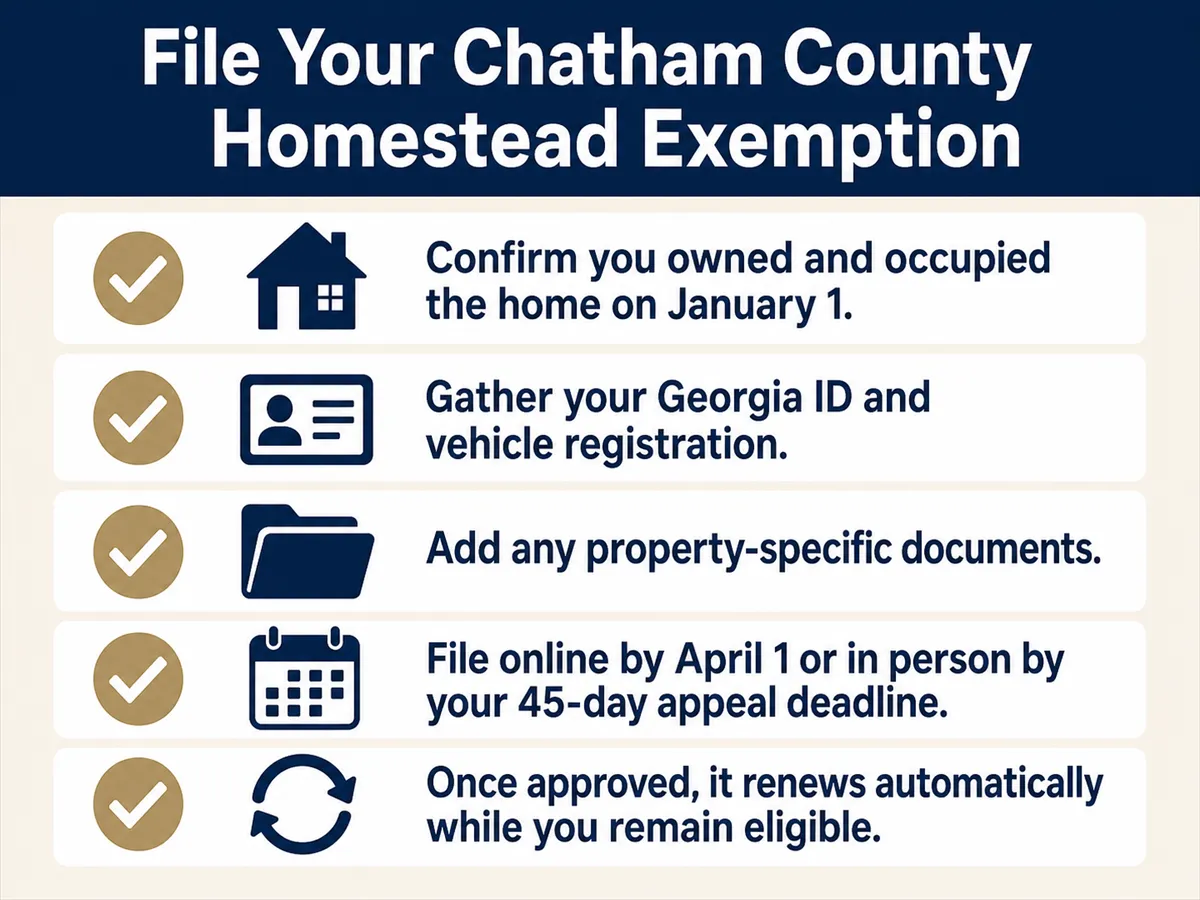
File with the Chatham County Board of Assessors, not with your mortgage company or at closing. SmartFile accepts online applications through April 1. Under the county’s current instructions, a homeowner who misses that online date may still apply in person through the 45-day appeal deadline printed on the annual assessment notice.
- Confirm you owned and occupied the home on January 1. It must be your legal primary residence, and your name must be on the title.
- Gather your Georgia ID and vehicle registration. The Board lists a Georgia driver’s license or state ID and Georgia vehicle registration. Both should show the homestead address.
- Add any property-specific documents. If county records have not caught up with a recent purchase, bring the recorded deed. Property held in trust can require the trust document and an affidavit. Age, income, disability, or veteran exemptions need supporting records.
- File online by April 1 or in person by your 45-day appeal deadline. Use the county’s SmartFile portal through April 1. After that, the Board says current-year applications must be made in person before the individual assessment-notice deadline.
- File at 222 West Oglethorpe Ave., Suite 113. The Board of Assessors office is in Savannah and lists weekday hours of 8:00 a.m. to 5:00 p.m. Call 912-652-7271 before visiting if your ownership, trust, or identification documents are unusual.
- Once approved, it renews automatically while you remain eligible. Keep the property as your owned and occupied homestead. A move or ownership change can require a new application.
The Department of Revenue and Chatham’s 2026 guidance describe the extended filing window, while Georgia.gov still displays April 1. In Chatham, follow the Board’s current instructions.
“I put the April 1 online deadline in every closing packet because it is easier to file early than to chase an assessment-notice deadline later. I also send a reminder email every January.”
Alex Rodino
Mistakes I see Chatham County homeowners make
The most common errors are treating closing paperwork as the application, assuming the seller’s exemption carries over, or waiting until a bill arrives. Homestead status follows the eligible owner and residence, not the house forever, and the owner must keep identification, occupancy, and exemption records aligned with the current home.
- Missing both filing windows. April 1 is the online deadline. If you also miss the 45-day appeal deadline on your assessment notice, an application generally applies to the next tax year.
- Assuming the seller’s exemption transfers. It does not. Apply in your own name once you own and occupy the home on January 1.
- Claiming two homesteads. Chatham allows only one homestead for an immediate family group, and the state bars another homestead claim in or outside Georgia.
- Keeping the exemption after a rental conversion. A rental is not an eligible homestead. If a sale may follow, see my Georgia capital gains guide.
- Leaving the old address on a driver’s license or vehicle registration. Update both before applying so they match the homestead address.
Buying here? I handle this at closing
Buying in Savannah or Chatham County? I walk every client through this exemption at closing, put the filing date in the closing packet, and send the January reminder. The goal is simple: make sure an easy post-closing task does not disappear under moving boxes, repairs, and everyday life.
For purchase planning, read my Georgia closing costs guide. Comparing nearby communities? Explore Pooler and Richmond Hill, then verify exemptions with the county where you buy.
Call me at 912-351-8935 or text 912-210-8967. No pressure, and I usually respond the same day.
Tax disclaimer: I am a real estate agent, not a tax professional or attorney. Amounts and rules change, and I cannot promise a saving for your bill. Confirm your situation with the Chatham County Board of Assessors at 912-652-7271 or a qualified tax professional.
Frequently asked questions
These answers cover the questions homeowners most often ask about filing, savings, renewal, and moving. The short version is that eligibility depends on January 1 ownership and occupancy, savings depend on the taxing district and exemptions approved, and Chatham homeowners file with the Board of Assessors.
How does the homestead exemption work in Georgia?
Georgia’s standard homestead exemption reduces an eligible home’s assessed value by $2,000 for county and school taxes, with listed exceptions for municipal school taxes and bonds. You generally must own and occupy the property as your legal residence on January 1. Georgia assesses property at 40% of fair market value, so the exemption reduces taxable assessed value, not the market value or tax bill dollar for dollar. Local exemptions can provide additional relief.
How much does the homestead exemption save in Georgia?
There is no single statewide dollar saving because millage rates and local exemptions differ. Using Chatham’s adopted 2025 county and school rates, the standard $2,000 assessed-value exemption saves an illustrative $55.70 on those two portions. That is an example, not a promise. Stephens-Day, the statewide floating cap, the new Chatham school exemption, and any age or disability benefits can change the result.
What is the deadline to file for homestead exemption in Georgia?
April 1 remains the main homestead filing date, but Georgia and Chatham now allow current-year applications through the end of the annual assessment notice’s 45-day appeal period. In Chatham County, SmartFile closes for homestead applications after April 1, so later current-year applications must be filed in person before the deadline on that owner’s notice. Applications after that point are generally processed for the following tax year.
What is the Stephens-Day exemption in Chatham County?
Stephens-Day is Chatham County’s local base-value homestead exemption for the county portion of property tax. It exempts the amount by which current fair market value exceeds the adjusted base-year value. The base generally starts with the property’s value in the year before the exemption was first granted, and qualifying improvements are added later. It does not freeze the entire bill because rates and other tax portions can change.
Do I have to apply for the homestead exemption every year?
No, an approved Chatham County homestead exemption generally renews automatically while you continue to own and occupy the same home as your legal residence. You need to apply again after buying and establishing a new homestead because the seller’s exemption does not transfer to you. Contact the Board of Assessors if ownership changes, the property enters a trust, you move, or you convert the home to a rental.
At what age do seniors stop paying school taxes in Georgia?
Georgia has no single age when every senior automatically stops paying school taxes. The statewide age 62 exemption can remove up to $10,000 of assessed value for school taxes and bonds, but it has an income test and is not a total statewide school-tax waiver. Counties can offer different local benefits. Chatham homeowners should ask the Board of Assessors which age, income, disability, and local rules fit their household.
Does my homestead exemption transfer when I buy a new house?
No, a homestead exemption does not transfer from the seller or follow you automatically to a new house. You must apply for the new property after you own and occupy it as your legal residence on January 1. The prior home’s exemption can no longer remain yours after it becomes a rental or ceases to be your homestead. Filing for the new home also establishes the applicable base-year treatment.


Join The Discussion