

Last updated: August 17, 2026
TL;DR: The cost of living in Savannah GA runs modestly below the U.S. average, with housing doing most of the saving. RentCafe’s March 2026 data puts the overall gap at 9% below the national average, but utilities and coastal insurance can run hotter than relocation brochures admit. Your address, home condition, flood zone, and household size matter more than one citywide index.
This guide is educational, not financial, tax, or insurance advice. Rates, premiums, taxes, qualifications, and fees change and vary by person and property. Confirm current figures with the provider, county, lender, and a qualified professional.
Savannah cost of living at a glance (2026 table)
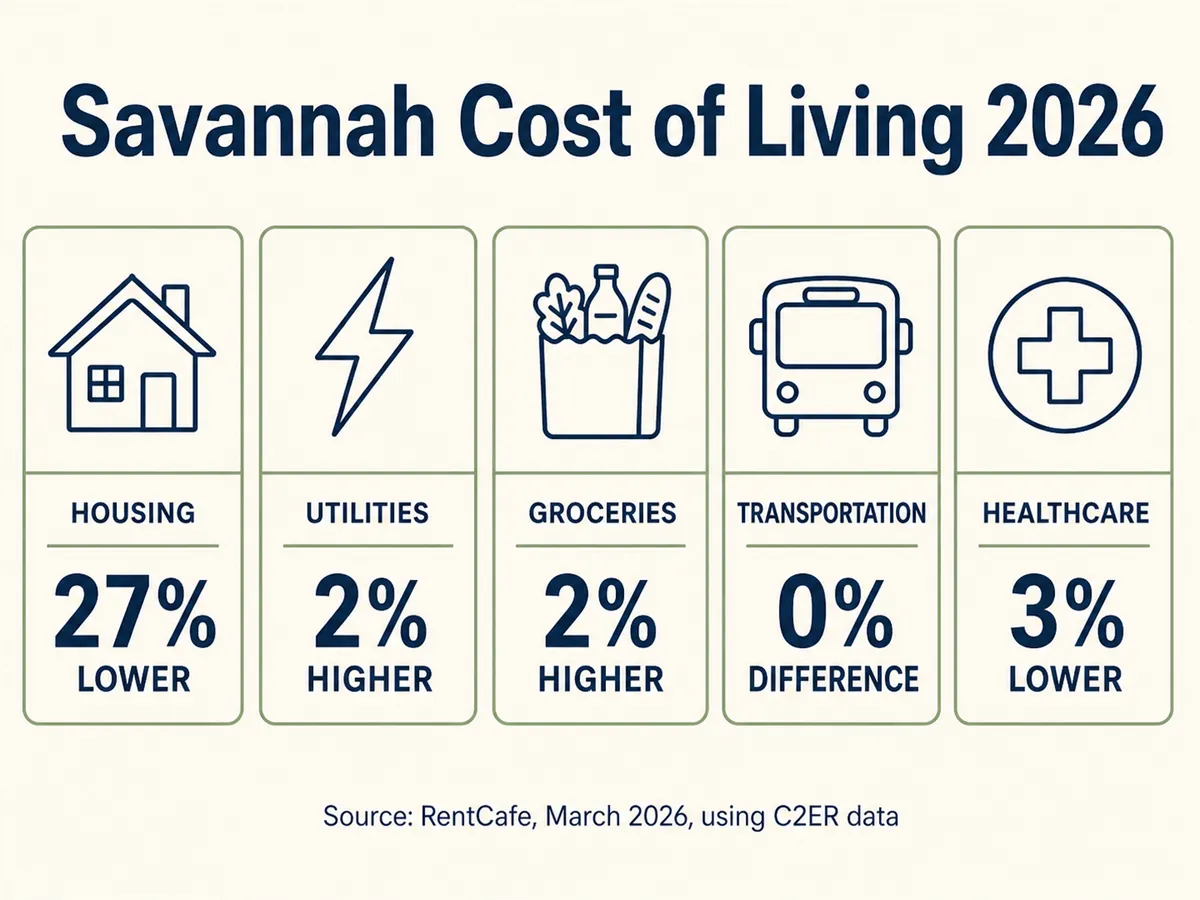
Savannah is below the national average mainly because of housing, not because every line item is cheap. RentCafe’s March 2026 data puts overall costs 9% below the U.S. benchmark, while Apartments.com’s June comparison says Atlanta costs 3.7% more overall. The table keeps each comparison source consistent.
| Category | Savannah vs U.S. average | Savannah vs Atlanta | Source |
|---|---|---|---|
| Housing | 27% lower | Atlanta home listing prices are 11.5% higher, and Atlanta apartment rents are 8.5% higher | RentCafe, March 2026; Apartments.com, June 2026 |
| Utilities | 2% higher | Atlanta is 0.9% higher | RentCafe, March 2026; Apartments.com, June 2026 |
| Groceries | 2% higher | Atlanta is 0.3% lower | RentCafe, March 2026; Apartments.com, June 2026 |
| Transportation | 0% difference | Atlanta is 4.2% higher | RentCafe, March 2026; Apartments.com, June 2026 |
| Healthcare | 3% lower | Atlanta is 2.7% higher | RentCafe, March 2026; Apartments.com, June 2026 |
| Insurance | Roughly 13% higher for homeowners coverage: insure.com puts Savannah at $2,914 per year against a $2,575 national average | Roughly 50% higher: Insurify lists Savannah at $4,811 per year and Atlanta at $3,196 on the same $300,000 dwelling assumption | insure.com, Savannah homeowners analysis; Insurify, Savannah homeowners rates. Separate quote models, not a C2ER index category |
The honest read is that Savannah’s housing discount is real, while groceries and utilities sit just above the national benchmark. Atlanta is 3.7% more expensive overall in Apartments.com’s model, but Savannah is not cheaper in every category. Insurance belongs in your actual quote file, not in a generic index.
Housing: rent and home prices
Housing is Savannah’s clearest budget advantage, but the word “average” hides a wide spread between downtown, the islands, Southside, and newer suburban inventory. Published apartment-rent and home-price measures also use different methods. Treat them as comparison anchors, then price the property, fees, insurance, taxes, and repairs at the address level.
RentCafe’s March 2026 snapshot reports average apartment rent of $1,699 per month and an average home price of $370,120. Apartments.com’s August 2026 guide breaks apartment rent out at $1,684 for a studio, $1,530 for one bedroom, $1,664 for two bedrooms, and $1,956 for three bedrooms.
For buyers, Zillow’s Savannah market page reports a median sale price of $333,083 as of May 31, 2026, and a median list price of $378,467 as of June 30, 2026. Those are different measures from RentCafe’s average, so I would never blend them into one made-up “Savannah home price.” I use the ZIP code, property type, condition, taxes, insurance, and likely repairs to build a real payment range.
When a city address strains the budget, buyers often test Pooler, Richmond Hill, or Rincon. Start with my live Pooler vs Richmond Hill vs Rincon comparison for the broader map. The point here is the budget release, not a second where-to-live guide.
Utilities: the summer cooling reality
Georgia’s electricity price is below the national rate, but that does not guarantee a gentle Savannah summer bill. Air-conditioning load, square footage, insulation, thermostat settings, and the rate plan can overwhelm the statewide average. Ask for the address’s 12-month usage history before you treat any calculator as your number.
The U.S. Energy Information Administration reports Georgia residential electricity at 14.90 cents per kilowatt-hour year to date through May 2026, below the U.S. figure of 18.11 cents. Its latest annual bill table puts the 2024 Georgia residential average at $151.25 per month. That is a statewide, year-round average, not an August promise. RentCafe’s Savannah estimate is higher at $228.68 for an energy bill.
“The number nobody puts in the relocation guide is your August power bill. I tell every buyer: get the 12-month utility history and an insurance quote before you fall in love with the payment.”
Alex Rodino
City fees changed too. Savannah’s official schedules show a $3.22 monthly water and sewer increase for the median inside-city user and a solid-waste fee increase from $40.77 to $42.81 per month. The stormwater fee, adopted by City Council, began July 1 at $4.75 monthly for a typical Tier 2 single-family home. That arithmetic is $91.62 in added municipal charges during calendar 2026, then $120.12 for a full 12 months at those rates. Natural gas customers in Atlanta Gas Light territory choose a marketer, while AGL maintains distribution, according to the Georgia Public Service Commission.
Insurance: the coastal line item
Insurance is the other number I price early because coastal wind exposure, roof age, flood zone, coverage limits, deductibles, claims history, vehicle profile, and credit factors can move it sharply. A statewide average is useful context, but only property-specific home, wind, and flood quotes belong in your closing budget.
Insurify’s 2026 quote data puts Georgia full-coverage auto insurance at about $260 per month. For homeowners coverage, Bankrate’s analysis of November 2025 rates reports a Georgia average of $2,041 per year for $300,000 in dwelling coverage. The same page’s carrier tables show Savannah samples above Atlanta for several insurers, but there is no single honest coastal multiplier that applies to every home.
City-level estimates spread widely because each publisher models a different borrower and property. insure.com puts a Savannah homeowners policy at $2,914 per year for $300,000 in dwelling coverage, about $339 above its $2,575 national average. Insurify is far higher at $4,811 per year on a similar $300,000 assumption, and lists Atlanta at $3,196. Read those as a range that says coastal Savannah prices above both Atlanta and the national benchmark, not as your quote.
Flood coverage is separate. FEMA’s National Flood Insurance Program says most homeowners policies do not cover flood damage. A federally backed mortgage generally requires flood insurance in a Special Flood Hazard Area, and a lender may still require it elsewhere. Check the FEMA flood map, then confirm coverage and price with the lender and a licensed insurance provider. This is not insurance advice.
Groceries, transportation, healthcare
Day-to-day expenses mostly cluster near the national benchmark: groceries run slightly higher, transportation is roughly even, and healthcare is slightly lower in the current C2ER-based data. Your commute and health plan will matter far more than a few index points, so use these figures as orientation rather than a household quote.
Apartments.com puts Savannah groceries 1.6% above the national average, utilities 0.8% above, and transportation 0.6% below. RentCafe’s March reading rounds groceries to 2% above, transportation to no difference, and healthcare to 3% below. That resolves the research conflict: the live RentCafe page says healthcare is 3% below the U.S. average, not 14% above.
For transit, Chatham Area Transit charges $1.50 for a one-way local route and $3 for an unlimited day pass. A car budget still needs fuel, parking, maintenance, registration, and insurance. A healthcare budget needs your actual premiums, deductible, prescriptions, and provider network, none of which a city index can predict.
Taxes in Savannah and Chatham County
Georgia has a flat state income-tax rate, while a Savannah property bill can combine county, city, school, and other applicable millage. Homestead relief can materially change the taxable value, but deadlines and eligibility rules matter. Confirm your parcel and filing status with the county and a qualified tax professional.
The Georgia Department of Revenue lists a 4.99% individual income-tax rate for 2026, with standard deductions of $15,000 for single, head-of-household, and married-filing-separately taxpayers and $30,000 for married couples filing jointly.
Chatham County’s published 2026 notice used 10.518 mills as the proposed general maintenance and operations rate. That is only one part of a total bill, and the county tells taxpayers to verify current rates with each jurisdiction. The Stephens-Day homestead exemption generally holds the county taxable assessed value to its base year for county purposes, with adjustments for additions or deletions. Chatham extended the 2026 exemption filing deadline to July 31; online applications had stopped April 1. Confirm the current filing window with the Board of Assessors. This is not tax advice.
What salary do you need to live in Savannah?
There is no single Savannah salary because “basic needs,” “comfortable,” and “rent-qualified” are different tests. Current methods put a single adult between about $52,000 for MIT’s basic-needs budget and roughly $68,000 under a rent-to-income rule. Families need a household-specific calculation, not a citywide average.
- MIT basic-needs method: The 2026 MIT Living Wage Calculator lists $25.05 per hour for one adult with no children, or $52,112 before taxes at 2,080 work hours.
- Apartments.com comfort estimate: Apartments.com says a single adult with no dependents should aim for about $67,000 before taxes. That is its own household-cost model, not a legal income requirement.
- 30% rent rule: Using RentCafe’s $1,699 average rent, the math is $1,699 x 12 / 0.30 = $67,960 gross annual income. This is a planning rule, not lender underwriting.
For a family of four, MIT shows two distinct cases. Two adults with two children and one worker need $84,312 before taxes under its basic-needs method. If both adults work, the combined required income is $101,323 because that model includes child care. Those are not interchangeable household types, so I do not average them.
So is Savannah affordable for you?
Savannah is below average overall, housing is the main lever, and utilities plus insurance are the honest asterisks. Whether it works for you comes down to the address, commute, household, debt, coverage needs, and cash reserves. Use this numbers guide first, then make the actual move decision.
For the fuller verdict, weigh the lifestyle tradeoffs separately. That should-you-move question is its own decision. This page stays focused on what the move costs.
Get a real budget from a local agent
A useful relocation budget starts with the payment you can carry and ends with properties that survive taxes, utilities, insurance, flood, maintenance, and commute. Tell me your budget and timeline, and I will tell you what it actually gets you here, with no brochure math and no pressure.
I am Alex Rodino, a U.S. Army veteran and licensed Georgia real estate agent serving Savannah and Coastal Georgia. Call me at 912-351-8935 or text 912-210-8967. I will help you compare the real monthly picture before you choose the house.
Frequently asked questions
The short answers below separate citywide benchmarks from the address-specific numbers that actually control a household budget. Cost indexes are useful for comparison, but rent, utilities, insurance, taxes, and mortgage qualification all use different methods. Confirm quotes and eligibility with the relevant provider before making a financial decision.
Is Savannah GA expensive to live in?
Savannah is modestly less expensive than the U.S. average overall. RentCafe’s March 2026 data puts the city 9% below the national benchmark, driven by housing at 27% below average. Utilities and groceries are each 2% higher, so the savings do not appear on every bill. Insurance, flood exposure, and the exact neighborhood can materially change a buyer’s real monthly cost.
What salary do you need to live comfortably in Savannah GA?
A single adult should compare at least two methods, not trust one magic salary. MIT’s 2026 basic-needs model requires $52,112 before taxes for one adult with no children. Apartments.com suggests about $67,000 before taxes for a single adult living comfortably. Using RentCafe’s $1,699 average rent and a 30% rent rule produces $67,960. Family size, debt, savings goals, and housing choice change the answer.
What is the average rent in Savannah GA?
RentCafe reports an average Savannah apartment rent of $1,699 per month in its March 2026 snapshot. Apartments.com’s August 2026 bedroom data shows $1,530 for a one-bedroom, $1,664 for a two-bedroom, and $1,956 for a three-bedroom. These are different datasets, not a contradiction. Building age, location, amenities, lease timing, pet fees, and other required monthly charges can move the actual total.
Is it cheaper to live in Savannah or Atlanta?
Savannah is cheaper overall in Apartments.com’s June 2026 comparison, which puts Atlanta’s cost of living 3.7% higher. Atlanta apartment rent is 8.5% higher and its average home listing price is 11.5% higher in that model. The category picture is mixed: Atlanta utilities are 0.9% higher, but groceries are 0.3% lower. Compare the same source and methodology before drawing a conclusion.
How much are utilities per month in Savannah GA?
There is no reliable one-size Savannah utility bill. EIA’s latest annual table puts Georgia’s 2024 residential electricity bill at $151.25 per month, while RentCafe estimates a Savannah energy bill at $228.68. Neither predicts a specific home’s August use. Add water, sewer, sanitation, stormwater, internet, and possible gas, then request the address’s 12-month history and confirm current rates with each provider.
Why is homeowners insurance higher on the Georgia coast?
Coastal homes can cost more to insure because carriers price wind and hurricane exposure alongside roof age, construction, replacement cost, deductibles, claims, and other risk factors. Bankrate’s current Georgia analysis uses a $2,041 statewide annual average for $300,000 in dwelling coverage, but Savannah quotes can differ sharply. Flood is normally separate from homeowners coverage, so check FEMA maps and price both policies early.
How much do you need to make to buy a house in Savannah GA?
There is no defensible citywide salary requirement for buying a Savannah home. Zillow’s median sale price was $333,083 as of May 31, 2026, but qualification also depends on down payment, interest rate, debts, credit, taxes, homeowners and flood insurance, loan type, and reserves. Ask a lender for a documented payment range, then let a local agent match that range to real properties. Do not reverse-engineer approval from the median price alone.



Join The Discussion