Quick answer: In Savannah’s Downtown Historic Overlay District, most exterior changes visible from a public right-of-way require a Certificate of Appropriateness (COA) from the Historic Review Board. Interior work, ordinary maintenance, and minor in-kind repairs are usually exempt. A COA is not a building permit. Some projects need both. Always confirm scope with City of Savannah/MPC staff before starting.
Published May 8, 2026 • Updated June 2026 • By Alex Rodino, Founder, Alexander Rodino Collective, serving Savannah & Coastal Georgia.

This guide is general information, not legal, architectural, or preservation advice. Savannah Historic District rules are administered through the City of Savannah’s zoning ordinance, the Savannah Downtown Historic District Board of Review, and related preservation review procedures. Rules can change. Always confirm specifics with the City of Savannah, MPC staff, and a preservation professional experienced with Historic Review Board review before starting any project.
TL;DR: Savannah Historic District Renovation Rules
- If you own or are buying a home in Savannah’s Historic District, most exterior changes visible from a public right-of-way require a Certificate of Appropriateness. Interior work, ordinary maintenance, and minor in-kind repairs are generally treated differently, but you should confirm before starting.
- There are three practical categories of work: no historic approval usually needed, staff-level or administrative review, and full Historic Review Board hearing.
- The City’s Savannah Downtown Historic District COA section applies to the Savannah Downtown Historic Overlay District and requires a COA for new construction, material exterior changes, relocation, demolition, awnings, certain signs, and exterior color changes unless an exemption applies. (Agenda Plus)
- General exterior maintenance, minor in-kind repairs, and some work not visible from the public right-of-way may be exempt, but the City’s ordinance still advises consultation with the Planning Director before work begins. (Agenda Plus)
- The most common reason projects get delayed is simple: owners assume “repair,” “replacement,” or “not visible” means no review is needed.
- A COA is not the same as a building permit. Some projects need both.
- Restrictions are part of why Historic District values can remain strong over time. They protect the district’s architectural character, streetscapes, and long-term scarcity.
Considering a Historic District purchase or renovation? ARC can help you assess feasibility before you commit through a custom Historic District home search or a Home Value and Selling Plan.
Table of Contents
- First, Understand Which Historic District You Are Actually In
- The Three Tiers of Work: What Needs Approval and What Does Not
- The Certificate of Appropriateness Process Step by Step
- Contributing vs. Non-Contributing Structures
- The 8 Most Common HRB Project Pitfalls
- Penalties and Enforcement
- How HRB Restrictions Affect Resale Value
- Buying a Historic District Home: What to Verify Before You Make an Offer
- Glossary: Historic District Terms in Plain English
- Working with the Right Professionals
- Frequently Asked Questions
First, Understand Which Historic District You Are Actually In
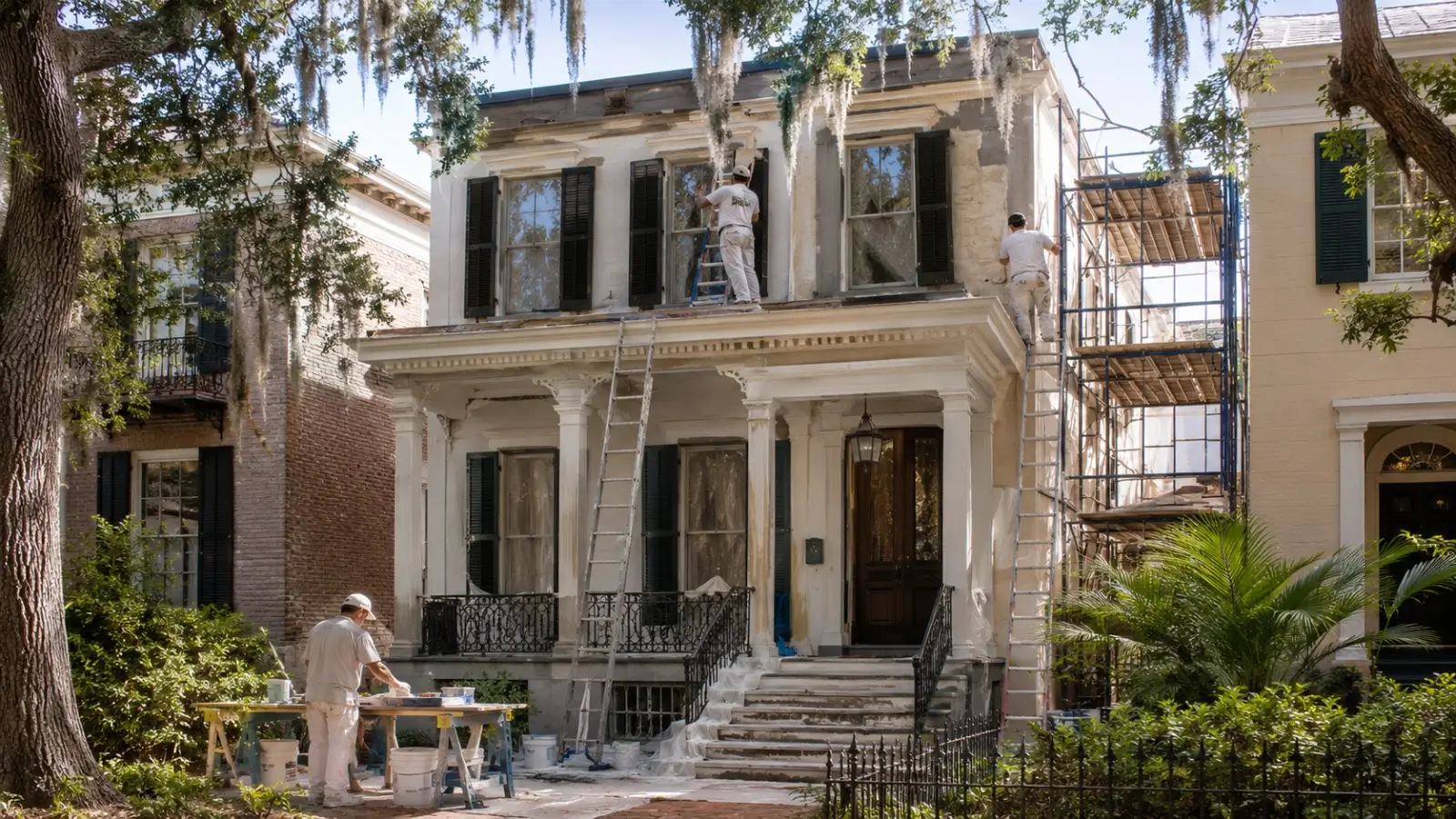
Savannah Historic District renovation rules depend on the exact district, overlay, and property status.
Many buyers use “Historic District” as a broad phrase. The City does not. Savannah has different historic districts, overlays, design standards, and review bodies. The Savannah Downtown Historic Overlay District is the one most buyers mean when they talk about the Landmark Historic District, downtown squares, historic facades, ironwork, row houses, carriage houses, and highly regulated exterior changes.
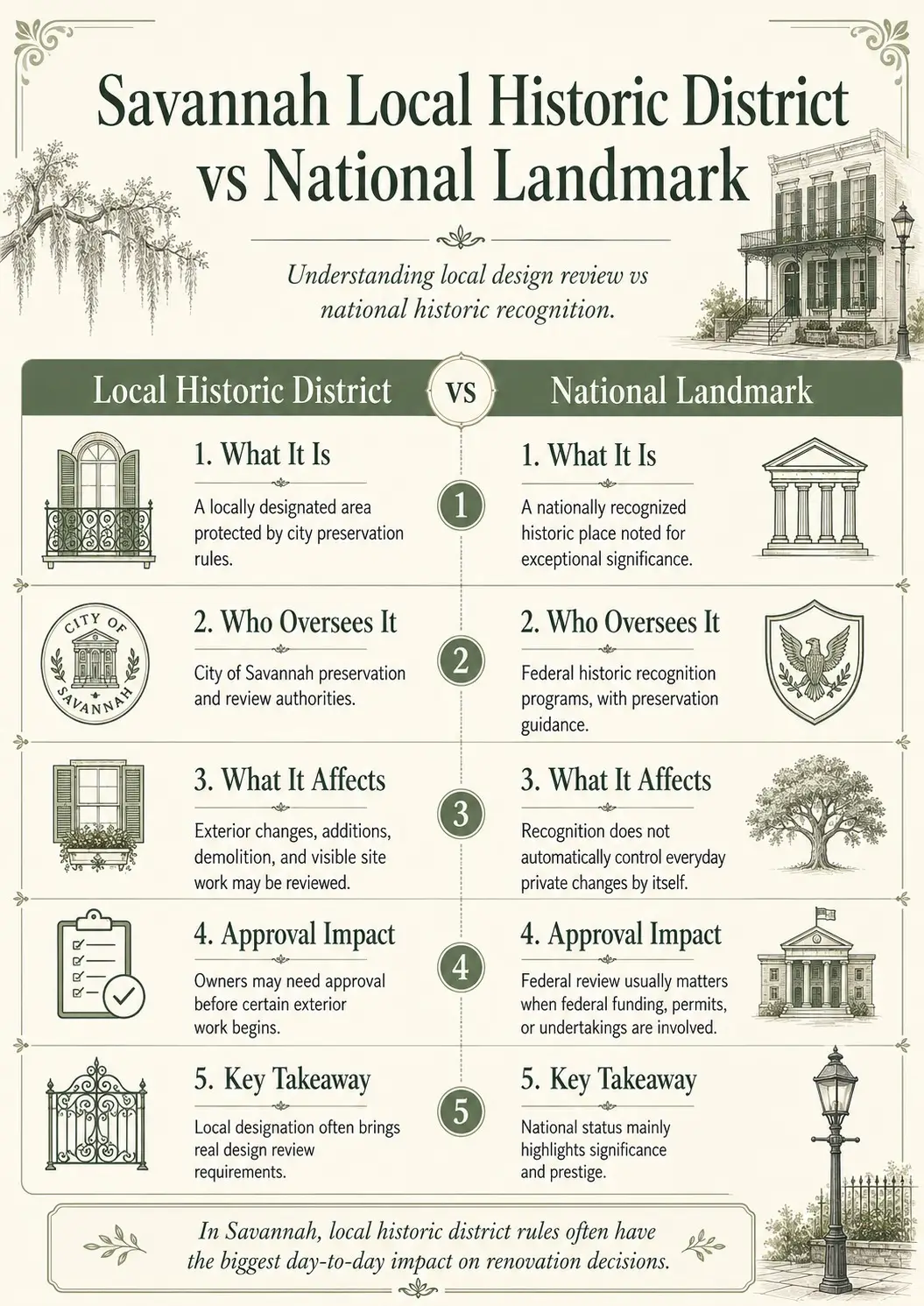
Local Historic District vs. National Historic Landmark District
A National Historic Landmark District is a federal recognition. It identifies a nationally significant historic area. The National Park Service says the Savannah National Historic Landmark District was designated by the Secretary of the Interior in 1966 and is one of America’s oldest and most prominent National Historic Landmarks. (NPS)
A Local Historic District or local historic overlay is different. Local rules control what owners can change, what review applies, and when a Certificate of Appropriateness is required. For renovation planning, the local designation matters more than the federal label.
Why the Distinction Matters
Being in the National Historic Landmark District does not automatically tell you what you can change. The practical question is whether the property is in the Savannah Downtown Historic Overlay District or another local historic overlay that triggers local review.
The City’s zoning ordinance has separate sections for local historic districts and properties, as well as a specific Certificate of Appropriateness section for the Savannah Downtown Historic District. (enCodePlus)
Other Historic Overlays in Savannah
Savannah also has other historic and conservation areas, including the Victorian Historic District, Streetcar Historic District, Cuyler-Brownville, and other overlays. These areas can have their own rules and review paths. The Victorian District is a separate historic area south of Savannah’s original district, according to National Park Service National Register materials. (NPGallery)
How to Confirm Your Property’s District
Before planning work, confirm:
- Whether the property is in the Savannah Downtown Historic Overlay District.
- Whether it is in another local historic district.
- Whether it is contributing or non-contributing.
- Whether another overlay applies.
- Whether prior COA approvals or violations exist.
District or Designation | Administering Body | Triggers Review? | What It Means for Owners |
|---|---|---|---|
Savannah Downtown Historic Overlay District | City of Savannah review process and Historic Review Board structure | Yes, for covered exterior work | The main local review framework for downtown Historic District exterior changes |
Other Local Historic Districts | City preservation review process | Usually yes, depending on district and work | Review may apply under local historic district rules |
National Historic Landmark District | National Park Service recognition | Not by itself for ordinary private renovation | Federal recognition of national significance, not the same as local approval |
National Register District | National Park Service / state historic preservation framework | Not by itself for ordinary private renovation | May matter for tax credits, grants, or federal undertakings |
Conservation or Special Overlay | City of Savannah | Sometimes | May add design, site, or use rules separate from historic review |
ARC insight: Historic District buyers often ask, “Can I renovate this?” The better first question is, “Which review layer applies?” A house can look historic, be federally recognized, be locally regulated, be contributing, or be affected by a separate overlay. Those are not the same thing.
The Three Tiers of Work: What Needs Approval and What Does Not
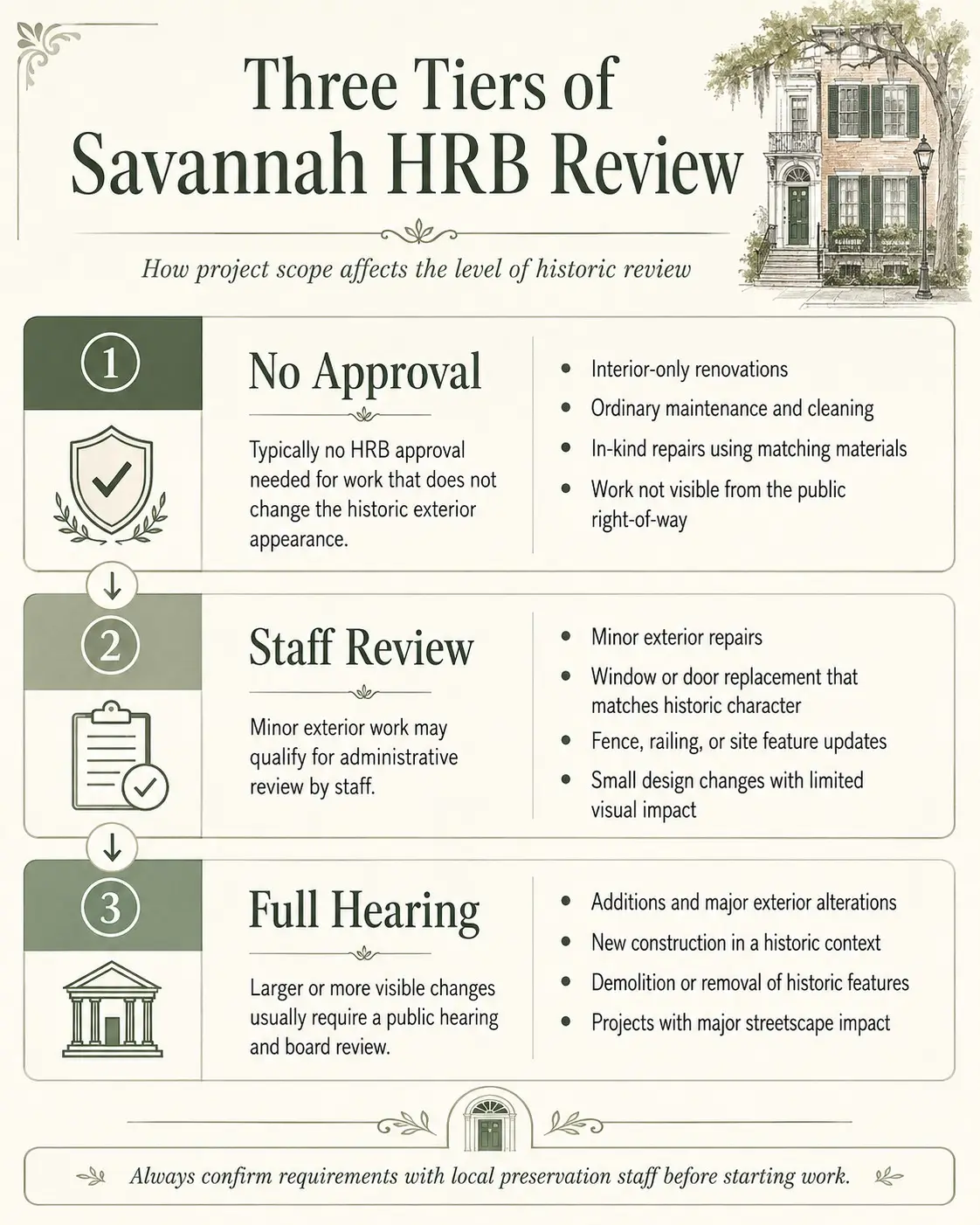
Categorization is a general guide, not a substitute for MPC or City review. Project-specific determinations are made by staff and the HRB. Always confirm before assuming a category.
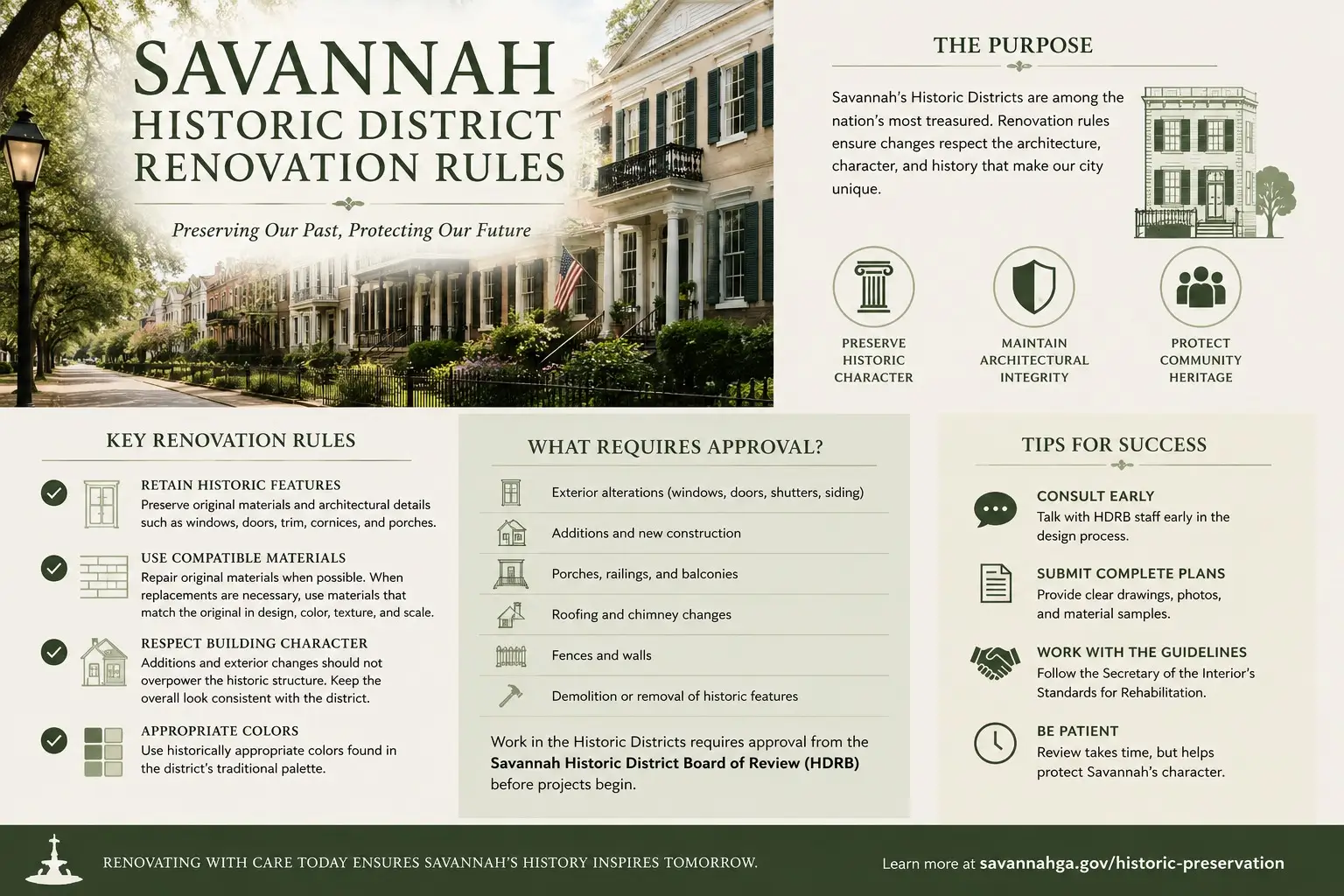
Savannah Historic District renovation rules are easiest to understand in three tiers: work that usually does not need historic approval, work that may be handled through staff-level review, and work that typically needs full Historic Review Board review. The City’s COA section focuses on material exterior changes, new construction, additions, relocation, demolition, awnings, exterior color changes, and certain signs, while also exempting general exterior maintenance, minor in-kind repairs, and some work not visible from a public right-of-way. (Agenda Plus)
Master Reference Table: Project Type by Review Level
Project Type | Usually No Historic Approval Needed | Staff-Level or Administrative Review | Full HRB Hearing Usually Needed |
|---|---|---|---|
Interior kitchen renovation | Often yes, if interior only | Building permit may still apply | Usually no, unless exterior changes are involved |
Interior bath renovation | Often yes, if interior only | Building permit may still apply | Usually no, unless exterior changes are involved |
Electrical, plumbing, HVAC inside | Historic approval often not needed | Building permit may still apply | Usually no, unless exterior equipment is visible |
Exterior repainting, same color | Confirm first | May be staff-level if documentation is needed | Usually no if same color and no material change |
Exterior repainting, new color | No | Often review required | May require board review depending on scope |
Roof repair, in-kind material | Often exempt if minor and in-kind | Confirm material and visibility | Usually no if truly minor and in-kind |
Roof replacement, different material | No | Sometimes staff-level if compatible and minor | Often HRB if visible or material change |
Window repair | Often encouraged | Staff review may apply if scope is larger | Usually no if repair preserves historic fabric |
Window replacement, in-kind | No assumption | Staff review may be possible | Often HRB if visible or affecting historic material |
Window replacement, different material or profile | No | Sometimes only for limited cases | Often HRB, especially visible elevations |
Front door replacement | No | Possible if exact in-kind and documented | Often HRB if visible or design changes |
Porch repair | Often if minor and in-kind | Staff review may apply | HRB if reconstruction or design change |
Porch reconstruction or addition | No | Sometimes staff-level for minor rear work | Often HRB |
Fence in front yard | No | May be staff-level depending on design | Often HRB if visible and material change |
Fence in rear yard | Sometimes if not visible | Staff review likely if visible from lane | HRB if visible and substantial |
Driveway or curb cut | No | Possible for minor site work | Often HRB and other City review |
Walkways and hardscape | Sometimes if minor and not visible | Staff review if visible | HRB for material visual changes |
HVAC equipment on visible elevation | No | Possible with screening plan | Often HRB if visible |
HVAC equipment concealed at rear | Maybe | Staff review likely if exterior | Usually no hearing if fully concealed and compliant |
Solar panels visible from public way | No | Possible but confirm | Often HRB |
Solar panels concealed | Maybe | Staff review likely | Usually less difficult if not visible |
Skylights visible from public way | No | Possible | Often HRB |
Awnings and shutters | No | Sometimes | COA usually required for awnings or visible alteration |
Residential signage over 3 square feet or illuminated | No | Staff review may apply | HRB likely under sign standards |
Major addition | No | No for most major work | HRB hearing expected |
Demolition | No | No | HRB hearing expected |
Exterior lighting fixtures | Sometimes if minor and in-kind | Staff review if visible | HRB if material design change |
Mature tree or hedge changes | Depends on tree and site rules | Staff review may apply | May trigger City tree or site review |
Subdivision or recombination in Downtown Historic Overlay | No | No | COA required under recent City ordinance update |
The City’s 2023 materials state that subdivision or recombination of property within the Savannah Downtown Historic Overlay District requires a Certificate of Appropriateness under the City’s COA framework. (Agenda Plus)
What Ordinary Maintenance Really Means
Ordinary maintenance usually means work that keeps existing materials functioning without materially changing appearance, design, material, profile, or configuration. The key word is usually. Once maintenance changes a visible historic feature, material, design, or color, review may be required.
What In-Kind Replacement Actually Allows
In-kind replacement means matching the existing feature closely in design, material, size, profile, color, texture, and visual character. The National Park Service’s rehabilitation standards say deteriorated historic features should be repaired rather than replaced, and when replacement is necessary, the new feature should match the old in design, color, texture, and where possible, materials. (nps.gov)
What Triggers Higher-Tier Review
Higher-tier review usually appears when work is visible from a public right-of-way, changes exterior appearance, affects historic material, changes design, involves demolition, relocates a structure, adds massing, changes exterior color, or affects a contributing resource.
The Certificate of Appropriateness Process Step by Step
A Certificate of Appropriateness is the formal approval for covered work in Savannah’s historic review process.
Step 1: Determine Whether Your Project Needs a COA
Start with the exact property and exact scope. Interior work may not need HRB approval, but visible exterior changes often do. The City’s COA applicability section for the Savannah Downtown Historic District covers new construction and material changes to exterior appearance, including alterations and additions. (Agenda Plus)
Step 2: Request Pre-Application Guidance
For projects that may require HRB review, a pre-application conversation is smart. Recent City text amendment materials state that a pre-application conference is required before submitting a COA that will require review by the Savannah Downtown Historic Board of Review, and recommended for projects that do not require board review. (Agenda Plus)
Step 3: Prepare Application Materials
Most applications need clear photos, drawings, product specifications, site plans, material information, and a description of the work. The more visible or complex the project, the more complete the package should be.
Step 4: Submit and Pay Fees
Submit through the current City or MPC process and confirm the current fee schedule. Do not rely on an old form saved from another owner or project. Historic review procedures and portals can change.
Step 5: Staff-Level vs. Full HRB Review
Some smaller or clearly compliant projects may be handled administratively. Larger, more visible, more complex, or more precedent-setting work may go to the Historic Review Board.
Step 6: Hearing and Public Comment
If a hearing is required, the project is reviewed against applicable standards. The board may approve, approve with conditions, deny, or continue the application depending on the record and criteria. City ordinance language states that after applying review criteria, the Historic Board of Review may approve as recommended, approve with modifications or conditions, deny, or continue. (Agenda Plus)
Step 7: Decision, Conditions, and Appeals
Read the decision carefully. Conditions matter. Approval is not always permission to build exactly as first proposed. Appeals may be available, but the process and deadlines should be confirmed with the City and legal counsel.
Typical COA Timelines
For planning purposes:
- Small staff-level items: often several weeks, depending on completeness and staff workload.
- Full HRB hearing track: commonly plan for at least one meeting cycle, plus time for submission, notice, staff review, revisions, and conditions.
- Complex work: additions, demolition, major alterations, or contested projects can take longer.
Do not schedule contractors until the approval path is clear.
Contributing vs. Non-Contributing Structures: Why It Matters
Contributing status tells you whether the building adds to the historic, architectural, or cultural value of the district.
What Makes a Structure Contributing
A contributing structure is generally one that supports the historic significance of the district. City materials define contributing resources through adopted maps and historic preservation plans, and contributing structures are tied to the architectural or historic value for which the district is significant. (Agenda Plus)
How Contributing Status Changes What You Can Do
Contributing buildings usually receive closer review because their materials, proportions, features, and relationship to the streetscape help define the district. Non-contributing structures can still be regulated. Being non-contributing does not mean “anything goes.”
How to Find Out If Your Home Is Contributing
Check the City’s contributing resources map, prior COA history, historic designation materials, or ask MPC staff. When buying, this should be part of your due diligence.
ARC insight: A non-contributing label does not automatically make a renovation easy. It may create more flexibility, but the new work still has to fit the district. Buyers should not pay a premium for “easy renovation potential” without confirming that assumption first.
The 8 Most Common HRB Project Pitfalls
Historic District projects usually go wrong when owners act before confirming the category.
1. Replacing Windows Without Verifying Requirements
Windows are one of the biggest risk areas. Repair is often preferred. Replacement can be sensitive because material, profile, muntin pattern, depth, and visible character matter.
2. Painting Before Confirming the Rules
Exterior color changes can require a COA under the Savannah Downtown Historic District rules. Even if the color feels tasteful, confirm first. (Agenda Plus)
3. Adding Visible Equipment Without Screening
HVAC condensers, electrical meters, vents, solar equipment, and utilities can create review problems when placed on visible elevations. Concealment and screening should be addressed before installation.
4. Removing Original Features
Porches, railings, trim, doors, shutters, masonry, and decorative details help define historic character. Removing them first and asking later can create enforcement and resale problems.
5. Installing Modern Materials on Visible Elevations
Vinyl windows, incompatible siding, certain composite materials, and flat-profile replacement components can trigger review issues. The NPS standards emphasize preserving distinctive materials and matching deteriorated features when replacement is necessary. (nps.gov)
6. Doing Demolition Without a COA
Demolition is highly regulated. City COA standards explicitly include relocation and demolition criteria in the Savannah Downtown Historic District framework. (Agenda Plus)
7. Treating Ordinary Maintenance Too Broadly
Maintenance does not mean redesign. Replacing a rotted board in-kind is different from changing material, dimensions, profile, or appearance.
8. Starting Work Before the Approval Is Final
A verbal “seems fine” is not a final approval. Wait for the written approval and understand every condition attached to it.
Penalties and Enforcement
If you have done unapproved work or received a notice, contact the City or MPC and a Georgia preservation attorney. Information here is general and not legal advice.
Unapproved work can create real consequences. The right response is not panic. It is documentation, professional guidance, and communication with the City.
Stop-Work Orders
If work begins without required approval, the City may require work to stop while the issue is reviewed. This can delay contractors, increase costs, and create problems with financing or insurance timelines.
Fines and Daily Penalties
The City’s ordinance includes violation and penalty provisions for COA sections. Do not assume the cost is minor. Confirm the current ordinance language and ask an attorney for advice if you receive a notice. (enCodePlus)
Required Restoration or Reversal
A project may need to be corrected, revised, or restored. That can mean removing non-compliant materials, changing equipment placement, replacing incompatible features, or submitting a retroactive application.
Impact on Future Sales
Unapproved work can affect disclosure, buyer confidence, inspection negotiations, appraisal concerns, and closing timelines. Sellers should resolve or disclose issues before going to market.
How HRB Restrictions Affect Resale Value
Historic restrictions usually support long-term value when they protect the character buyers are paying for.
Why Restrictions Often Support Value
Historic District buyers are not just buying square footage. They are buying streetscape, architectural integrity, walkability, scarcity, and a protected setting. Review rules help preserve those qualities.
When Restrictions Limit the Buyer Pool
Restrictions can narrow the buyer pool when a buyer wants modern windows, major exterior redesign, large additions, demolition flexibility, or inexpensive substitute materials. Some buyers do not want a regulated property. That is fine. They should buy elsewhere.
Pre-Sale Renovations That Add Value
The best pre-sale work is usually compliant, visible, and confidence-building:
- Repairing rotten wood in-kind.
- Freshening paint after confirming rules.
- Repairing porch elements.
- Correcting obvious deferred maintenance.
- Servicing HVAC and systems.
- Cleaning, landscaping, and decluttering.
- Documenting prior approvals.
When to Sell As-Is Instead
Sell as-is when the project is too complex, the approval path is unclear, or the likely buyer may want to shape the work themselves. For broader pricing context, see ARC’s guide to Savannah home values by neighborhood.
ARC insight: Renovating before selling only makes sense when the work is clear, compliant, and likely to be valued by buyers. In the Historic District, a rushed renovation can create more risk than value if the materials, approvals, or design details are wrong.
Buying a Historic District Home: What to Verify Before You Make an Offer
A Historic District purchase needs a different due diligence checklist.
- Confirm the district and overlay.
Verify whether the home is in the Savannah Downtown Historic Overlay District or another local historic district. - Confirm contributing status.
A contributing structure usually requires more sensitive review. Ask for the mapped status. - Pull prior COA history.
Ask whether prior exterior work was approved and whether documentation exists. - Check for unresolved violations.
Unresolved historic-review issues can affect closing, renovation plans, and resale. - Review windows, roof, porch, railings, and doors.
These features often carry the most value and review sensitivity. - Confirm any unpermitted work.
Ask the seller, inspector, and closing team what work appears undocumented. - Look for preservation easements or deed restrictions.
These can create obligations separate from normal zoning review. - Use a historic-experienced inspector.
Older homes need inspection judgment around moisture, structure, electrical, plumbing, masonry, and wood repair. - Budget for HRB-compliant materials.
Historic-compatible repair can cost more than standard replacement. - Do not waive feasibility questions.
If your purchase depends on adding a porch, changing windows, expanding the rear, or adding parking, investigate before committing.
For inherited or deferred-maintenance Historic District property, see ARC’s guide to selling an inherited Savannah home or private options for a complicated property.
Glossary: Historic District Terms in Plain English
Historic Review Board (HRB)
The review body commonly associated with exterior changes in Savannah’s Downtown Historic District. In City ordinance materials, the Savannah Downtown Historic District Board of Review has final authority over certain Certificates of Appropriateness for the Downtown Historic District. (Agenda Plus)
Chatham County-Savannah Metropolitan Planning Commission (MPC)
The planning agency commonly involved in processing and staff review for preservation-related applications. Confirm current procedures through official City or MPC channels before submitting.
Certificate of Appropriateness (COA)
The formal approval for covered work in a local historic district. A COA confirms that proposed work meets applicable historic review standards. It does not automatically replace a building permit.
Local Historic District (LHD)
A locally regulated historic district. Local designation is what usually triggers local review rules for private exterior work.
National Historic Landmark District (NHLD)
A federal recognition of national significance. The Savannah National Historic Landmark District was designated in 1966, according to the National Park Service. (NPS)
Contributing Structure
A building, structure, site, or object that adds to the historic or architectural significance of the district.
Non-Contributing Structure
A resource that does not add to the district’s historic significance in the same way. It may still be regulated.
Ordinary Maintenance
Routine work that maintains existing materials and appearance without materially changing the exterior. Confirm before assuming.
In-Kind Replacement
Replacement that matches the old feature in material, design, profile, color, texture, and visual character.
Design Standards
Rules and criteria used to evaluate proposed work. Savannah’s Downtown Historic District design standards are part of the City’s zoning framework. (Agenda Plus)
Secretary of the Interior’s Standards
National preservation standards used as a framework for historic work. The National Park Service says the standards address preservation, rehabilitation, restoration, and reconstruction. (nps.gov)
Stop-Work Order
An enforcement action that can halt work when required approvals or permits are missing.
Preservation Easement
A legal restriction that may protect historic features. It can exist separately from City review.
Material Change
A change that affects the visible appearance, material, design, or historic character of a resource.
Working with the Right Professionals
Historic District projects need the right team.
For anything beyond minor maintenance, consider:
- A preservation-experienced architect.
- A contractor familiar with HRB-reviewed work.
- A home inspector experienced with historic homes.
- A preservation attorney for violations, easements, or complex ownership issues.
- A real estate advisor who understands how renovation feasibility affects value.
ARC does not replace those professionals. ARC helps buyers, sellers, and owners understand the real estate side of the decision before they spend time and money.
For property searches, start with Historic District homes for sale or compare nearby Victorian District homes.
Frequently Asked Questions
What can I renovate without HRB approval in Savannah?
Interior renovations usually do not need HRB approval if they do not alter the exterior. Ordinary maintenance and minor in-kind repairs may also be exempt, but you should confirm with staff before starting.
Do I need HRB approval to replace windows in Savannah’s Historic District?
Yes, visible window replacement often requires review, especially if material, profile, size, or configuration changes. Repair is usually preferred, and replacement should be carefully documented.
Can I paint my Savannah Historic District home any color?
No, you should not assume you can paint any exterior color without review. The City’s Savannah Downtown Historic District COA section includes exterior color changes among covered activities unless an exemption applies. (Agenda Plus)
How long does Savannah HRB approval take?
Small staff-level items may take several weeks, while full HRB review can take at least one meeting cycle. Complex projects can take longer if revisions, public notice, or conditions are involved.
What is a Certificate of Appropriateness in Savannah?
A Certificate of Appropriateness is the formal approval for covered work in a local historic district. It confirms that the proposed project meets applicable preservation review standards.
Can I add an addition to a Historic District home in Savannah?
Yes, additions can be possible, but visible additions usually require HRB review. Design, massing, location, materials, height, and compatibility with the historic building and streetscape matter.
What happens if I do unapproved work on a Savannah historic home?
Unapproved work can lead to stop-work orders, penalties, required corrections, and resale complications. Contact the City or MPC and a Georgia preservation attorney before assuming the issue is minor.
Is my Savannah home a contributing structure?
Your home’s contributing status must be checked through the applicable historic district map or preservation records. Contributing status affects review sensitivity but does not mean non-contributing structures are unregulated.
What is the difference between the Local Historic District and the National Historic Landmark District?
A Local Historic District triggers local review rules, while a National Historic Landmark District is federal recognition. For renovation approval, local district status usually matters more.
Can I install solar panels on my Historic District home?
Solar panels may be possible, but visibility and installation details matter. Concealed or minimally visible panels are generally easier than panels visible from a public right-of-way.
Can I replace my roof in Savannah’s Historic District?
Roof replacement may require review if the material, profile, color, or visible appearance changes. Minor in-kind repair may be treated differently, but confirm before ordering materials.
Do interior renovations need HRB approval?
Interior renovations usually do not need HRB approval unless they affect the exterior or protected historic features under another agreement. Building permits may still be required.
Do HRB restrictions hurt my home’s resale value?
HRB restrictions can limit some buyer choices, but they often support long-term value by protecting the Historic District’s character. The right buyer sees the rules as part of the value.
Can I appeal an HRB denial?
Appeal rights may be available depending on the decision and applicable ordinance. Confirm deadlines, procedure, and legal options with the City and a Georgia attorney.
How do I know if a property is in the Local Historic District?
Confirm the address through City zoning, historic overlay maps, or MPC staff before relying on a listing description. A National Register or National Landmark reference is not the same as local review status.
Key Takeaways
- Savannah Historic District renovation rules depend on local district status, not just the phrase “historic.”
- Most visible exterior changes in the Savannah Downtown Historic Overlay District require a Certificate of Appropriateness unless an exemption applies.
- Interior work usually does not need HRB approval, but building permits may still apply.
- Ordinary maintenance and in-kind repair are narrower than many owners assume.
- Window replacement, exterior color changes, additions, porches, demolition, awnings, signs, and visible equipment are common review triggers.
- A COA is not the same as a building permit.
- Contributing status matters, but non-contributing buildings can still be regulated.
- Before buying or renovating, confirm district status, prior COAs, violations, materials, and feasibility.
Buying, Selling, or Weighing a Renovation in Savannah’s Historic District?
Historic District homes reward careful planning. They also punish assumptions.
If you are buying, ARC can help you evaluate whether the home fits your renovation goals before you commit. If you already own, ARC can help you think through whether to renovate, sell as-is, offer credits, or build a longer selling plan.
We do not replace architects, contractors, attorneys, or MPC staff. We help you understand how the rules, condition, market, and resale strategy fit together.
Author Bio
Alex Rodino is the Founder of The ARC Platform, serving buyers and sellers across Savannah and Coastal Georgia. ARC helps clients compare Historic District, Victorian District, in-town, island, and suburban options with calm, structured guidance focused on property condition, renovation feasibility, resale strategy, and long-term fit.


Join The Discussion