
Last updated: August 14, 2026
TL;DR: First time home buyer programs in Georgia start with the Georgia Dream state mortgage and its Standard, PEN, and Choice down payment options. Eligible buyers can also use FHA, VA, USDA, or low-down-payment conventional financing, while Savannah buyers may add the city’s DreamMaker assistance. Complete approved homebuyer education early because the certificate is a required step for Georgia Dream and DreamMaker.
Program limits, rates, and funding change; this is general information, not financial or lending advice. Confirm current figures with the program and a participating lender before making decisions.
Who counts as a first-time buyer in Georgia
For Georgia Dream, a first-time buyer is someone who has not owned and occupied a primary residence during the 3 years before closing. DCA also waives that test for approved targeted-area purchases, although the buyer cannot own other real estate at closing. The mortgage, income, asset, and education rules still apply.
The Georgia Department of Community Affairs uses principal-residence ownership, not whether your name ever appeared on any property. Undeveloped land and a home not permanently attached to a foundation do not count under DCA’s definition. A participating lender reviews tax transcripts, prior addresses, credit, and the program affidavit before DCA approves funding.
For the standard program, DCA requires a 640 minimum credit score, liquid assets no greater than $20,000 or 20% of the sale price immediately after closing, whichever is greater, and at least $1,000 contributed to the purchase. Retirement accounts such as a 401(k) or IRA are excluded from the liquid-asset calculation. Approved homebuyer education is required.
“The step that delays most of my first-time buyers is not the loan, it is the education certificate. Do it before you are racing an appraisal and a closing date.”
Alex Rodino
Georgia Dream Homeownership Program (the state’s flagship)
Georgia Dream pairs a 30-year fixed first mortgage from a participating lender with optional down payment help. DCA sets the mortgage rate, reviews program compliance, and funds a deferred second lien. The key limits depend on the property’s county, so Georgia’s advertised maximum is not automatically the limit for a Savannah purchase.
As of August 4, 2026, the DCA rate page, effective July 23, lists 5.875% for a Georgia Dream first mortgage with or without assistance. Rates can change weekly. DCA’s July 8 limits run as high as a $625,000 sale price and household income of $137,555 for 1 to 2 people or $158,188 for 3 or more, but those top figures apply to listed Atlanta-area counties.
Chatham, Bryan, Effingham, and Liberty fall in DCA’s “all other Georgia counties” tier. For a Savannah or Coastal Georgia purchase, the current Georgia Dream and Peach Select ceiling is $475,000. Maximum household income is $101,700 for 1 to 2 people and $116,955 for 3 or more. DCA counts income from household members who will occupy the home, not only borrowers on the mortgage.
Standard, PEN, and Choice assistance
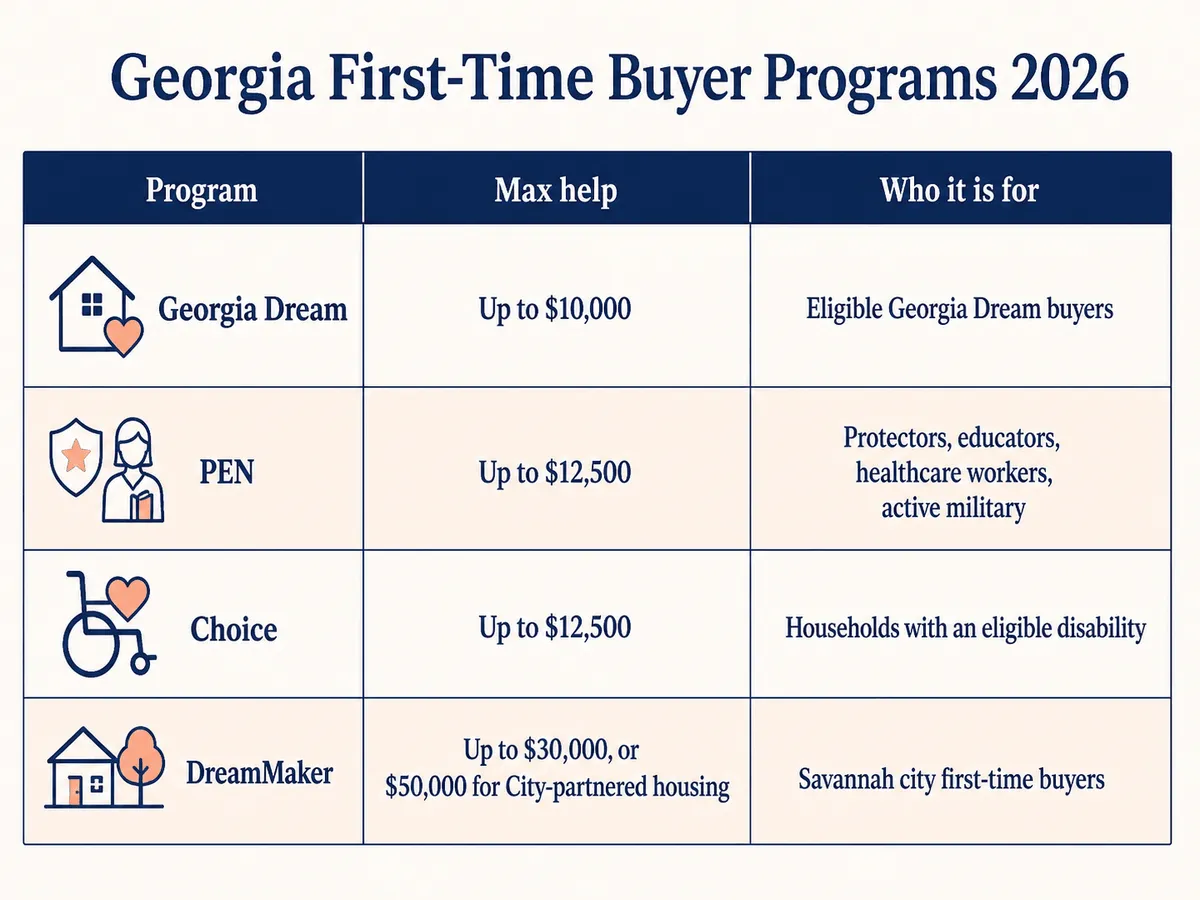
DCA’s current Georgia Dream page caps Standard help at the lesser of 5% of the purchase price or $10,000. PEN raises that to the lesser of 6% or $12,500 for eligible protectors, educators, healthcare workers, people working in those industries, and active military. Choice uses the same 6% and $12,500 limits when someone in the household has an eligible disability.
This help is not a grant. DCA records a 0% second mortgage with no monthly payment. The balance becomes due when you sell, refinance, or stop using the property as your primary residence. Other approved assistance may be allowed behind DCA’s liens, but the lender must clear the lien order and every program’s rules before anyone promises a stack.
Peach Select VA
Peach Select VA is a separate 30-year fixed option for qualified military veterans who can use a VA mortgage. The current DCA rate is 4.8750%, effective July 23, 2026. It provides no Georgia Dream down payment assistance, but DCA says an eligible outside assistance program may be combined in a subordinate position. That requires lender and assistance-program approval.
| Program | Who qualifies | Max help | Where it applies | Source |
|---|---|---|---|---|
| Georgia Dream | Eligible Georgia Dream buyers | Up to $10,000 | Georgia, with county-based limits | Georgia DCA |
| Georgia Dream PEN | Protectors, educators, healthcare workers, active military | Up to $12,500 | Georgia, with county-based limits | Georgia DCA flyer |
| Georgia Dream Choice | Households with an eligible disability | Up to $12,500 | Georgia, with county-based limits | Georgia DCA flyer |
| Peach Select VA | Qualified military veterans eligible for the Georgia Dream VA product | No Georgia Dream DPA; 4.8750% rate as checked August 4, 2026 | Georgia, with county-based limits | Georgia DCA |
| FHA | Qualified owner-occupants, not limited to first-time buyers | Not DPA; 3.5% minimum down at a 580 or higher decision score | Nationwide | HUD |
| VA | Eligible service members, veterans, and certain surviving spouses | Not DPA; no down payment in most qualifying purchases | Nationwide | U.S. Department of Veterans Affairs |
| USDA | Income-eligible buyers purchasing an eligible rural primary residence | Not DPA; no money down for qualified buyers | USDA-eligible rural areas | USDA Rural Development |
| Savannah DreamMaker | Savannah city first-time buyers | Up to $30,000, or $50,000 for City-partnered housing | City of Savannah only | City of Savannah |
DCA also lists Peach Plus and Peach Advantage for first-time and repeat buyers with different income, price, and assistance structures. They are not first-time-buyer-only programs. If Standard misses by income or price, ask a participating lender to screen those products rather than assuming Georgia Dream is unavailable.
The federal loan types every Georgia first-timer should know
FHA, VA, and USDA are mortgage types, not first-time-buyer grants. HomeReady and Home Possible are conventional products. They can supply the first mortgage underneath state or local assistance when both sets of rules allow it. Compare total payment, mortgage insurance, property eligibility, cash needed, and approval standards with a qualified lender.
FHA
HUD permits maximum FHA purchase financing at a 580 or higher decision credit score, which means a 3.5% minimum down payment. FHA is not limited to first-time buyers and includes mortgage insurance. Georgia Dream can use an eligible FHA first mortgage, subject to DCA’s separate 640 minimum and program limits.
VA
A VA-backed purchase loan can require no down payment when the sale price does not exceed appraised value, subject to eligibility, entitlement, and lender approval. It is reusable and not first-time restricted. Read my VA vs FHA vs conventional Coastal Georgia guide for the full loan comparison.
USDA
USDA Rural Development offers no-money-down direct and guaranteed options for qualified buyers in eligible rural areas. Eligibility is address-specific. Buyers looking beyond Savannah’s urban footprint in Bryan, Effingham, or Liberty County should check the official USDA eligibility map for the exact property rather than assume an entire county qualifies.
Conventional 97, HomeReady, and Home Possible
Fannie Mae’s standard 97% LTV option permits 3% down when at least one borrower is a first-time buyer. HomeReady and Freddie Mac Home Possible also offer down payments as low as 3% for eligible borrowers. Income and underwriting rules vary, so compare mortgage insurance, flexibility, and assistance compatibility.
The VA loan: Georgia’s biggest de facto first-timer program (Savannah edition)
Near Fort Stewart and Hunter Army Airfield, the VA loan often does more for an eligible first-time buyer than a small assistance loan. It can remove the down payment entirely, avoid monthly mortgage insurance, and remain available on a later purchase. The tradeoff is that entitlement, appraisal, funding fee, and property standards still matter.
I am a U.S. Army veteran and an MRP, so I start with the VA math before sending a military buyer toward extra liens and paperwork. Peach Select can sharpen that option with DCA’s current 4.8750% rate, but it cannot use Georgia Dream’s own second mortgage. DCA permits another eligible assistance source in a subordinate position, subject to approval.
If you are moving on orders, start with my military relocation plan for Fort Stewart and Hunter AAF, then use the linked loan guide for the mechanics. The question is not which program sounds generous. It is which combination produces the best sustainable payment with the fewest fragile conditions.
Savannah and Chatham County: the local programs the national lists miss
DreamMaker is Savannah’s major local first-time-buyer program. It can cover eligible down payment, closing, or financing gaps through a deferred City loan, but the home must be inside Savannah city limits and pass program inspections. Household income restrictions, first-mortgage terms, documentation, education, and available funding determine whether a file works.
The City’s current DreamMaker page offers up to $30,000 for general eligible housing and up to $50,000 for housing developed with a City partner. Both are 2% interest, 30-year deferred-payment loans. The current application says no payment is due until sale or transfer, refinancing, or the buyer no longer occupies the home as a primary residence.
This city-limit rule matters. A home in Pooler, Richmond Hill, or Savannah Quarters may fit your search, but it does not meet DreamMaker’s Savannah location test. I have helped buyers pair an FHA first mortgage with DreamMaker assistance, but the lender and City must approve the structure before it goes into an offer plan.
Complete education early. CCCS of Savannah offers free monthly workshops and counseling options that issue certificates. Neighborhood Improvement Association offers a free monthly workshop and says the certificate is required for DreamMaker or Georgia Dream assistance.
The City also lists employer-assisted purchase programs for City of Savannah, St. Joseph’s/Candler, Memorial HCA, and Georgia Ports Authority employees. Ask Housing Services which option is active and stackable for your employer. DreamMaker applications are ongoing only while funds remain, so a buyer who waits until contract week can lose both time and leverage.
How to actually apply (the order that saves you weeks)
The fastest route is to screen eligibility, finish education, choose an approved lender, reserve assistance, and only then shop inside the correct limit. A normal preapproval alone does not reserve Georgia Dream or DreamMaker funds. Build the program into the financing plan before writing an offer, including extra review time and property conditions.
- Check the definition and limits. Confirm first-time status, household income, post-closing liquid assets, credit, county, and likely sale-price ceiling.
- Finish homebuyer education. Georgia Dream requires a HUD-approved course and a completion certificate dated within 12 months of closing. DreamMaker’s application asks about education completed in the prior 12 months.
- Use the right lender. Apply through a Georgia Dream participating lender, not directly with DCA. Call 1-800-359-4663 for DCA help.
- Reserve the assistance. Your lender submits the file and reserves DCA funds. For DreamMaker, coordinate the City application, lender package, contract, and inspections.
- Shop inside the real limit. Use the county price cap and property rules, not a statewide headline or an online preapproval ceiling.
The paperwork people underestimate is household income, tax transcripts, prior-address explanations, gift sourcing, education, and assistance lien approval. Give every requested document one clear file name and return conditions together. DCA tells lenders to submit a complete package at least 10 business days before closing, which is why last-minute uploads create avoidable stress.
Ready to use one of these programs in Savannah?
Tell me your budget and county, and I will tell you which programs are worth screening before you tour. I will help coordinate the education certificate, property limits, offer timeline, and program paperwork, then connect you with a participating lender who can make the actual credit and lending decision.
Call 912-351-8935 or text 912-210-8967. No pressure, usually the same day.
Program limits, rates, and funding change; this is general information, not financial or lending advice. Confirm current figures with the program and a participating lender before making decisions.
Frequently asked questions
Georgia buyers most often ask what assistance exists, how much help is available, and whether income or credit rules will stop them. These short answers use the agencies’ published August 2026 rules. A participating lender and the relevant program must still confirm eligibility for your household, property, mortgage, and funding date.
What programs are available for first-time home buyers in Georgia?
Who qualifies for the Georgia Dream Homeownership Program?
How much down payment assistance can you get in Georgia?
Georgia Dream Standard offers the lesser of 5% of the purchase price or $10,000. PEN and Choice offer the lesser of 6% or $12,500 for eligible households. Savannah DreamMaker offers up to $30,000 for general eligible housing or $50,000 for City-partnered housing inside Savannah. These are loans, not automatic grants, and funding availability plus first-mortgage approval determines the final amount.



Join The Discussion