


Last updated: August 1, 2026
TL;DR: My short answer to home appraisal for sellers Savannah is that the buyer’s lender needs a supportable opinion of value before it will finalize most financed purchases. If the appraisal is lower than the contract price, I show you the math and the contract options: adjust the price, ask the buyer to cover some or all of the gap, seek a lender-led review, or move on. Sometimes holding firm wins, but most of the time the best answer depends on the buyer’s cash, your timeline, and the quality of the comparable sales.
What a home appraisal is and why it matters to you as the seller
I tell Savannah sellers that a home appraisal is an independent opinion of value obtained for the buyer’s lender, not a second home inspection and not a promise that the contract price will be approved. If the value does not support the loan, the sale can pause while the parties review their choices.
The Consumer Financial Protection Bureau defines an appraisal as a written, independent assessment of value. Fannie Mae requires the lender or its authorized agent to select the appraiser, not the seller or real estate agent, under its appraiser selection rules. I can provide accurate facts and relevant sales, but I cannot direct the result.
- Current local context: Redfin reported a Savannah median sale price of $339,247 for the three months ending May 2026, down 3.1% from a year earlier, with a median of 82 days on market. Those citywide figures are market context, not a value for your house. Source: Redfin Savannah Housing Market, May 2026.
- Appraisal friction is real: NAR’s report posted July 9, 2026 said 7% of contracts were delayed by appraisal issues. Source: NAR REALTORS® Confidence Index.
- The term still confuses sellers: In NAR’s 2025 Appraisal Issues Survey, 44% of non-appraiser respondents said most or all of their clients did not understand an appraisal gap when they began working together. Source: NAR 2025 Appraisal Issues Survey.
For a PCS seller, the appraisal can feel especially sharp because the report date and the next housing decision are already moving. I have seen that pressure tempt sellers to accept the first proposed price cut. I slow the conversation down, separate the report from the contract rights, and show what each option does to timing and net proceeds.
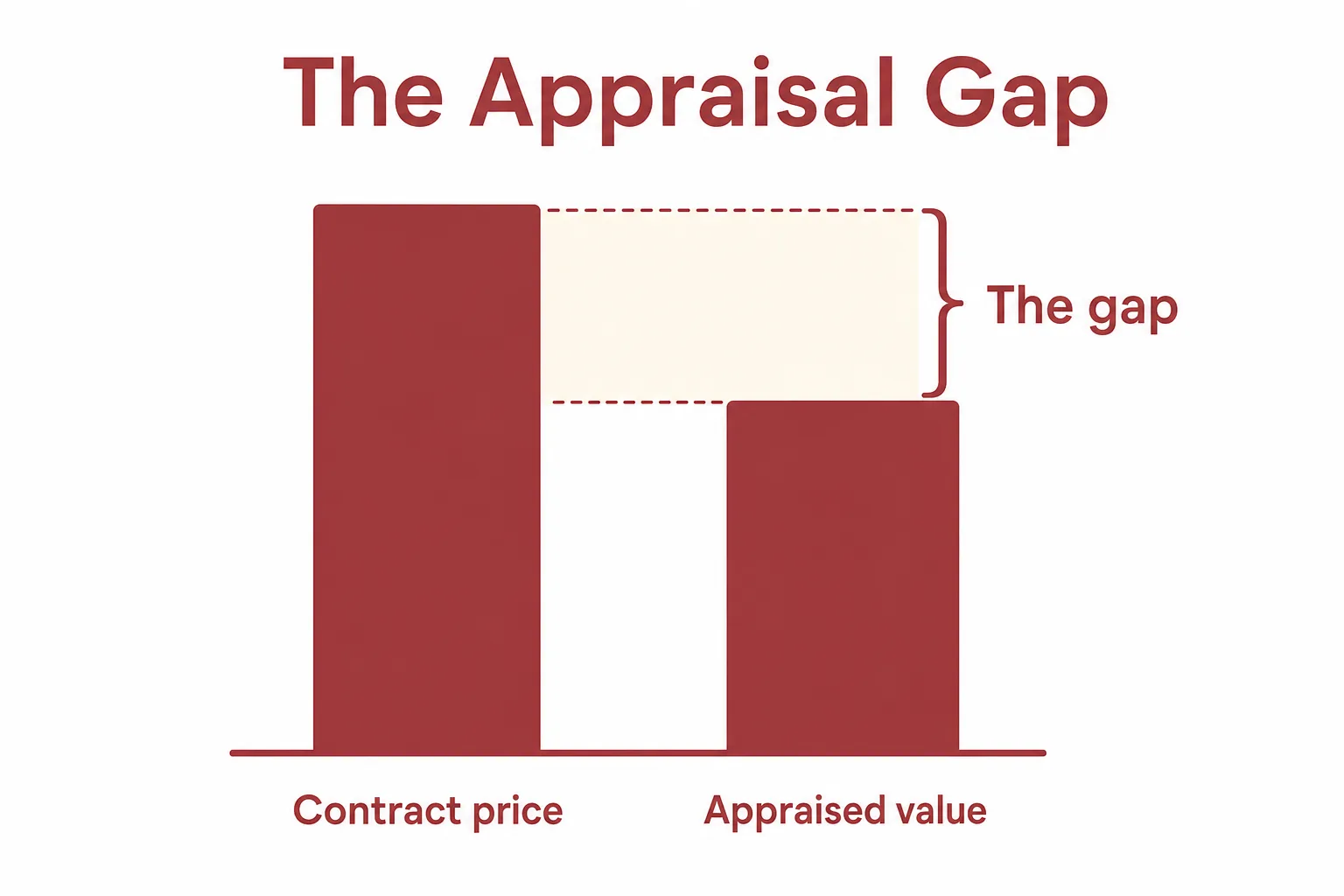
The appraisal gap: what it is and your options when it comes in low
An appraisal gap is the difference when the contract price is higher than the appraised value. It does not automatically require you to lower the price or require the buyer to pay the difference. I first read the appraisal, the financing terms, and the contract, then compare the real cost and risk of each response.
The options below track Freddie Mac’s low-appraisal guidance for sellers, including buyer cash, a lower price, factual review, and a possible later appraisal when better comparable evidence exists.
| Option | What it means | When it fits |
|---|---|---|
| Lower the price | You amend the contract price to a level the financing can support. | It can fit when keeping a qualified buyer and protecting the closing date matters more than testing the market again. |
| Buyer pays the gap | The buyer brings additional cash that is not supplied by the mortgage. | It can fit when the buyer has the funds, still believes the contract price is justified, and the contract permits the path. |
| Meet in the middle | You reduce the price while the buyer brings some additional cash. | It can fit when both sides want the sale and sharing the gap produces a workable loan and closing. |
| Dispute or reconsider | The buyer asks the lender to review supported errors, missing facts, or stronger comparable sales through its reconsideration of value process. | It can fit when the report contains a material factual problem or overlooked evidence, not simply because the result is disappointing. |
| Relist | The current contract ends according to its terms and you return the home to the market. | It can fit when the parties cannot agree and your timing, carrying costs, and likely next appraisal support taking the risk. |
I show sellers the math before recommending a path. A new financed buyer may face the same comps, while a price reduction may preserve a strong buyer and needed closing date. Sometimes holding firm wins. Most of the time, pride is not a pricing strategy.
A reconsideration of value, often called an ROV, is not a demand for a higher number. Under Fannie Mae’s current ROV requirements, the lender must provide a borrower process for unsupported, deficient, or potentially discriminatory appraisals, review the request, and keep the final value reliable and supported. I help organize factual corrections and relevant comps for the buyer and lender to submit.
Important: I am providing general real estate information, not tax, legal, or financial advice. Appraisal contingencies, earnest money, commission, taxes, and loan decisions are situation-specific. I want you to confirm legal and contract questions with a Georgia real estate attorney, tax questions with a CPA, and loan or appraisal questions with the buyer’s lender.
How the appraisal process works, step by step
In a typical financed Savannah sale, the buyer’s lender orders the appraisal, the appraiser gathers property and market evidence, the lender reviews the completed report, and the buyer receives the valuation. I track each milestone, but timing varies with the loan, property complexity, appraiser availability, and whether repairs or corrections are required.
- The lender orders the valuation. The buyer may be required to pay the appraisal cost, so I confirm the lender’s requirement for that file.
- The appraiser gathers property data. For an on-site assignment, the appraiser records condition, quality, room count, site characteristics, and visible improvements. I make access easy.
- The appraiser analyzes comparable sales. Fannie Mae prefers similar same-area sales when possible and requires explanations for competing neighborhoods. Read the Fannie Mae comparable-sales guidance.
- Adjustments reconcile differences. Lot, condition, location, concessions, and other market-supported differences may require supported adjustments. It is not a simple price-per-square-foot exercise.
- The lender reviews and delivers the report. The CFPB says a first-lien mortgage applicant must receive the completed appraisal promptly and no later than three days before closing. The buyer is the applicant, so I coordinate through the buyer’s side if my seller needs the relevant findings.
An appraisal is different from a home inspection. I explain it this way: the appraisal answers, “What is this property worth for the lending decision?” The inspection answers, “What condition is the property in, and what may need repair?” The CFPB’s inspection guide treats them as separate steps that buyers generally need for different reasons.
How Savannah sellers prepare for a strong appraisal
You cannot force an appraisal result, but you can reduce preventable uncertainty. I prepare a concise comps packet, verify the home’s facts, document visible improvements, make the property easy to access, and price from supportable evidence before the offer arrives. Clean information helps the appraiser understand the property without turning the visit into a sales pitch.
Build the evidence before the appointment
I start with the same discipline I use when I explain how to price your Savannah home. I identify recent closed sales that compete for the same buyer, review current competition, and include useful facts such as permitted improvements, major system updates, floor-plan information, and features public records may miss. I keep the packet short and verifiable.
Make condition visible, not theatrical
I ask sellers to handle access, lighting, clutter, minor maintenance, and curb appeal. Cleanliness creates no magic bonus, but it makes condition easier to observe. My guide to what affects your Coastal GA home value explains why condition must be judged beside location, flood profile, lot, and nearby sales.
With a Pooler buyer, I have seen a polished renovation create strong emotion while nearby sales still set the supportable range. That is why I separate buyer appeal from appraised support. Both matter, but they are not the same thing.
“The appraisal is where pricing strategy either holds up or backfires. I show sellers the math early, because a hopeful price is not a substitute for a supportable comparable sale.”
Alex Rodino, licensed Georgia real estate advisor #443565
Local factors that move Savannah appraisals
Savannah appraisals are especially sensitive to location and true competition. I look closely at flood designation, elevation evidence, historic-district restrictions, legal short-term-rental use, island versus mainland buyer pools, and nearby new construction. None creates an automatic dollar adjustment; each matters only to the extent that market evidence shows buyers react to it.
Flood zone and elevation
Fannie Mae requires the appraisal report to identify a FEMA Special Flood Hazard Area, flood zone, map number, and effective date. See its site-section requirements. I gather current map and reliable elevation records, then let comparable market behavior show the value effect.
Historic-district rules
In Savannah’s local historic districts, certain exterior changes may require a Certificate of Appropriateness under the City’s historic-preservation guidance. I flag permits and documented improvements because uncertain approval history raises different questions than properly documented work.
Short-term-rental use
The City says a legal short-term vacation rental needs a certificate and must fit zoning rules. I verify the use before treating income as a selling point. When an income approach is appropriate, Fannie Mae requires supporting rental and sales data. See the Savannah STVR rules and Fannie Mae guidance.
Islands, mainland neighborhoods, and new construction
A Tybee, Wilmington, Skidaway, or Whitemarsh property should not be forced into mainland comps because the drive looks short. Fannie Mae allows competing-area sales with explanation. In Pooler, Richmond Hill, and Rincon, resales may also compete with builder inventory and incentives.
At a Richmond Hill closing, I watched the comparison turn on which homes the same family would realistically choose. The right question was not just proximity. It was whether the sale competed for the same buyer and whether the differences were supported.
Price it to appraise from day one
The safest appraisal strategy starts before the listing goes live. I price from recent supportable sales, account for current competition, and explain where buyer emotion may outrun lender evidence. Then I prepare the comp story and negotiation paths early, so a low report becomes a decision with numbers instead of a last-minute crisis.
An automated estimate can start the conversation, but it cannot inspect condition, understand a Savannah block, or decide whether an island comp truly competes. Begin with ARC’s free Coastal Georgia home value estimate, then ask me for a property-specific CMA. If you are weighing representation against doing it yourself, my FSBO vs Realtor honest-math guide shows where the work and risk actually sit.
Work With Alex
Call me at 912-351-8935 or text me at 912-210-8967. Tell me the property, your timing, and what you are worried about. I will give you a straight read and usually respond the same day.
No pressure. Usually the same day. A few details is all I need.
Frequently asked questions
These are the appraisal questions I hear most from Savannah, Pooler, Richmond Hill, Rincon, and island sellers. I answer them plainly below, but your contract and loan can change the outcome. For a live transaction, I want the buyer’s lender and the closing attorney involved before anyone assumes what must happen next.




Join The Discussion