
By Alex Rodino, U.S. Army veteran (Capt.) · Licensed GA REALTOR® #443565 · MRP
Last updated: August 10, 2026
TL;DR: Living in Savannah GA means walkable history, a coast roughly 20 to 30 minutes away, and a cost of living below the national average. The trade is a genuinely hard summer, hurricane and insurance math, gnats, and peak-weekend crowds downtown. Savannah is a great fit for some people and honestly wrong for others. This guide will help you tell which side you are on.
What it is actually like to live in Savannah
Living in Savannah feels slower and more neighborly than a big metro, but it is not a sleepy museum piece. The squares and porches set the rhythm, SCAD students and visitors keep downtown moving, and a short drive takes you to residential streets where daily life feels much quieter.
I moved because I wanted a smaller city with coastal access and neighborhoods that still felt like neighborhoods. I expected the beauty. I did not expect how quickly ordinary routines would attach themselves to it: crossing a square on the way to lunch, watching a summer storm gather from a porch, or walking Jones Street after dinner because the live oaks still make me slow down. That is the Savannah I stayed for.
The scale matters. The U.S. Census Bureau estimated 148,808 people in Savannah in 2024. Its latest metro table puts the Savannah metro at 438,314 people in 2025, up from 405,341 in 2020. Growth is being pulled by the Port of Savannah, Gulfstream’s Savannah headquarters and manufacturing campus, and Hyundai’s Metaplant and battery investment in Bryan County. You feel that growth in jobs, traffic, construction, and housing pressure.
The pros of living in Savannah
Savannah’s strongest advantages are part of normal life, not just vacation photos: a historic core you can walk, quick access to beaches and marsh, relatively moderate costs, short winters, and unusually good food for a city this size. Those benefits are real enough to justify the compromises for the right person.
Walkable history you live in, not visit
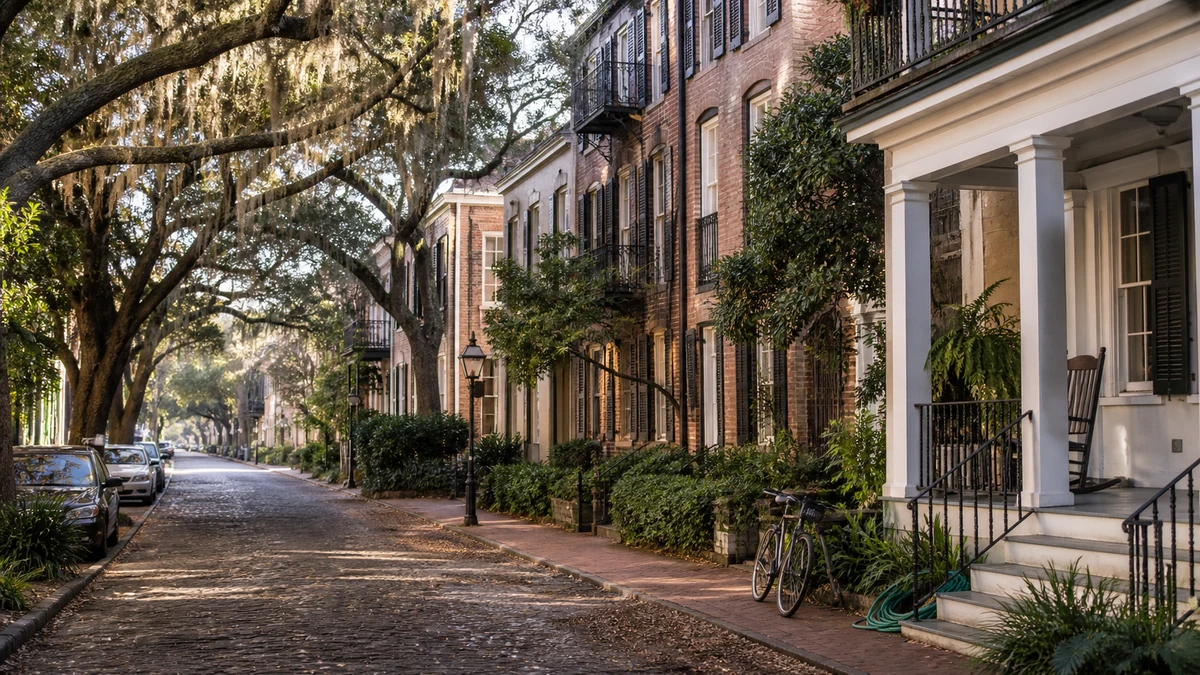
Savannah lets you use its history as part of your day. The city says the historic district has 22 squares, and downtown errands can take you under live oaks instead of across a giant parking lot. My favorite evening version is simple: Jones Street, a turn through a square, then home before the lamps and moss disappear into the dark.
The coast is 20 minutes away
Tybee Island puts an Atlantic beach within an easy half-day escape. Official Tybee guidance describes the trip as 17.5 miles and about 20 minutes from the Historic District, while its newer day-trip guide says about 30 minutes and longer on busy summer weekends. I tell buyers to think 20 to 30 minutes in light traffic, then add patience when everyone has the same beach idea.
Cost of living below the national average
Savannah still costs less than the country overall, but it is not the bargain some old relocation guides promise. As of August 2026, Redfin’s calculator puts overall costs 9% below the national average and housing 27% below. Redfin reported a $339,247 median sale price in May 2026, while Zillow reported $1,807 average rent as of June 30, 2026. Those figures measure different things, so do not treat them as interchangeable.
Georgia is kind to retirement income
Georgia gives qualifying retirees meaningful state-income-tax relief. The Georgia Department of Revenue says taxable Social Security is exempt from Georgia income tax. Its latest published IT-511 booklet allows up to $35,000 of retirement-income exclusion per qualifying person at ages 62 to 64 and up to $65,000 at 65 or older. This is not tax advice. Confirm current rules with a tax professional before moving.
A food scene that punches above the city’s size
Savannah gives you serious choices without requiring big-city planning every night. When visiting clients ask me for three stops, I send them to Crystal Beer Parlor for an old Savannah lunch, The Wyld Dock Bar for a marsh-side meal, and Brochu’s Family Tradition to see what the newer food scene is doing. They are different enough to make the point.
Mild, short winters
Winter is brief enough that outdoor life never fully shuts down. NOAA’s 1991 to 2020 normals for Savannah International Airport show a 61.4°F average January high. That can mean December yard work in a light layer or a clear January walk on Tybee, although cold snaps still happen.
The cons of living in Savannah (the honest part)
The downsides are not small footnotes: summer can drain you, coastal risk changes the cost of a house, bugs can ruin a perfect yard evening, and tourism changes downtown’s rhythm. Add wage pressure and uneven crime patterns, and Savannah becomes a place you should test honestly before committing.
Summer is genuinely hard
Savannah summer is not just hot. It is hot, humid, and persistent. NOAA’s 1991 to 2020 normals put the average high at 92.3°F in July and 90.8°F in August. At 8 a.m. in July, the air can already feel like a wet blanket. Locals do yard work early, follow shade, hydrate, and move long walks to evening. I tell everyone who calls me about moving here: come in July first. If you still love it, you will love it forever.
Hurricanes, flood zones, and what they do to insurance
Coastal weather risk belongs in the budget before you fall in love with a house. The National Weather Service documents tropical-cyclone impacts across coastal Georgia, and FEMA explains that A and V zones are high-risk areas where flood insurance is required for federally backed mortgages. I check the FEMA map on day one, then have buyers quote homeowners, wind, and flood coverage for the exact address. I will not quote you an average premium, because there is no single trustworthy Savannah-area number: wind exposure, flood zone, roof age, and construction can move coastal quotes dramatically from one address to the next, so the quote on the exact house is the only figure that matters. Insurance terms change, so confirm with your insurer. This is not financial, insurance, or legal advice.
The gnats are not a joke
Sand gnats and no-see-ums can turn a mild porch evening into a retreat indoors, especially near marsh and water. The local joke has receipts: Savannah’s former minor-league club was literally the Sand Gnats. The first time they found me in the yard, I learned that wishful thinking is not mitigation. Lightweight clothing, moving air, screens, and a repellent that works for you matter.
Tourists own downtown on peak weekends
Downtown belongs to visitors on the busiest weekends, and St. Patrick’s Day is the clearest example. Parking tightens, restaurant waits stretch, and a simple cross-town drive becomes a plan. The Savannah Area Chamber reports 12.9 million visitors to the Savannah and Chatham County area in 2024, including 7.2 million overnight guests. The balance is that the crowd pressure falls away quickly outside the core. Locals learn the calendar, make reservations, and choose a different route when downtown is in full festival mode.
Crime statistics need neighborhood-level honesty
Crime deserves specific research, not a slogan about an entire city or neighborhood. The Savannah Police Department’s 2023 UCR table recorded 5,885 Part I offenses, including 1,226 violent and 4,659 property offenses, and labels the figures preliminary and subject to change. For national context, the FBI reported a U.S. violent crime rate of 363.8 offenses per 100,000 people in 2023. Be careful setting those side by side: local tables and national rates can use different offense definitions, reporting systems, and population bases, which is one reason single-number city rankings mislead.
Citywide totals hide block-level variation, and I will not label a neighborhood safe or unsafe for you. Pull SPD’s weekly reports and incident maps, visit the exact block at different times, drive the surrounding routes, and ask nearby residents what they experience. I give clients the process, not a steering verdict.
Wages run below the price growth
Local income does not stretch as far as the national cost headline suggests. Census QuickFacts reports Savannah’s median household income at $57,137 for 2020 to 2024, compared with a U.S. median of $80,734 for the same period. That gap helps explain why remote workers and retirees may feel comfortable while households earning local wages feel the housing pressure much more sharply.

Savannah pros and cons at a glance
Savannah’s decision comes down to paired tradeoffs: the same coast that gives you marsh and beach access brings storm and insurance exposure, while the historic core that makes daily walks special also attracts heavy visitor traffic. This table keeps the choice plain, with no new claims beyond the sections above.
| Pros | Cons |
|---|---|
| Walkable history you use every day | Peak-weekend tourist crowds downtown |
| Beach and marsh access | Hurricanes, flood zones, and insurance math |
| Costs below the national average | Local household income below the U.S. median |
| Mild, short winters | Hot, humid, persistent summers |
| A varied local food scene | Sand gnats and no-see-ums |
| Port, aviation, and manufacturing growth | More traffic and housing pressure |
| Retirement-income tax relief | Rules require individual tax advice |
Who Savannah fits, and who it does not
Savannah fits people who value character and coastal access enough to plan around summer and storm season. It is a harder match for anyone who needs big-city wages in a narrow field, wants downtown quiet at all times, or cannot make the insurance numbers work.
Savannah fits:
- People who want walkable history and coastal life at a below-national price.
- Remote workers bringing a bigger-market salary.
- Retirees who value mild winters and want to review Georgia’s tax treatment with a professional.
- Anyone willing to plan around a hot summer instead of fighting it.
Savannah probably is not your city if:
- You hate humidity more than you love the city’s character.
- You need a deep local job market in your niche at big-city pay.
- Hurricane-season insurance math breaks your budget.
- You want quiet-suburb anonymity while living downtown.
A no to downtown can still be a yes to the Savannah area. Pooler, Richmond Hill, and Rincon trade old-city walkability for more suburban space and different commute patterns. Start with my live Pooler vs. Richmond Hill vs. Rincon comparison, then explore current buyer pages for Pooler and Richmond Hill. Hunter Army Airfield is in Savannah and Fort Stewart is up the road, so this is also a major PCS destination. My military relocation guide is the next step for that move.
Talk to someone who already made this decision
I moved here, stayed, and know that the right answer is not always Savannah proper or even Savannah at all. Tell me what you are moving for and what worries you, and I will give you the straight answer, including the parts that do not favor me.
Call 912-351-8935 or text 912-210-8967. No pressure, and you will usually hear back the same day.
Frequently asked questions
These are the questions I hear most from people deciding whether to move to Savannah. The short answers are direct, but each one depends on the exact address, household budget, commute, and tolerance for coastal weather. Use them as a filter, then investigate the details that matter to your move.
Is Savannah GA a good place to live?
Savannah GA is a good place to live for people who value historic walkability, coastal access, mild winters, and a smaller-city pace. It is a weaker fit if humidity, storm exposure, downtown tourism, or a limited local job market in your field are deal breakers. The smartest test is to visit in July, drive the places you would actually use, and price housing plus insurance before deciding.
What are the downsides of living in Savannah GA?
The biggest downsides are long, humid summers, hurricane and flood exposure, insurance costs, sand gnats, and tourist congestion in the historic core. Local wages also lag the national median household income. None of those makes Savannah universally bad, but each can change your daily comfort or budget. Test the climate in summer and get address-specific insurance quotes before treating the move like a vacation.
Is it expensive to live in Savannah GA?
Savannah costs less than the country overall, but housing may not feel cheap on a local salary. Redfin reported overall living costs 9% below the national average and a $339,247 median sale price for May 2026. Zillow reported $1,807 average rent as of June 30, 2026. Your real number depends on location, home type, insurance, transportation, and whether you earn local or remote income.
Is Savannah GA safe to live in?
Savannah cannot be reduced to a single safe-or-unsafe label. Savannah Police Department publishes citywide UCR data, weekly reports, and incident maps, but city averages hide major block-level differences and do not predict an individual’s experience. Review the official SPD map for the exact address, visit at different times of day, drive nearby routes, and talk with residents. A real estate agent should give you that research process, not steer you with a verdict.
What is the weather like in Savannah year round?
Savannah has short, mild winters and long, humid summers. NOAA’s 1991 to 2020 normals show a 61.4°F average high in January, 92.3°F in July, and 90.8°F in August. Spring and fall can be excellent for porches, walking, and marsh time, although gnats can be active. Summer routines shift toward early mornings, shade, air conditioning, hydration, and afternoon-storm flexibility.
Is Savannah GA a good place to retire?
Savannah can be a strong retirement choice for mild winters, coastal recreation, food, history, and Georgia’s treatment of qualifying retirement income. The tradeoffs are summer heat, storm planning, insurance, and the cost difference between downtown, islands, and suburbs. Georgia tax rules depend on age and income type, so confirm them with a tax professional. A separate retirement guide should handle the deeper financial and lifestyle comparison.
What salary do you need to live comfortably in Savannah GA?
There is no honest one-salary answer because household size, debt, housing choice, insurance, and transportation change the budget. Useful anchors are Zillow’s $1,807 average rent as of June 30, 2026 and Redfin’s $339,247 median sale price for May 2026. Build your number from the exact home and insurance quote, then add utilities, transportation, food, health care, savings, and a hurricane-season reserve.


Join The Discussion