

Last updated: July 30, 2026
By Alex Rodino, U.S. Army veteran (Capt.) · Licensed GA REALTOR® #443565 · Updated July 24, 2026
Important: I am sharing general educational information, not tax, legal, or financial advice. Commission terms, contracts, taxes, seller concessions, and loan rules depend on the facts. Please confirm legal questions with a Georgia real estate attorney, tax questions with a CPA, and financing questions with your lender.
TL;DR: Real estate commission Savannah sellers and buyers pay is always negotiable, and no law sets a standard rate. Since August 17, 2024, offers of buyer-agent compensation cannot appear on the MLS, while many buyers must sign a written agreement before touring a home. I show sellers the full net sheet because a lower fee can help, but only if the pricing, marketing, negotiation, and buyer-pool effects do not cost more than the savings.
How real estate commissions actually work (and what changed in 2024-2025)
In brief: Real estate commissions are negotiated payments for representation, commonly settled at closing from the funds moving through the transaction. The 2024 NAR practice changes did not set a new rate. They changed how buyer-agent compensation is agreed to, disclosed, and communicated, especially through written buyer agreements and off-MLS discussions.
I start with two separate conversations. A seller negotiates the listing side with the listing firm. A buyer negotiates the buyer side in a written agreement with the firm representing that buyer. The purchase contract and the closing statement then show which party or firm is funding each obligation. That can include the seller, the listing firm, the buyer, or a combination permitted by the agreements.
The national practice changes took effect on August 17, 2024. According to the National Association of REALTORS® homebuyer guide, an MLS participant working with a buyer generally needs a written agreement before an in-person or live virtual tour. That agreement must state an objectively ascertainable compensation amount or method, and the agent cannot receive more than the agreed amount from all sources combined.
The same NAR guide says a buyer does not need that agreement merely to talk with an agent at an open house or ask about services. That distinction matters. I do not tell a Pooler buyer that every conversation creates a long commitment. I explain the document, the services, the duration, the cancellation language, and the pay terms before we tour.
In 2025, the market operated under those rules. There was not a second nationwide rule that created a government commission schedule. NAR’s current materials still say compensation is fully negotiable and not set by law. In my practice, I put the choices on paper and show the math instead of repeating a supposed going rate.
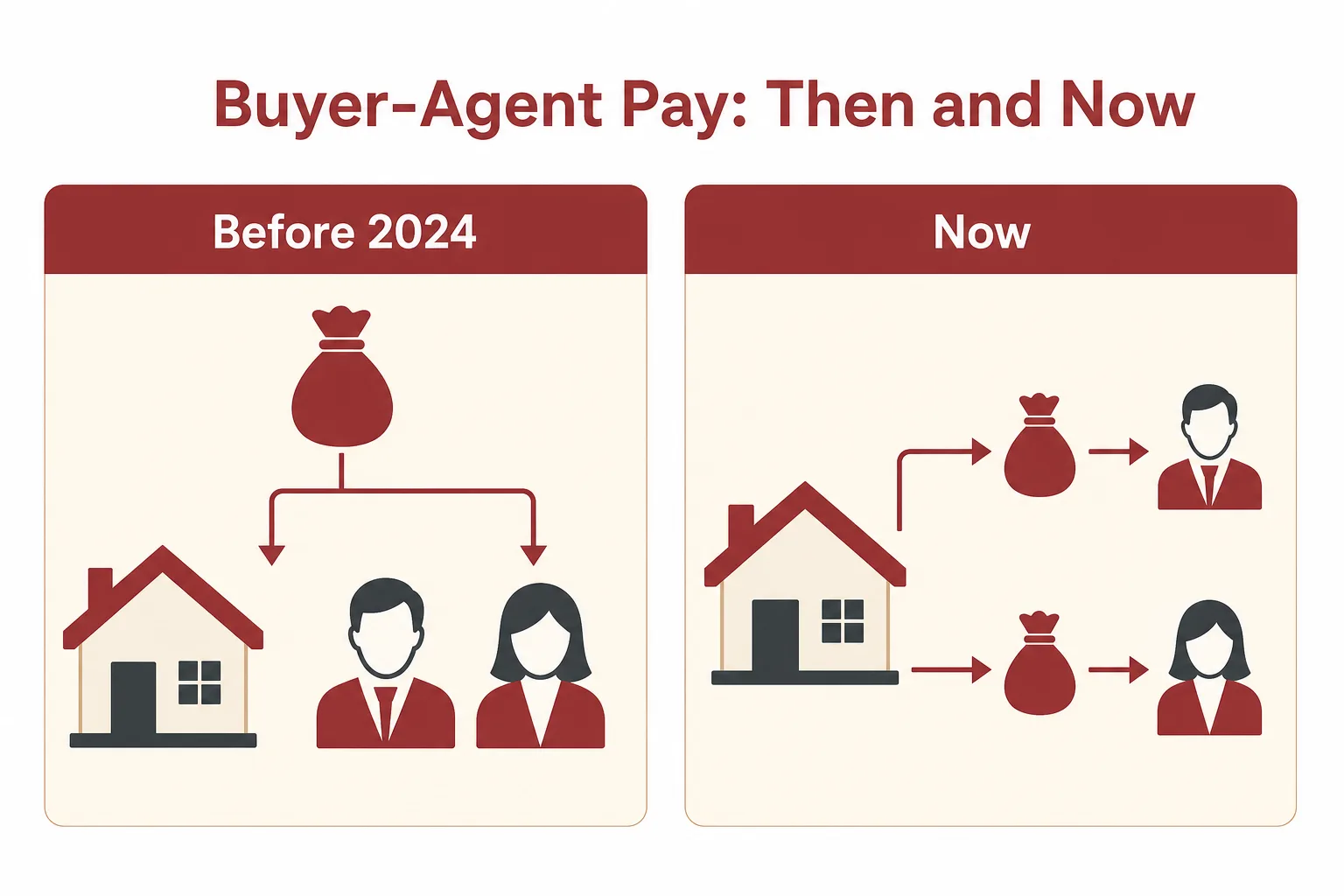
What the NAR settlement changed for Savannah sellers and buyers
In brief: The settlement changed the process, not the basic right to negotiate. Buyer-agent pay is now addressed directly in a buyer agreement, offers of that pay stay off the MLS, and seller approval remains necessary when the seller or listing firm will fund it. Every side should know the amount and source before closing.
| Item | Before August 17, 2024 | Now |
|---|---|---|
| How buyer-agent pay is set | A listing firm could publish an offer of cooperative compensation through a participating MLS. Buyers and their agents could still discuss their relationship and services. | The buyer agreement states the amount or an objective method. Payment may come from the buyer, seller, listing firm, or a permitted combination, but total compensation cannot exceed the buyer agreement. |
| Where it is advertised | Offers of buyer-agent compensation were commonly displayed with the listing in the MLS. | Offers cannot be displayed on an MLS. They may be communicated off the MLS, including through direct broker communication, subject to the seller’s authorization and applicable rules. |
| Buyer-broker agreements | NAR MLS policy did not impose one nationwide pre-tour written-agreement rule. | An MLS participant working with a buyer generally must have a written agreement before an in-person or live virtual home tour. A buyer visiting an open house alone is treated differently. |
| Negotiability | Commission and compensation were negotiable and not set by law. | They remain fully negotiable and not set by law. The written agreements must make that clear. |
The table follows NAR’s settlement FAQs and its Written Buyer Agreements 101 guidance, which I checked for this July 2026 update. Local MLS rules, brokerage forms, and Georgia law still control the actual documents, so I send contract questions to an attorney rather than guessing.
Representation remains common even with the clearer pay process. NAR’s 2025 Profile of Home Buyers and Sellers summary, published November 3, 2025, reported that 88% of buyers and 91% of sellers used an agent or broker, while FSBO sales were 5% of sellers. Those are national research findings, not Savannah commission rates.
Who pays the buyer agent now?
In brief: No single party automatically pays the buyer agent in every transaction. A seller may authorize compensation, a listing firm may make an off-MLS offer, a buyer may request payment in the purchase offer, or the buyer may owe some or all of the agreed amount. Every option remains negotiable.
NAR’s consumer guide to negotiating written buyer agreements says a buyer can ask a seller to offer compensation through the purchase agreement. A seller can accept, reject, or counter that term along with price, closing date, repairs, and other parts of the offer. The buyer’s own written agreement remains the ceiling on what the buyer’s firm may receive.
For a Savannah seller, the question is strategic: could an authorized buyer-side payment improve the offer or help a capable buyer preserve cash, and is that benefit worth the cost? A seller can decide property by property and offer by offer. The old MLS field is gone, but the business decision is not.
I once walked a PCS seller through this when the move timeline mattered more than winning one isolated line item. We compared the likely buyer pool, the terms we expected, and the projected net. I did not promise that paying a buyer side would create a better offer. I showed how we would judge the whole offer if that request arrived.
A Pooler buyer can face the other side of the same decision. If the seller will not cover the full obligation in the buyer agreement, the buyer may need cash or a different negotiation structure. I tell buyers to confirm affordability and concession rules with their lender before writing, because a real estate agent should not improvise loan advice.
What is negotiable, and how commission affects your net
In brief: The fee, services, duration, cancellation terms, and buyer-agent compensation strategy can all be discussed before signing. Your best choice is not automatically the lowest percentage or the highest service package. I compare projected sale price, costs, concessions, risk, and execution so the decision rests on expected net proceeds.
A listing fee may cover pricing analysis, preparation advice, photography, listing presentation, market exposure, showing coordination, offer comparison, negotiation, inspection response, appraisal support, and closing follow-through. Ask what is included and what costs extra. A low number with limited service is a different product from a full plan, and the agreement should make that difference visible.
Here is a hypothetical illustration, not a Savannah rate, recommendation, or claim about what anyone should charge. On a $400,000 sale, a negotiated 2.5% listing fee equals $10,000. If the seller separately authorizes up to 2% for the buyer side, that equals $8,000, or $18,000 combined. If an accepted offer instead requests 1.5% for the buyer side, that piece is $6,000, bringing the illustration to $16,000. The percentages are assumptions used only to show arithmetic. The NAR consumer guide confirms that actual compensation may be a flat fee, percentage, hourly fee, or another objective method, and remains fully negotiable.
“I show sellers the math. Sometimes the cheaper option wins because the service and expected result are genuinely equal. Most of the time it does not win if weak pricing, poor presentation, or thin negotiation costs more than the fee saved.”
Alex Rodino, Georgia REALTOR® #443565
For the wider decision, read my guide to FSBO vs Realtor: the honest math, then compare how to price your Savannah home and whether you should sell your Savannah home in 2026. Those choices affect the same net sheet, but none of those pages declares a standard commission.
Questions to ask before you sign a listing agreement
In brief: Before signing, ask what you will pay, what the service includes, how buyer-agent requests will be handled, how long the agreement lasts, and how cancellation works. Then ask for a property-specific marketing plan and estimated net sheet. Clear answers now prevent expensive assumptions after the listing is active.
- What exactly is the listing fee? Ask whether it is a percentage, flat amount, or another objective method, and whether any separate costs apply.
- What is included? Get specifics on photography, preparation, MLS entry, digital marketing, showing management, negotiation, and transaction coordination.
- What is our buyer-agent compensation strategy? Ask whether you are authorizing any off-MLS offer, whether you will decide only when an offer arrives, and how each choice could affect your net and buyer pool.
- What is the marketing plan for this home? A Tybee property, an in-town Savannah home, and a Richmond Hill resale should not receive a copy-and-paste plan.
- How long is the agreement? Confirm the start date, expiration, extension terms, and what happens if you pause or withdraw.
- How can I cancel? Read notice requirements, protection periods, reimbursable expenses, and any fee that could survive cancellation. Ask a Georgia attorney about language you do not understand.
- What might I net? Request an estimate that includes the mortgage payoff, negotiated compensation, expected seller costs, possible concessions, repairs, taxes, and HOA items.
At a Richmond Hill closing, I saw again why the early conversation matters: the compensation lines should confirm decisions already understood, not introduce a surprise. I want my clients to know what each line means before the final statement arrives.
See what you would actually net
In brief: Your useful number is the estimated sale price minus payoff, negotiated compensation, closing costs, concessions, repairs, taxes, and property-specific charges. I can start with an instant estimate, then build a CMA and seller net sheet around your Savannah or Coastal Georgia home so you can compare real options.
Start with the free Coastal Georgia home value estimate. The calculator gives you an instant starting point, and you can request a CMA so I can review current comparable sales, condition, competition, likely buyer pool, and timing. No national estimate can see the block, roof, flood profile, renovation quality, or new-construction competition the way a local review can.
Call me at 912-351-8935 or text 912-210-8967. I serve Savannah, Pooler, Richmond Hill, Rincon, Tybee, Wilmington, Skidaway, Whitemarsh, Chatham County, and communities near Hunter AAF and Fort Stewart.
Frequently asked questions
In brief: The questions I hear most are about who pays, what changed, whether commissions remain negotiable, and what buyers must sign. The short version is that the process is more explicit, not fixed: written agreements and off-MLS communication matter, while the final amount and funding structure still depend on negotiation.
Who pays the real estate commission in Georgia?
In a conventional Georgia closing, seller-authorized compensation is commonly paid from sale proceeds and allocated between the listing and buyer sides, but the contracts can instead make the buyer responsible for some or all of the buyer-side obligation, depending on the negotiated listing, buyer, and purchase agreements. The amount and funding source are negotiable. The NAR changes did not impose a commission rate; they changed how buyer compensation is documented and communicated. Ask your attorney to review the contract and closing statement.
What did the NAR settlement change?
The NAR settlement removed offers of buyer-agent compensation from the MLS and requires an MLS participant working with a buyer to enter a written agreement before an in-person or live virtual tour, with limited situations such as an unrepresented buyer attending an open house treated differently. The agreement must state an objective compensation amount or method. Commissions remain negotiable and are not set by law.
Do sellers still pay the buyer agent commission?
Yes, a seller may still agree to fund buyer-agent compensation, but the seller is not automatically required to do so in every transaction and the offer cannot be posted on the MLS or accepted as a term of every purchase offer. A buyer may request that payment in the purchase offer, or may pay under the buyer agreement. I advise sellers to compare the request with price, financing, concessions, timing, risk, and projected net before deciding.
Are real estate commissions negotiable in Savannah?
Yes, real estate commissions in Savannah are fully negotiable, just as NAR states they are not set by law, and that includes the amount, payment method, scope of service, and the handling of any buyer-agent request for your specific property. I will explain what my service includes and show the expected net effect. No agent should present a percentage as a government rate or mandatory Savannah standard.
What is a buyer-broker agreement?
A buyer-broker agreement is the written contract that defines the buyer’s relationship with the firm providing buyer representation, including services, duration, duties, termination terms, and an objective compensation amount or method, before you begin touring properties together in person or virtually. Under the NAR practice changes, many buyers sign before touring a listed home with an MLS participant. Read it closely, negotiate terms you do not accept, and ask an attorney about legal language before signing.
Is a lower commission always better for my net?
No, a lower commission improves your net only when the price, service, exposure, negotiation, concessions, risk, and closing outcome remain equal or improve, and the agent’s work supports that result from pricing through closing without creating offsetting costs or risk. Sometimes a lower-fee option wins; most of the time the comparison needs more than one line. My guide to FSBO vs Realtor: the honest math uses the same principle: compare likely net proceeds and workload, not a fee in isolation.
What should I ask before signing a listing agreement?
Ask for the exact fee method, included services, marketing plan, buyer-agent compensation strategy, agreement length, expiration date, cancellation procedure, protection period, reimbursable expenses, and a property-specific net estimate before you give anyone authority to market your home publicly for sale. I also recommend asking who handles showings, offers, inspection issues, appraisal questions, and closing communication. If any clause affects your legal rights or taxes, pause and confirm it with a Georgia attorney or CPA.




Join The Discussion