

This guide is general information, not legal, tax, or financial advice. Rules, rates, and deadlines can change. Confirm specifics with the Georgia Department of Revenue, Georgia Department of Driver Services, your county tax commissioner, and a licensed CPA or attorney before acting.

TL;DR: Moving to Savannah from Out of State in 2026
Moving to Savannah from out of state is manageable when you treat it as a 12-week checklist, not one big move.
Savannah is a practical relocation destination for buyers who want coastal access, historic neighborhoods, airport convenience, military proximity, and a lower housing-cost profile than many Northeast, West Coast, and major urban markets.
In your first 30 days after moving, get your Georgia driver’s license, register your vehicle, update insurance, confirm school enrollment, and start your homestead exemption process if you bought a primary residence.
Georgia new residents must apply for a Georgia driver’s license within 30 days of becoming a resident, according to the Georgia Department of Driver Services. Georgia vehicles must also be registered within 30 days of moving to the state, according to the Georgia Department of Revenue. (Georgia Department of Driver Services)
Georgia’s income tax rate is a flat 5.19% as of April 2026. Georgia’s state sales tax rate is 4%, before local sales taxes. Georgia has no inheritance tax, and Georgia Department of Revenue guidance says taxable Social Security and Railroad Retirement income on the federal return are exempt from Georgia income tax. (Georgia Department of Revenue)
Georgia homestead exemption applications are generally tied to an April 1 deadline for the current tax year, and Chatham County says applications made after April 1 are considered for the next tax year. (Georgia Department of Revenue)
Quick Answers: Moving to Savannah (2026)
- Driver's license deadline: 30 days after becoming a Georgia resident (Georgia DDS)
- Vehicle registration deadline: 30 days after moving to Georgia (Georgia DOR)
- Georgia income tax (April 2026): Flat 5.19%
- Georgia state sales tax: 4% (plus local)
- Title Ad Valorem Tax (TAVT) for new residents: 3%
- Chatham County homestead exemption deadline: April 1 for current tax year
- Social Security: Federally taxable Social Security and Railroad Retirement income are exempt from Georgia income tax
- City of Savannah utility setup: Up to 7 days to process online applications
Table of Contents
- Why People Are Moving to Savannah
- The 12-Week Relocation Countdown
- Georgia Taxes for New Residents
- Georgia DDS and Vehicle Registration for New Residents
- Utilities in Savannah
- School Enrollment for Relocating Families
- Homeowner’s and Flood Insurance
- Cost of Living
- Coming From Another City?
- Military Relocation
- Buying Sight Unseen
- Healthcare and Logistics
- Frequently Asked Questions
Why People Are Moving to Savannah
In brief: Savannah draws out-of-state movers with coastal lifestyle, historic character, airport access, and major employers like Hyundai Metaplant and Gulfstream, plus strong growth in Bryan and Effingham counties.
Savannah is drawing out-of-state movers because it combines job growth, coastal lifestyle, historic character, airport access, and multiple suburban options within one metro area.
The City of Savannah had an estimated 148,808 residents as of July 1, 2024, according to the U.S. Census Bureau. The broader relocation story is even stronger outside the city. Bryan County, which includes Richmond Hill and the Hyundai Metaplant growth corridor, had an estimated 51,105 residents in 2024, while Effingham County had an estimated 73,148 residents and grew 12.9% from April 2020 to July 2024. (U.S. Census Bureau)
Major employers shape the move. The Georgia Department of Economic Development says Hyundai Motor Group Metaplant America represents a $7.59 billion investment and at least 8,500 on-site jobs in Bryan County. Gulfstream also remains a major Savannah-area aerospace anchor, with Georgia’s economic development agency noting that Gulfstream’s Savannah headquarters have been in the city since 1967. (Georgia Department of Economic Development)
Military relocation is also part of the market. Fort Stewart and Hunter Army Airfield serve incoming soldiers and families through a shared newcomers resource, with Hunter Army Airfield located in Savannah and Fort Stewart serving the broader coastal Georgia military footprint. (U.S. Army Fort Stewart-Hunter Army Airfield)
Savannah is not a fit for everyone. Summers are hot and humid, flood and insurance questions matter, and some suburbs are growing fast. For the right buyer, though, Savannah offers a practical mix of housing, history, coast, work access, and lifestyle.
The 12-Week Relocation Countdown

In brief: Treat the move as a 12-week countdown, giving each phase a clear job from decision and financing through closing and the first 90 days of Georgia residency.
Moving to Savannah from out of state works best when each phase has a job.
12 Weeks Out: Decision and Discovery
Start with a clear shortlist. Decide whether you are focused on in-town Savannah, the islands, or suburbs like Pooler, Richmond Hill, and Rincon.
Do this first:
- Compare Historic District homes, Ardsley Park homes, islands, and metro suburbs.
- Set up remote search alerts.
- Estimate net proceeds if you are selling your current home.
- Interview movers and get at least three written quotes.
- Build a first-pass relocation budget.
10 Weeks Out: Finances and Pre-Approval
Get pre-approved with a lender who can lend in Georgia. This matters if you are buying while still living in another state.
Review credit score, debt-to-income ratio, cash to close, current home sale timing, Georgia-specific insurance costs, and Vehicle Title Ad Valorem Tax (TAVT).
Georgia new residents pay TAVT at a 3% rate, according to the Georgia Department of Revenue. Confirm the exact vehicle calculation before you move. (Georgia Department of Revenue)
8 Weeks Out: Schools, Healthcare, and Employment
School and healthcare setup should begin before you arrive. Confirm the school district by exact address, request transcripts and withdrawal documents, gather immunization and screening records, identify primary care providers and any specialists you need, confirm remote work rules with your employer, and verify commute expectations if you are moving for Gulfstream, HMGMA, Fort Stewart, Hunter Army Airfield, JCB, logistics, healthcare, or port-related work.
6 Weeks Out: House-Hunting Trip or Virtual Tours
This is the point where buyers either visit for 2 to 3 days or begin live video tours.
Use the visit to narrow, not browse. Drive the likely commute. See the grocery run. Check distance to daycare, schools, airport, parks, and medical care.
If you are choosing between suburbs, start with ARC’s Pooler vs. Richmond Hill vs. Rincon comparison.
4 Weeks Out: Offer, Inspection, and Insurance Binding
Once you are under contract, the move becomes real.
Your checklist: confirm due diligence dates, schedule home inspection, ask about roof age, HVAC, plumbing, and electrical, check flood zone by exact address, request an elevation certificate if relevant, get homeowner’s insurance quotes, get flood insurance quotes if needed, and confirm closing logistics.
FEMA’s Map Service Center is the official public source for flood hazard information. Use it before your due diligence period ends.
3 Weeks Out: Utilities, Mail, and Subscriptions
Set up your start dates early. Handle electricity, water and sewer, gas (if applicable), trash and recycling, internet, security system, USPS change of address, and updates to banks, credit cards, employer records, subscriptions, and medical portals.
City of Savannah utility service applications can take up to 7 days for online submissions to process, according to the city’s utility setup page. (City of Savannah)
2 Weeks Out: Logistics Lockdown
Now confirm every practical detail: mover arrival and delivery windows, closing appointment or remote closing process, utility start dates, school records transfer, an essentials box, cleaning at both ends, pet travel and vet records, and photos of valuable items before movers arrive.
1 Week Out: Move Week
This week is about reducing surprises. Complete final walkthrough, verify repairs and receipts, confirm keys, garage remotes, mailbox keys, gate codes, and HOA access, confirm utilities are active, keep closing documents accessible, and keep medications, passports, IDs, pet records, and school records outside the moving truck.
Move Day and Days 1 to 7
Start with safety and access. Change locks, confirm HVAC is working, locate the main water shutoff, locate the electrical panel, test smoke and carbon monoxide detectors, note irrigation controls, schedule pest, HVAC, chimney, fireplace, or crawlspace service if needed, and walk the property after heavy rain if possible.
Days 8 to 30: Establish Georgia Residency
This is the deadline window. Apply for a Georgia driver’s license within 30 days of becoming a resident, register your vehicle within 30 days of moving to Georgia, update vehicle insurance, register to vote, update your employer records, start homestead exemption if you purchased a primary residence, and confirm school enrollment is complete.
Georgia DDS requires new residents to apply for a Georgia driver’s license within 30 days, and Georgia DOR requires new residents to register vehicles within 30 days of moving to Georgia. (Georgia Department of Driver Services)
Days 30 to 90: Integrate
Now move from setup to stability. Meet neighbors, join local groups, review your first utility bills, confirm property tax payment timing, check your assessment notice if you purchased, review insurance once all discounts and documents are complete, and track home maintenance items from inspection.
Months 3 to 12: Optimize
The first year is when small misses show up. Review first Georgia tax return considerations with a CPA, review insurance before renewal, revisit refinance options if rates change, file or confirm homestead exemption by the applicable deadline, and build a maintenance calendar for roof, HVAC, pest control, crawlspace, gutters, landscaping, and storm prep.
ARC insight: Out-of-state buyers often focus on the closing date. The smoother move comes from planning the 30 days after closing. License, vehicle registration, utilities, insurance, school records, and homestead exemption are the items that make Savannah feel organized faster.
Georgia Taxes for New Residents
In brief: Georgia has a flat 5.19% income tax (April 2026), a 4% state sales tax, no estate or inheritance tax, and a 3% TAVT for new residents titling vehicles.
Tax rates and brackets change. Figures below are current as of April 2026. Confirm with Georgia Department of Revenue for the latest.
Georgia State Income Tax
Georgia’s income tax rate is a flat 5.19% as of April 2026, according to Georgia Department of Revenue tax updates. (Georgia Department of Revenue)
Retirees should pay special attention to Georgia rules. Georgia DOR says taxable Social Security and Railroad Retirement income on the federal return are exempt from Georgia income tax. Georgia also provides retirement income exclusions for certain taxpayers age 62 or older, subject to current rules. (Georgia Department of Revenue Retirees FAQ)
Property Taxes in Chatham, Bryan, and Effingham Counties
Georgia property tax is local. Your bill depends on county, city, school district, assessed value, exemptions, and millage rates.
Georgia DOR explains that one mill equals $1 per $1,000 of assessed value and uses 40% of fair market value in its property tax calculation example. (Georgia Department of Revenue)
Georgia Homestead Exemption
The Georgia homestead exemption is for eligible homeowners who own and occupy a home as their legal residence. Georgia DOR says homeowners must generally own the property on January 1 and file by the deadline for property tax returns, historically April 1, to receive the exemption for the current tax year. (Georgia Department of Revenue)
Chatham County’s Board of Assessors says Chatham homestead applications made on or before April 1 are considered for the current tax year, while applications made after April 1 are considered for the next tax year. (Chatham County Board of Assessors)
Sales Tax and Other State Taxes
Georgia’s state sales and use tax rate is 4%, before local rates are added. The Georgia DOR rate chart effective January 1, 2026 states that the state sales and use tax rate is 4%. (Georgia Department of Revenue)
Georgia Has No State Estate Tax
Georgia has no inheritance tax, and Georgia DOR states that Georgia has no inheritance or estate tax waiver requirements. Confirm estate-specific issues with a CPA or attorney. (Georgia Department of Revenue)
Title Ad Valorem Tax on Vehicles
New Georgia residents pay TAVT at 3% when titling and registering vehicles, according to Georgia DOR. Vehicles must be registered within 30 days from the date you move to Georgia. (Georgia Department of Revenue)
Georgia vs. Your Current State: Tax Snapshot
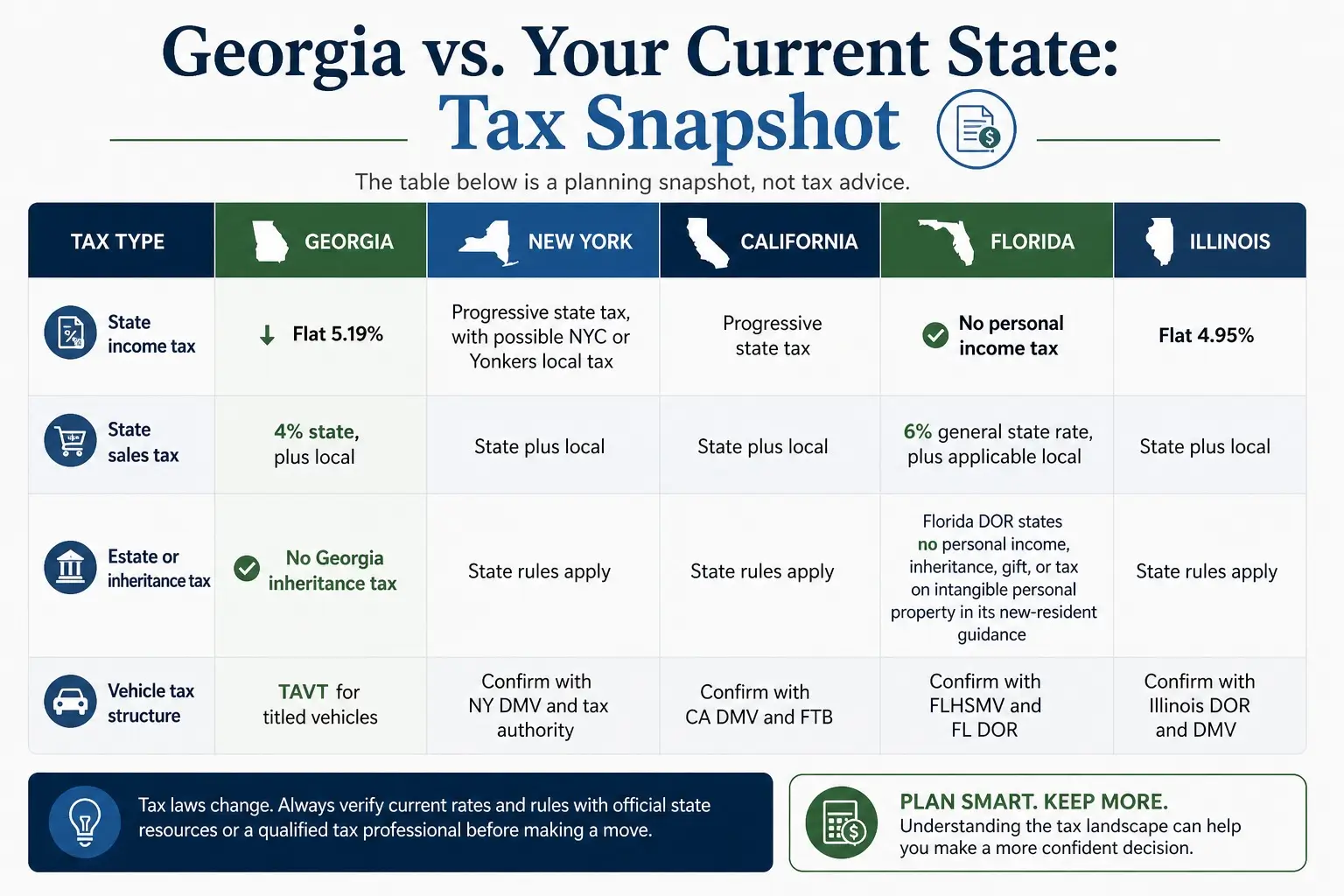
The table below is a planning snapshot, not tax advice.
Tax Type | Georgia | New York | California | Florida | Illinois |
State income tax | Flat 5.19% | Progressive state tax, with possible NYC or Yonkers local tax | Progressive state tax | No personal income tax | Flat 4.95% |
State sales tax | 4% state, plus local | State plus local | State plus local | 6% general state rate, plus applicable local | State plus local |
Estate or inheritance tax | No Georgia inheritance tax | State rules apply | State rules apply | Florida DOR states no personal income, inheritance, gift, or tax on intangible personal property in its new-resident guidance | State rules apply |
Vehicle tax structure | TAVT for titled vehicles | Confirm with NY DMV and tax authority | Confirm with CA DMV and FTB | Confirm with FLHSMV and FL DOR | Confirm with Illinois DOR and DMV |
Official state sources should be checked before acting. New York publishes state tax tables through its Department of Taxation and Finance, California publishes personal income tax rate schedules through the Franchise Tax Board, Illinois lists a 4.95% income tax rate, and Florida DOR’s new-resident tax guide states Florida does not impose personal income tax, inheritance tax, gift taxes, or tax on intangible personal property. (New York State Department of Taxation and Finance)
Georgia DDS and Vehicle Registration for New Residents
In brief: New Georgia residents have 30 days to get a Georgia driver’s license and 30 days to register their vehicles after moving.
New Georgia residents have two major 30-day tasks: driver’s license and vehicle registration.
Deadline to Get a Georgia Driver’s License
Georgia DDS says you must apply for a Georgia driver’s license within 30 days of becoming a Georgia resident. DDS customer service centers can transfer an out-of-state license to a Georgia license or ID. (Georgia Department of Driver Services)
Documents You Need
DDS says out-of-state license transfer applicants must present documentation showing identity, residential address, and U.S. citizenship or lawful status. Your full Social Security number must be provided on the required online form, and your current out-of-state license is required unless it was lost or stolen. (Georgia Department of Driver Services)
Georgia DDS Documents to Bring
Bring your current out-of-state driver’s license, proof of identity, proof of Georgia residency, proof of U.S. citizenship or lawful status, Social Security number documentation if DDS requires it, and name-change documents if your current name differs from your identity document.
DDS REAL ID guidance lists acceptable identity, name-change, Social Security, and Georgia residency documents. (Georgia Department of Driver Services REAL ID)
Registering Your Vehicle
Georgia DOR says new residents must register vehicles within 30 days of moving to Georgia and must visit the County Tag Office to apply for Georgia title and registration. DOR also says new residents need a valid Georgia driver’s license or ID before registering vehicles. (Georgia Department of Revenue)
For Chatham County buyers, that means coordinating your Georgia license, vehicle title, vehicle registration, and homestead exemption documents early.
Utilities in Savannah
In brief: Utility setup depends on the exact address; City of Savannah online applications can take up to 7 days, and electricity, gas, internet, and trash providers vary by location.
Utility setup depends on the exact address and jurisdiction.
Electricity
Electric service varies by address. Confirm the electric provider before closing or move-in. Some buyers assume the same provider serves the whole Savannah area, but service areas can vary by city, county, development, and utility territory.
Water and Sewer
The City of Savannah provides utility service setup through its Utility Services Division. The city says online utility submissions can take up to 7 days to process. (City of Savannah)
Pooler’s Utility Billing department handles water, sewer, and sanitation billing for City of Pooler customers. (City of Pooler)
Richmond Hill allows new residents to apply for water service online or in person at City Hall and requests a completed application, photo ID, and lease or settlement statement for online applications. (City of Richmond Hill)
Natural Gas, Internet, Trash, and Recycling
Gas, internet, trash, and recycling vary by address. Confirm service with the closing attorney, HOA, city, county, or property manager before move-in.
Utility Setup Table
Utility | Primary Provider or Office | Setup Lead Time | How to Start Service |
Savannah water and sewer | City of Savannah Utility Services | Up to 7 days for online submissions | Apply through City of Savannah Utility Services |
Pooler water, sewer, sanitation | City of Pooler Utility Billing | Confirm by move date | Contact City of Pooler Utility Billing |
Richmond Hill water | City of Richmond Hill | Confirm by move date | Apply online or in person with required documents |
Electricity | Address-specific | 1 to 2 weeks recommended | Confirm by exact address before closing |
Natural gas | Address-specific | 1 to 2 weeks recommended | Confirm by exact address |
Internet | Address-specific | 2 to 3 weeks recommended | Schedule as soon as closing is firm |
Trash and recycling | City, county, HOA, or private provider | Varies | Confirm jurisdiction and HOA rules |
ARC insight: The address matters more than the city name. Two homes with the same Savannah mailing address can have different water, trash, HOA, school, and flood-zone realities. Before closing, ARC helps remote buyers build an address-level checklist so setup does not become a guessing game.
School Enrollment for Relocating Families
In brief: Enroll by exact address, not city name, and gather birth certificate, proof of residency, immunization Form 3231, and Form 3300 screening records before you arrive.
School enrollment should be researched by exact address, not by city name.
Which District You Are In
The Savannah relocation area usually means one of three public school systems: Savannah-Chatham County Public School System for much of Savannah, Pooler, and Chatham County; Bryan County Schools for Richmond Hill and Bryan County; and Effingham County Schools for Rincon and Effingham County.
Documents Required for Enrollment
Savannah-Chatham County Public School System lists required documents such as a certified birth certificate, proof of address, parent or guardian identification, immunization certificate Form 3231, and vision, hearing, dental, and nutrition certificate Form 3300. SCCPSS says Form 3231 must be provided within 30 days of enrollment and Form 3300 within 120 days. (Savannah-Chatham County Public School System)
Bryan County registration requirements include immunization Form 3231, Georgia Form 3300, proof of residency, Social Security card or waiver, birth certificate, and previous school records for transferring students. (Bryan County Schools)
Effingham County Schools requires proof of residency, birth certificate, Social Security card or waiver, Form 3231, Form 3300, custody documents when applicable, parent or guardian photo ID, and other documents based on the student’s situation. (Effingham County Schools)
Practical Enrollment Checklist
Before you move, collect a birth certificate, parent or guardian ID, proof of residency, immunization record, Form 3300 screening record, withdrawal form, report card or transcript, IEP, 504, ESOL, gifted, or discipline records if applicable, and custody paperwork if applicable.
Homeowner's and Flood Insurance
In brief: Handle Coastal Georgia homeowner’s and flood insurance before your due diligence period ends, and confirm flood zone and elevation by exact address using FEMA’s Map Service Center.
Coastal Georgia insurance should be handled before the end of your due diligence period.
Wind, Hail, and Hurricane Deductibles
Homeowner’s insurance in Coastal Georgia may include separate wind, hail, or hurricane deductible language. Do not assume the deductible is a flat dollar amount. Ask your insurance agent to convert percentage deductibles into actual dollars.
Do You Need Flood Insurance?
Flood insurance depends on the exact property, lender, flood zone, elevation, and risk profile. FEMA’s Map Service Center is the official public source for flood hazard information.
Elevation Certificates
If a property is in a mapped flood zone, ask whether the seller has an elevation certificate. It may help the insurance agent understand the property’s flood rating.
For a deeper address-level checklist, read ARC’s Savannah flood zones and insurance guide.
Cost of Living
In brief: Savannah’s median owner-occupied home value of $248,900 is well below NYC, Los Angeles, Boston, and Miami on Census benchmarks, though insurance and taxes shape the full picture.
Savannah is usually less expensive than New York City, Los Angeles, Boston, and Miami on public housing benchmarks, but the comparison depends on neighborhood, insurance, taxes, and commute.
The table below uses Census QuickFacts housing data. It compares city-level median owner-occupied home values and median gross rent for 2020 to 2024, not current asking prices.
Category | Savannah | NYC | Los Angeles | Chicago | Boston | Miami |
Median owner-occupied home value | $248,900 | $777,600 | $921,200 | $334,100 | $731,700 | $518,100 |
Median gross rent | $1,382 | $1,821 | $1,933 | $1,440 | $2,147 | $1,758 |
State income tax | 5.19% flat | Progressive | Progressive | 4.95% flat | Progressive | No personal income tax |
State sales tax | 4% state, plus local | State plus local | State plus local | State plus local | State plus local | 6% state, plus applicable local |
Housing-cost takeaway | Lower than most comparison cities | High ownership cost | Highest home-value benchmark here | Closer to Savannah, but higher taxes may matter | High rent and home value | Lower income tax, higher housing benchmark than Savannah |
Census QuickFacts reports Savannah’s median owner-occupied value at $248,900 and median gross rent at $1,382 for 2020 to 2024. The same Census source reports NYC at $777,600 and $1,821, Los Angeles at $921,200 and $1,933, Chicago at $334,100 and $1,440, Boston at $731,700 and $2,147, and Miami at $518,100 and $1,758. (U.S. Census Bureau QuickFacts)
For current neighborhood-level value context, read ARC’s guide to current Savannah home values by neighborhood.
Coming From Another City? Here's Your Best Savannah Neighborhood Match
In brief: Your best Savannah neighborhood often depends on the city you are leaving, balancing walkability, schools, commute, and coastal access.
Your best Savannah fit often depends on the lifestyle you are leaving.
Coming From | Best Fit | Runner-Up | Why |
Brooklyn, Queens, or NYC | Best fit if you want walkability, older homes, restaurants, and urban texture. | ||
Manhattan | Best fit if you want walkability, architecture, restaurants, and a more central setting. | ||
Boston | Best fit if you like established neighborhoods, older homes, trees, and a residential feel. | ||
Washington, DC or Northern Virginia | Best fit if schools, commute logic, and suburban structure matter most. | ||
Chicago | Best fit if you want older housing stock, neighborhood identity, and in-town access. | ||
San Francisco or Bay Area | Best fit if you want character, creative energy, or coastal access. | ||
Los Angeles | Best fit if lifestyle, beach access, and neighborhood personality matter. | ||
Atlanta | Best fit if you are used to suburban tradeoffs, commute math, and retail convenience. | ||
South Florida | Best fit if you want planned communities, coastal lifestyle, or a calmer pace. | ||
Jacksonville or Charleston | Best fit if you want a suburban coastal Georgia base with practical access. |
This is a starting point. Before you choose, tour in-town, islands, and suburbs on the same trip.
Military Relocation
In brief: Military families should pick neighborhoods by installation: Richmond Hill suits Fort Stewart commuters, while Pooler and Southside fit Hunter Army Airfield.
Military families should choose neighborhoods based on installation, commute, school needs, and daily routine.
Best Savannah-Area Neighborhoods for Military Families
For Hunter Army Airfield, many buyers consider Pooler, Southside Savannah, Midtown, Georgetown, and some island or in-town options depending on commute tolerance. For Fort Stewart, Richmond Hill is often the stronger Savannah-area suburb to evaluate first.
Fort Stewart and Hunter Army Airfield provide official newcomer resources for incoming military households. (U.S. Army Fort Stewart-Hunter Army Airfield)
VA Loan Considerations
VA buyers should confirm property condition, appraisal expectations, insurance, flood status, and closing timeline early. A VA loan can work well in Savannah, but property condition and seller expectations need to be managed clearly.
Hunter Army Airfield Commute Reality
Hunter Army Airfield is in Savannah, so the strongest commute options depend on where you want to live and what gate or worksite you use most often. Pooler and Southside options often deserve early review.
Fort Stewart Commute Reality
Fort Stewart is a different commute pattern. If Fort Stewart is your daily destination, Richmond Hill generally deserves a first look before Pooler or in-town Savannah.
Buying a Savannah Home Sight Unseen
In brief: Buying sight unseen is safe when due diligence is not skipped: use live video tours, inspections, insurance quotes, flood checks, and careful closing coordination.
Buying a Savannah home sight unseen can be safe when “sight unseen” does not mean “due diligence unseen.”
What Sight Unseen Means in 2026
A strong remote purchase still includes live video tours, recorded walkthroughs, seller disclosures, inspection review, insurance quotes, flood checks, neighborhood context, commute testing, and closing coordination.
Live Video Tours and Virtual Due Diligence
A useful video tour is not a highlight reel. It should show the street approach, neighboring homes, parking, drainage, roofline, exterior condition, crawlspace or slab concerns, HVAC and water heater, closets and storage, natural light, noise, and odor if someone local can assess it.
Inspection Strategy
Use the inspection period actively. Ask the inspector about roof, HVAC, plumbing, electrical, foundation, moisture, drainage, wood rot, termites, and safety issues. Then pair the inspection with insurance quotes before moving forward.
Remote Notary and Closing Logistics
Georgia closing logistics should be confirmed with the closing attorney or title company. Some documents may be handled remotely, while others may require specific notarization or overnight delivery. Do not assume until the closing office confirms the process.
What ARC Handles on the Ground
ARC can help with live video tours, neighborhood context, offer strategy, inspection coordination, repair review, insurance questions, flood-zone prompts, walkthroughs, and local logistics.
Start here: build a custom Savannah home search or book a virtual relocation consultation.
Healthcare, Doctors, and Logistics Most People Forget
In brief: Before the truck arrives, transfer medical and pet records, move prescriptions, update insurance and voter registration, and line up local providers.
The move is not done when the truck arrives.
Checklist: transfer medical records, identify a primary care provider, identify specialists, transfer prescriptions, move pet veterinary records, update vehicle insurance, confirm pet rules with HOA or city, register to vote, update estate documents with a Georgia attorney if needed, update banks, employer, payroll, and emergency contacts, and find local community groups that match your neighborhood, school, military, retirement, or work needs.
Small logistics make a big difference in the first 90 days.
Frequently Asked Questions
What is the 30-day rule for new Georgia residents?
New Georgia residents have 30 days from the date they establish residency to apply for a Georgia driver's license (Georgia DDS) and 30 days from moving to Georgia to register their vehicles (Georgia DOR). Vehicle registration also triggers the one-time 3% Title Ad Valorem Tax (TAVT) on the vehicle's value. Missing either deadline can result in fees and registration issues.
How do I move to Savannah from out of state?
Move to Savannah from out of state by planning the relocation as a 12-week timeline. Lock financing and a Georgia-licensed lender by week 10, confirm school district by exact address by week 8, finalize inspection and insurance by week 4, and complete Georgia driver’s license, vehicle registration, and homestead exemption setup within the first 30 days after closing.
How long do I have to register my car in Georgia?
You have 30 days from the date you become a Georgia resident to register your vehicle. New residents must visit the County Tag Office, present a Georgia driver’s license or ID, provide proof of ownership, and pay a one-time 3% Title Ad Valorem Tax (TAVT) on the vehicle’s value, per the Georgia Department of Revenue.
How long do I have to get a Georgia driver's license?
You have 30 days from becoming a Georgia resident to apply for a Georgia driver’s license. Visit any Georgia DDS Customer Service Center with proof of identity, residency, U.S. citizenship or lawful status, and your current out-of-state license to complete the transfer.
What is the Georgia homestead exemption and how do I apply?
The Georgia homestead exemption reduces the taxable value of an owner-occupied primary residence. To claim it for the current tax year, you generally must own and occupy the home as of January 1 and file with your county tax commissioner by April 1. In Chatham County, applications received after April 1 apply to the next tax year.
Is Savannah cheaper than NYC, LA, Chicago, or Boston?
Yes. Savannah is generally cheaper than NYC, LA, and Boston on Census median owner-occupied home value and median gross rent. Chicago is closer on housing benchmarks, but Georgia’s flat 5.19% income tax, lower property values, and Coastal Georgia insurance costs change the comparison. Compare neighborhood, taxes, insurance, and commute before deciding.
What is the Georgia state income tax rate?
Georgia’s state income tax is a flat 5.19% as of April 2026. The rate applies to most taxable income on the Georgia return. Confirm current rates and brackets with the Georgia Department of Revenue or a licensed CPA before making relocation decisions, since state tax law can change year to year.
Does Georgia tax Social Security?
No. Georgia does not tax federally taxable Social Security or Railroad Retirement income. The taxable portion reported on your federal return is subtracted on Georgia Schedule 1 of Form 500, so it does not flow into Georgia taxable income. Georgia also offers a retirement income exclusion for taxpayers age 62 and older, subject to current rules.
Who provides electricity in Savannah?
Electricity in Savannah depends on the exact service address. Some homes are served by Georgia Power, while others fall under municipal or cooperative providers. Confirm the electric provider, water and sewer utility, trash service, gas, and internet by exact address before closing; service areas can vary by city, county, and development.
How do I enroll my kids in Savannah schools?
Enroll your kids by first confirming the assigned district by exact address, then gathering proof of residency, a certified birth certificate, parent or guardian photo ID, immunization record (Form 3231), vision/hearing/dental/nutrition screening (Form 3300), and prior school records. Requirements vary slightly across Savannah-Chatham County Public Schools, Bryan County Schools, and Effingham County Schools.
Is it safe to buy a house in Savannah sight unseen?
Yes. Buying sight unseen in Savannah can be safe when due diligence is not skipped. Use live video tours, a thorough home inspection, written insurance quotes, a FEMA flood-zone check by exact address, remote closing coordination, and a local agent who can verify property condition, drainage, and neighborhood context on the ground.
What is the best Savannah neighborhood for remote workers?
The best Savannah neighborhood for remote workers depends on lifestyle. Starland District and the Historic District suit walkable urban living, Ardsley Park offers established residential streets, Wilmington Island provides coastal access, and Pooler or Richmond Hill work well for suburban home offices with reliable internet and easy airport access.
Do I need flood insurance in Savannah?
You may need flood insurance in Savannah if your lender requires it or the property’s flood-zone risk profile justifies it. Check the exact address through FEMA’s Map Service Center, request an elevation certificate when relevant, and get binding flood insurance quotes before your due diligence period ends. Coastal Georgia premiums vary widely by elevation and zone.
What is the cost of living in Savannah vs. Florida?
Savannah typically has lower median owner-occupied home values than Miami, Jacksonville, or Tampa, while Florida has no state personal income tax. The right comparison weighs Georgia’s flat 5.19% income tax against Florida’s higher housing benchmarks, plus property taxes, homeowners and flood insurance, and lifestyle priorities like beach access, walkability, and commute.
How long does a move from New York, California, or Illinois to Savannah typically take?
Most interstate moves to Savannah from New York, California, or Illinois take several days to two weeks from pickup to delivery, depending on distance, mover schedule, load size, and season. Confirm exact pickup and delivery windows in writing, ask about consolidated versus dedicated trucks, and keep medications, IDs, and essential documents with you.
Key Takeaways
- Moving to Savannah from out of state is easiest when planned as a 12-week timeline.
- Georgia new residents have 30 days to get a Georgia driver’s license and 30 days to register vehicles.
- Georgia’s income tax rate is a flat 5.19% as of April 2026.
- Georgia does not tax federally taxable Social Security income on the Georgia return.
- Homestead exemption timing matters, especially for Chatham County buyers.
- Utility, school, flood, and insurance details must be checked by exact address.
- Remote buying can work when video tours, inspections, insurance, and closing logistics are handled carefully.
- ARC can help out-of-state buyers compare neighborhoods, tour remotely, and build a practical move plan.
Planning a Move to Savannah? Get a Local Guide Who Knows the Logistics.
Relocating is easier when someone local can help you sort the details before they become problems.
ARC helps out-of-state buyers compare neighborhoods, narrow school and commute priorities, review flood and insurance questions, set up remote-friendly searches, coordinate video tours, and manage on-the-ground details during the buying process.
There is no pressure and no generic relocation script. The goal is simple: help you understand Savannah clearly enough to make a confident decision.
About the Author
Alex Rodino is the Founder of The ARC Platform (Alexander Rodino Collective), a Savannah and Coastal Georgia real estate practice operating under Keller Williams Coastal Area Partners. Based at 329 Commercial Drive in Savannah, ARC serves homeowners, buyers, and sellers across the Historic District, the islands, and the metro corridors of Pooler, Richmond Hill, and Rincon.
Alex works directly with out-of-state buyers, including relocating professionals, military families assigned to Hunter Army Airfield and Fort Stewart, retirees, and remote workers, guiding each move from neighborhood selection through closing. The relocation process at ARC includes neighborhood comparisons, school and commute mapping, flood and insurance review, live video tours, remote inspection coordination, and on-the-ground details that are easy to miss when buying from another state.
For a free virtual relocation consultation or to start a remote-friendly home search, contact ARC at 912-351-8935 or info@thearcplatform.com.
Sources Cited in This Article
- Georgia Department of Driver Services, Apply for a New Georgia License or ID.
- Georgia Department of Driver Services, Out-of-State License Transfer.
- Georgia Department of Driver Services, REAL ID.
- Georgia Department of Revenue, Important Tax Updates.
- Georgia Department of Revenue, Retirees FAQ.
- Georgia Department of Revenue, Property Tax Homestead Exemptions.
- Georgia Department of Revenue, Property Tax Millage Rates.
- Georgia Department of Revenue, General Rate Chart Effective January 1, 2026.
- Georgia Department of Revenue, Estate Tax FAQ.
- Georgia Department of Revenue, Vehicle Taxes, TAVT.
- Georgia Department of Revenue, Vehicle Registration for New Georgia Residents.
- Chatham County Board of Assessors, Exemptions.
- U.S. Census Bureau QuickFacts, Savannah city, Georgia.
- Georgia Department of Economic Development, Hyundai Motor Group Metaplant.
- U.S. Army Fort Stewart-Hunter Army Airfield, Newcomers.
- Federal Emergency Management Agency, Map Service Center.
- City of Savannah, How to Set Up Service.
- City of Pooler, Utility Billing.
- City of Richmond Hill, Starting/Stopping Service.
- Savannah-Chatham County Public School System, Registration Documents.
- Bryan County Schools, Registration Requirements.
- Effingham County Schools, Student-Parent Handbook.
- New York State Department of Taxation and Finance, Tax Tables.




Join The Discussion