
By Alex Rodino, Founder, Alexander Rodino Collective | Serving Savannah & Coastal Georgia
Last updated: June 30, 2026 · 26-minute read

Downsizing in Savannah means trading a larger family home for a smaller, lower-maintenance property in Coastal Georgia, and for most retirees and empty nesters, the decision is as much about lifestyle, taxes, and timing as it is about square footage. The goal isn’t to rush; it’s to make the next step clear, practical, and manageable.
This guide is educational, not legal, tax, or financial advice. Always confirm specifics with a CPA, financial advisor, and a Georgia real estate attorney before acting.
TL;DR: Downsizing in Savannah (2026)
- What it is: Trading a larger family home for a smaller, lower-maintenance Coastal Georgia property.
- Three main paths: a smaller single-family home, a low-maintenance suburb or townhome, or a 55+/amenitized community.
- Top areas: The Landings on Skidaway, Savannah Quarters in Pooler, Richmond Hill, Ardsley Park, Historic District condos, Wilmington Island, and Effingham County.
- Federal tax: Section 121 may exclude up to $250,000 of gain ($500,000 married filing jointly) on a primary residence (IRS Pub. 523).
- Georgia perk: Retirement-income exclusion up to $35,000 (ages 62–64) or $65,000 (65+); county homestead rules vary (Georgia DOR).
- Default move order: Sell first, or at least know your realistic net proceeds, before committing to a next home.
Table of Contents
- Should You Downsize? A 7-Question Self-Assessment
- The Three Most Common Downsizing Paths in Coastal Georgia
- Best Savannah & Coastal Georgia Neighborhoods for Downsizers
- Sell First or Buy First? A Framework
- Capital Gains Tax When Selling Your Family Home
- Georgia Tax Advantages for Retirees
- Selling the Family Home: Pre-Sale Work Worth Doing
- Aging-in-Place Considerations for the New Home
- The Downsizing Timeline
- When Downsizing Is Emotionally or Logistically Complex
- Mistakes Downsizers Make in Coastal Georgia
- How Much Does Downsizing Cost in Savannah?
- Savannah vs. Florida for Retirees
- Frequently Asked Questions
- Key Takeaways
Should You Downsize? A 7-Question Self-Assessment
Downsizing in Savannah starts with fit, not square footage.
Use the questions below as a private self-check. You do not need every answer today. The point is to understand whether the home still supports the life you want.
Downsizing tracks a national shift: U.S. Census Bureau data show the 65-and-older population grew faster than any younger age group last decade, and many of those households are rethinking how much home they actually need.
1. Are there rooms you have not used in the last 90 days?
Unused rooms are often the first sign that the house is larger than the life happening inside it. Guest rooms, formal dining rooms, upstairs bedrooms, offices, bonus rooms, and storage spaces can quietly become maintenance burdens.
2. Is maintenance starting to feel heavier than it used to?
Yard work, roof repairs, HVAC, painting, cleaning, gutters, stairs, and exterior upkeep all take energy. If maintenance is becoming the thing that controls your weekends, the house may be asking for more than you want to give.
3. Are stairs a current or near-future concern?
A two-story home can work well for years, then become inconvenient quickly. If a main-level bedroom, step-free entry, or single-story floor plan would reduce stress, that belongs in the decision.
4. Would freeing up equity improve retirement quality of life?
For long-time homeowners, home equity may be one of the largest assets. Selling can free up money for retirement income, travel, healthcare, helping family, or simply reducing financial pressure. Run the numbers with a CPA or financial advisor before deciding.
5. Is the location still serving you?
A home that was perfect for raising children may not be perfect for this stage. Think about proximity to family, doctors, groceries, friends, worship, social life, airport access, and hobbies.
6. Are taxes, insurance, and utilities taking up more of the budget?
A larger home usually brings larger utility bills, insurance premiums, maintenance costs, and property-tax exposure. If those costs are growing faster than your comfort level, a lower-maintenance home may make sense.
7. Does the home still match how you want to spend your time?
This is the real question. If you would rather travel, walk, golf, boat, volunteer, spend time with family, or simplify your routine, your home should support that.
Decision matrix:
If you answered yes to 5 to 7 questions, it is likely time to seriously plan. If you answered yes to 3 or 4, build a 12 to 24 month plan. If you answered yes to 0 to 2, revisit the decision in 1 to 2 years.
The Three Most Common Downsizing Paths in Coastal Georgia
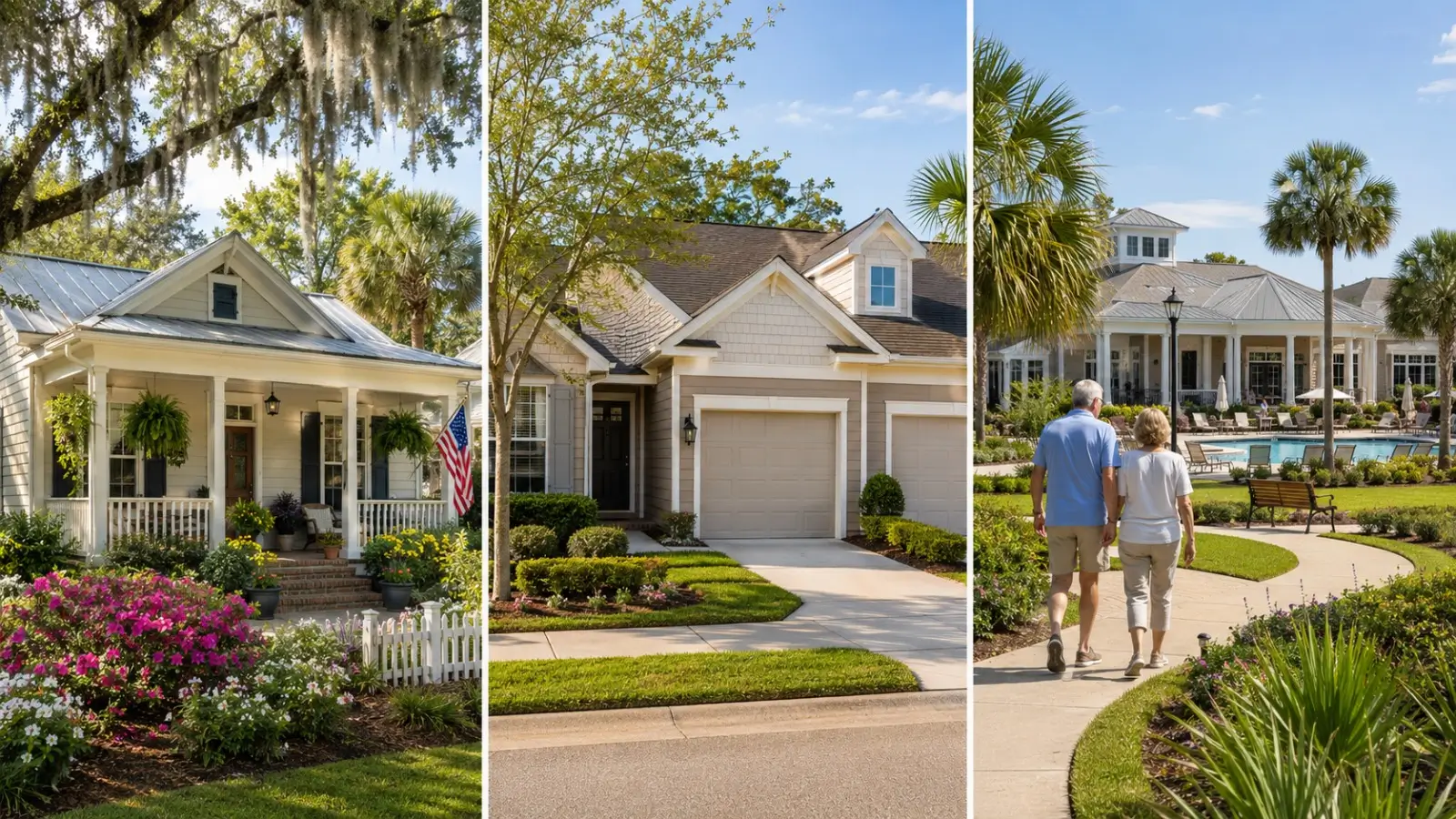
In brief: Most Savannah downsizers follow one of three paths.
Path A: Smaller Single-Family Home
This is the “same lifestyle, less house” path. You keep a yard, a driveway, privacy, and a familiar ownership style, but reduce square footage and maintenance.
This works well for homeowners leaving a large Ardsley Park, Wilmington Island, Pooler, Richmond Hill, or Southside home but not wanting a condo or heavily managed community. It can also work for buyers who want room for visiting family without maintaining a 3,000 square foot home.
Pros: familiar ownership, privacy, guest space, flexible resale.
Cons: still includes yard work, exterior maintenance, insurance, and repairs.
Best fit: downsizers who want simpler, not fully maintenance-free.
Path B: Low-Maintenance Suburb, Patio Home, or Townhome
This path works for homeowners who want less yard, less exterior responsibility, and a more manageable footprint. Pooler, Richmond Hill, Wilmington Island, Effingham County, and some Southside areas can all offer versions of this.
The key is to understand what the homeowner’s association (HOA) actually covers. Some communities handle lawn care. Others cover common areas only. Some include exterior maintenance. Others do not.
Pros: easier maintenance, often newer construction, smaller floor plans, community amenities.
Cons: HOA fees, rules, possible rental restrictions, less privacy.
Best fit: buyers who want predictability and a cleaner weekly routine.
Path C: 55+ or Amenitized Community
This path is less about age and more about lifestyle. The right community may offer trails, club activities, golf, fitness, security, social structure, lawn care, or amenity access.
In Coastal Georgia, this can include 55+ communities, amenitized neighborhoods, gated communities, or active-adult-oriented sections within broader communities. Confirm the exact community status and rules before relying on marketing language.
Pros: community, structure, social options, amenities, lower maintenance.
Cons: dues, rules, less flexibility, possible waitlists or limited inventory.
Best fit: buyers who want the next home to come with a built-in lifestyle.
Best Savannah and Coastal Georgia Neighborhoods for Downsizers
The best Savannah neighborhoods for retirees and empty nesters depend on whether you want walkability, golf, boating, medical access, family proximity, low maintenance, or a smaller payment.
The table below is a planning guide. Exact price ranges, HOA/POA dues, and available floor plans shift with the market; ask us for a current MLS snapshot for any community before making a decision.
| Neighborhood / Community | Type | Typical Price Range | HOA / POA Range | Maintenance Level | Best For |
|---|---|---|---|---|---|
| Skidaway Island & The Landings | Single-family, villas, gated amenity community | ~$550K–$2M+ | POA + optional club; varies by floor plan | Medium to low | Golf, amenities, retirement lifestyle |
| Savannah Quarters, Pooler | Patio homes, townhomes, amenitized community | ~$400K–$900K | Moderate HOA, club optional | Low to medium | Suburban convenience & newer homes |
| Richmond Hill 55+ & amenitized communities | Patio homes, single-family, select age-targeted | ~$350K–$800K | Varies by community | Low to medium | Family proximity, Bryan County suburb feel |
| Ardsley Park / Habersham Village | Smaller homes, cottages, condos nearby | ~$450K–$1.2M | Generally none; condo HOAs vary | Medium | In-town access without downtown density |
| Historic District condos | Condo, townhome, historic property | ~$400K–$1.5M | Moderate to high HOA | Low inside unit, higher due diligence | Walkability, culture, lock-and-leave |
| Wilmington Island patio homes & villas | Patio homes, townhomes, smaller single-family | ~$375K–$900K | Low to moderate HOA | Low to medium | Coastal lifestyle & daily convenience |
| Effingham County patio-home communities | Patio homes, smaller suburban homes | ~$275K–$550K | Low HOA where present | Low to medium | Lower cost & quieter setting |
| Tybee Island smaller cottages | Small single-family, condo, cottage | ~$500K–$1.5M | Varies; coastal/flood factors | Medium to high (coastal exposure) | Beach lifestyle, storm-aware buyers |
Price ranges are planning estimates as of 2026 and change with inventory. Request a current MLS snapshot for any community before making a final decision.
Quick clarification. Is The Landings a 55+ community? No. The Landings on Skidaway Island is an all-ages, amenity-rich gated community, not a legally restricted 55+ neighborhood. It is, however, one of the most popular downsizing destinations in Coastal Georgia thanks to golf, marinas, trails, and a strong social calendar. Always verify a community’s legal status before relying on marketing language.
Sell First or Buy First? A Framework for the Trickiest Decision

In brief: Most downsizers should know the sale number before committing to the next purchase.
Strategy | Best For | Pros | Cons | Typical Use Case |
Sell first | Sellers who need proceeds to buy | Clear budget, less financial pressure | Need temporary housing or rent-back | Long-owned family home with significant equity |
Buy first | Strong cash position or financing flexibility | More control over move timing | Two homes, carrying costs, risk | Competitive low-maintenance home becomes available |
Bridge loan or HELOC | High equity, strong income, clean timeline | Can unlock timing flexibility | Debt, approval risk, interest cost | Buying before selling with professional advice |
Sell with rent-back | Sellers who need proceeds but want move time | Clear sale plus more transition time | Buyer must agree | Downsizer needs 30 to 60 days after closing |
Why Most Downsizers Should Sell First
Selling first gives clarity. You know your net proceeds, your budget, and your timing. This is especially helpful if the family home has deferred maintenance, a mortgage payoff, tax questions, or uncertain market value.
When Buying First Makes Sense
Buying first can work when you have enough cash or financing flexibility to carry both homes. It can also make sense if the right villa, condo, or low-maintenance property appears and inventory is limited.
Bridge Loan, HELOC, or Other Middle Path
A bridge loan or home equity line of credit can create flexibility, but it is not right for everyone. Talk to a lender, CPA, and financial advisor before using debt to solve timing.
Sell with a Rent-Back
A rent-back can let you close the sale, receive proceeds, and stay in the home for a short period while you close on the next place. This can reduce pressure, but it depends on buyer agreement and contract terms.
ARC insight: Downsizing transactions work best when the old home and the next home are planned together. ARC helps clients build two timelines: one for sale readiness and one for the next-home search. The goal is to avoid making a rushed purchase just because the family home finally goes under contract.
Not sure if you should sell first or buy first?
Get a no-pressure home value & selling-plan estimate so you can decide with real numbers, not guesses.
Capital Gains Tax When Selling Your Family Home
In brief: Section 121 may let qualifying sellers exclude up to $250,000 of gain ($500,000 married filing jointly) on a primary residence; run the numbers before listing.
ARC is a real estate practice, not a CPA or tax attorney. The information below is general guidance. Confirm specifics with a licensed tax professional.
Section 121 Primary-Residence Exclusion
The Section 121 primary-residence exclusion is the core federal tax concept for long-time homeowners. According to IRS Publication 523, homeowners who qualify may exclude up to $250,000 of gain, or up to $500,000 if married filing jointly, when selling a main home. The IRS’s ownership and use test generally requires owning and using the home as your main residence for at least two of the five years ending on the sale date.
Step-Up in Basis for Surviving Spouses
If one spouse has passed away, basis can become more complex. Some homeowners may receive a step-up in basis on part or all of the property depending on ownership form, timing, state law, and estate facts. This is a CPA question, not a guess.
When Long-Time Owners Need to Run the Math
If you bought decades ago, paid off the mortgage, added improvements, and now own a much more valuable property, run the gain calculation before listing. The sale price is not the taxable gain; basis, improvements, selling costs, and exclusions all matter.
Documentation to Save
- Original purchase documents (if available)
- All closing statements
- Major renovation receipts & permits
- Roof, HVAC, plumbing, electrical, and addition records
- Prior appraisals
- Estate or inheritance documents (if applicable)
- Records of selling costs
Timing Can Matter
Marital status, health events, death of a spouse, estate planning, and moves into assisted living can all affect timing and tax treatment. Talk with your CPA before signing a listing agreement if tax exposure may be meaningful.
Georgia Tax Advantages for Retirees
In brief: Georgia lets eligible retirees exclude up to $35,000 (ages 62 to 64) or $65,000 (65 and older) of qualifying retirement income, and county homestead exemptions can lower the bill further.
Georgia retirement income exclusion and county-specific senior exemptions have eligibility rules that change. Confirm with the Georgia Department of Revenue and your county tax commissioner before relying on any figure.
Georgia can be attractive for retirees, but the details depend on income, age, county, property, and filing status.
Georgia Retirement Income Exclusion
The Georgia DOR states that taxpayers age 62 or older, or permanently and totally disabled regardless of age, may be eligible for a retirement income adjustment. Eligible retirement income includes pensions, annuities, interest, dividends, rental-property net income, capital gains, royalties, and up to $5,000 of earned income.
Georgia DOR also notes the exclusion may be up to $35,000 for ages 62–64 and up to $65,000 for Georgians 65 and older.
Homestead Exemption Refresher
Per Georgia DOR, a homeowner is generally entitled to a homestead exemption if the home was owned and was the legal residence as of January 1 of the taxable year. Applications are filed with county tax officials, and local exemptions may be more beneficial than the statewide exemption.
Senior School Tax and Local Exemptions
County-level exemptions vary widely:
- Chatham County: lists senior school tax exemption, special Chatham exemptions, disabled veteran exemptions, city exemptions, floating homestead, and tax deferral for the elderly, with documentation required for age-, income-, or disability-based programs (Chatham County Board of Assessors).
- Bryan County: senior homestead applicants age 65+ may qualify for a $50,000 local exemption for county, city, and school board ad valorem taxes (Bryan County).
- Effingham County: lists 62–64 income-based exemptions, a 65+ exemption, and a 65+ income-based exemption with different county and school amounts (Effingham County).
| County | Senior School Tax Exemption | Age Threshold | Income Threshold | How to Apply |
|---|---|---|---|---|
| Chatham | Yes, multiple special exemptions | Varies by program | Varies by program | Chatham County Board of Assessors |
| Bryan | Yes, $50,000 local exemption | 65+ | Standard qualifications | Bryan County Tax Assessor / Tax Commissioner |
| Effingham | Yes, multiple senior categories | 62–64 and 65+ | Some categories income-based | Effingham County exemption process |
Downsizing Can Reset Your Property Tax Math
When you sell one home and buy another, you don’t simply carry over the old tax bill. The new home’s assessed value, county, city, exemptions, and millage rate all change the annual cost. Confirm the new property’s tax estimate before closing.
Selling the Family Home: What Pre-Sale Work Is Worth Doing
In brief: A long-owned home usually needs a different selling plan than a recent resale.
The Reality of a Long-Owned Home
Many family homes have decades of belongings, older finishes, full closets, records, furniture, tools, holiday decorations, and deferred projects. That doesn’t mean the home is a problem; it means the sale needs a plan.
Start with documents, valuables, and safety. Then move to sorting, donation, estate sale, clean-out, repairs, and presentation.
High-ROI Pre-Sale Updates
The best pre-sale work usually removes buyer objections without over-investing:
- Deep cleaning & decluttering
- Paint touch-ups (interior & trim)
- Yard cleanup & light landscaping
- Lighting updates and bulb-color consistency
- Minor repairs (doors, drawers, cracked outlet covers)
- Roof clarity (recent inspection & documentation)
- HVAC service & filter changes
- Moisture or leak repair
- Safety issues (handrails, GFCI outlets, smoke detectors)
- Odor removal (carpet, pet, smoke)
What to Skip
Do not rush into a full kitchen, bathroom, flooring, or luxury-finish project without a clear pricing plan. Buyers may prefer to choose their own finishes; a rushed renovation often costs more than it returns.
When Sell As-Is Is Better
Sell as-is when the home has major condition issues, estate complexity, emotional strain, or when the likely buyer will renovate anyway. In those cases, clarity and pricing matter more than repairs.
For pricing context, read our Savannah home values by neighborhood guide. For cleanup-heavy or estate-related situations, read our step-by-step roadmap for selling an inherited home in Georgia.
Aging in Place Considerations for the New Home
In brief: The next home should support your future, not just your current move.
Single-Story Floor Plans
A single-story home is often the easiest long-term fit. If you choose a two-story home, look for a main-level bedroom, full bath, laundry, and everyday living space.
Wider Doorways and Curbless Showers
Universal design does not have to look clinical. Wider doorways, curbless showers, lever handles, good lighting, lower thresholds, and step-free entries can make daily life easier without changing the feel of the home.
For a deeper checklist of age-friendly home features, the HUD resources for senior citizens outline aging-in-place modifications and housing options worth reviewing before you buy.
Healthcare Access
Consider drive time to major medical providers, specialists, pharmacies, urgent care, and hospitals. In Savannah, that may mean proximity to Memorial Health, St. Joseph’s/Candler, Southside services, Pooler medical offices, or Effingham-area providers depending on where you live.
Family and Social Life
The best downsize is not always the smallest home. It is the home that keeps you connected. Think about family dinners, grandchildren, friends, church, clubs, hobbies, walking routes, golf, boating, and airport access.
Many Coastal Georgia downsizers are veterans or military families timing a move around a transition or retirement from service. If that is you, our Coastal Georgia military relocation help walks through PCS timing, VA loan options, and choosing the right next neighborhood.
Mobility Changes
Plan for what may be helpful later: parking close to the door, low-maintenance yard, wider hallways, storage on the main level, and minimal steps.
The Downsizing Timeline
In brief: Downsizing usually works better as a 12-month plan than a 30-day scramble.
12 Months Out: Decide and Get Aligned
Talk with your spouse, adult children, or trusted advisor if they are part of the process. Agree on what you want to simplify and what you want to preserve.
9 Months Out: Get a Home Value and Selling Plan
Request a realistic value range and net proceeds estimate. Start decluttering one room at a time. Do not begin with the hardest room.
Start here: get a Home Value and Selling Plan.
6 Months Out: Build the Buyer Shortlist
Decide what the next home must have. Include size, stairs, HOA comfort, pets, guests, garage, yard, healthcare, family proximity, and monthly budget.
4 Months Out: Pre-Sale Prep and Tax Planning
Meet with a CPA if capital gains, estate, or income planning may matter. Decide what repairs to do and what to skip.
3 Months Out: List or Begin a Private Conversation
Some sellers go to market. Others prefer private options, especially when the home is condition-challenged or emotionally sensitive.
2 Months Out: Offer, Inspection, and Next Search
Once the family home is under contract, the buy-side search becomes more focused. If you need a rent-back or flexible closing, negotiate early.
1 Month Out: Coordinate the Move
Confirm movers, utilities, insurance, address updates, medical records, prescriptions, and closing details. Keep key documents and medications with you.
Move Week and First 30 Days
Change locks, confirm utilities, set up healthcare, update voter registration, review insurance, and make the new home functional before perfect.
90 Days Post-Move
Revisit taxes, exemptions, insurance, healthcare, estate documents, and any lingering belongings. A downsize is a process, not a single weekend.
When Downsizing Is Emotionally or Logistically Complex
Some downsizing decisions need more privacy and less pressure.
Long-Time Family Homes
A 40-year home is not just a property. It holds memories, routines, repairs, photos, and family history. Give yourself permission to move slowly and deliberately.
Recently Widowed Sellers
A recently widowed seller may need a different pace. The right plan may include quiet valuation, private options, and help sorting what must happen now versus later.
Adult Children Coordinating from Out of State
Adult children can help, but the homeowner’s voice should stay central whenever possible. If the adult children live out of state, use shared documents, scheduled updates, and one point of contact.
Homes with Significant Deferred Maintenance
If the home needs major work, a traditional listing may still be possible. So may an as-is MLS sale, private sale, or investor option. The right path depends on condition, timeline, and emotional bandwidth.
When the Conversation Should Be Private
If the home sale involves grief, conflict, health concerns, estate issues, or major repairs, a private options conversation may be the most respectful first step. ARC offers private options for a complicated property situation when a public listing is not the right first move.
ARC insight: The best downsizing plan is not always the fastest one. Some clients need the numbers first. Others need to know where they are going next. Others need time with belongings. A good process makes room for all three without turning the move into a crisis.
Mistakes Downsizers Make in Coastal Georgia
- Underestimating belongings. A full attic, garage, shed, and closets can take months to sort. Start earlier than you think; 6 to 12 months is realistic for a 40-year home.
- Buying before knowing net proceeds. Your next-home budget should be based on a realistic net-proceeds estimate, not an online algorithm. Selling costs, repairs, mortgage payoff, taxes, and concessions all matter.
- Ignoring HOA and POA fees. A smaller home with large dues may not reduce monthly cost as much as expected. Always read what the dues actually cover.
- Skipping flood and insurance checks. Coastal Georgia insurance can dramatically change the math. Review flood zone, homeowner’s insurance, wind deductible, and roof age before committing. Start with our Savannah flood zone map by neighborhood guide.
- Missing capital gains exposure. Long-owned homes can have large appreciation. Talk to a CPA before listing if the gain may exceed the Section 121 exclusion.
- Choosing a community without a day-in-the-life test. Visit at different times of day. Drive to the grocery store. Check healthcare distance. Walk the neighborhood. Review visitor parking.
- Forgetting healthcare transitions. Doctors, specialists, prescriptions, Medicare plans, pharmacies, and medical records should all be part of the move plan.
- Letting adult children decide everything. Adult children can help, but the next home should still support the homeowner’s life. Keep the homeowner’s voice at the center of the decision whenever possible.
How Much Does Downsizing Cost in Savannah?
Downsizing in Savannah typically carries five categories of cost. None are surprises if you plan early, and most can be reduced by sequencing the work over 6 to 12 months.
| Cost Category | Typical Range (2026) | Notes |
|---|---|---|
| Real estate commission & seller closing costs | ~6–8% of sale price | Brokerage fees, title, transfer tax, attorney fees, concessions. |
| Pre-sale cleanup & light repairs | $1,500–$8,000 | Paint, landscaping, deep clean, minor fixes. Skip luxury remodels. |
| Estate sale, donation hauls, junk removal | $500–$5,000 | Depends on accumulated belongings and whether an estate-sale company is used. |
| Local move (Coastal Georgia) | $1,800–$6,500 | Local movers, packing, storage in transit. Out-of-state moves cost more. |
| New-home setup & transition costs | $1,000–$5,000+ | Locks, utilities, window treatments, furniture adjustments, first-year HOA dues. |
Bottom line: For a typical $600,000 Savannah-area family-home sale, plan for total downsizing costs of roughly $42,000–$65,000 across the transaction, depending on condition, distance, and how much you move yourself. Knowing this number before you shop is the single biggest stress-reducer.
Savannah vs. Florida for Retirees: A Quick Comparison
Many Savannah downsizers also consider Florida. Both have appeal: coast, mild winters, no state income tax burden on most retirement income, but they trade off on cost of living, hurricane exposure, insurance, and lifestyle. Confirm any tax detail with a CPA before relying on it.
| Factor | Coastal Georgia (Savannah area) | Florida (e.g., Jacksonville, NE FL) |
|---|---|---|
| State income tax on retirement | State income tax applies, but retirees 62+ can exclude up to $35,000–$65,000 of qualifying retirement income (Georgia DOR). | No state income tax. |
| Property taxes | Moderate; senior homestead exemptions vary by county (Chatham, Bryan, Effingham). | Moderate; Florida’s Save Our Homes cap and Homestead Exemption apply. |
| Homeowner’s insurance | Higher than inland GA, but generally lower than coastal FL. | Among the highest in the U.S.; coastal counties especially. |
| Hurricane exposure | Present, but historically less frequent direct hits than peninsular FL. | Higher frequency, especially for the Gulf and SE coasts. |
| Median home price | Generally lower than Florida coastal counterparts. | Higher in many comparable coastal markets. |
| 55+ & amenitized communities | Growing inventory (The Landings, Richmond Hill, Pooler). | Largest selection in the country. |
| Lifestyle character | Walkable historic city, marshes, oaks, four mild seasons. | Year-round warm weather, beach-forward, more master-planned options. |
How to decide: If you value walkability, history, four-season climate, and lower insurance exposure, Savannah usually wins. If you prioritize zero state income tax, the largest 55+ inventory in the U.S., and warmer winters, Florida often wins. Many of our clients split the difference with a primary home in Coastal Georgia and a winter rental further south.
Want a personal tour of the best downsizer neighborhoods?
We’ll build a custom shortlist around your lifestyle, healthcare, and budget, before you commit to anything.
Frequently Asked Questions
Should I downsize my home in retirement?
You should consider downsizing if your home no longer fits your time, health, budget, or lifestyle. Start with maintenance, stairs, unused space, equity, location, and monthly cost.
What are the best Savannah neighborhoods for retirees?
The Landings, Wilmington Island, Historic District condos, Ardsley Park, Savannah Quarters, Richmond Hill, and select Effingham County communities can all fit retirees. The best choice depends on lifestyle and budget.
Are there 55+ communities in Savannah?
Yes, there are age-targeted and low-maintenance options in the Savannah region, but each community’s legal 55+ status and rules should be verified before relying on marketing language.
Should I sell my house before buying my next one?
Most downsizers should know their sale proceeds before buying the next home. Buying first can work if cash flow, carrying costs, and financing are clearly planned.
Will I owe capital gains tax when I sell my family home?
You may owe capital gains tax if your gain exceeds available exclusions. The IRS allows qualifying sellers to exclude up to $250,000 of gain, or $500,000 if married filing jointly. (IRS)
What is the Section 121 primary-residence exclusion?
The Section 121 exclusion allows qualifying homeowners to exclude gain from selling a main home. IRS Publication 523 explains the ownership, residence, and look-back tests. (IRS)
Does Georgia tax retirement income?
Georgia offers a retirement income exclusion for qualifying taxpayers age 62 or older. Georgia DOR says qualifying retirement income can include pensions, interest, dividends, rental income, capital gains, royalties, and limited earned income. (Department of Revenue)
Are there senior property tax exemptions in Georgia?
Yes, Georgia and local counties offer homestead-related exemptions, and some are age or income based. Georgia DOR says county exemptions can vary and may be more beneficial than statewide exemptions. (Department of Revenue)
Lorem ipsum dolor sit amet, consectetur adipiscing elit. Ut elit tellus, luctus nec ullamcorper mattis, pulvinar dapibus leo.
What is the best low-maintenance neighborhood in Coastal Georgia?
The best low-maintenance neighborhood depends on whether you want golf, beach, suburb convenience, or walkability. The Landings, Savannah Quarters, Historic District condos, Wilmington Island villas, and Richmond Hill patio homes are common starting points.
How long does downsizing usually take?
A thoughtful downsize often takes 6 to 12 months from decision to move-in. Belongings, prep work, tax planning, sale timing, and the next-home search usually take longer than expected.
Should I do major repairs before selling?
You should do major repairs only when the expected return and timeline are clear. Often, cleaning, decluttering, paint, landscaping, safety repairs, and system documentation matter more than large renovations.
Is The Landings a good downsizing community?
The Landings can be a strong downsizing fit for buyers who want golf, amenities, gates, trails, clubs, and a structured community. It is not the lowest-cost option and requires careful HOA and club review.
What is a bridge loan?
A bridge loan is short-term financing that may help you buy before selling. It can create flexibility, but it adds cost and risk, so review it with a lender and financial advisor first.
Can I downsize and stay in my current neighborhood?
Yes, you can downsize within your current neighborhood if smaller homes, condos, or townhomes are available. This can preserve routines, friends, doctors, and favorite local places.
How do I handle 30 years of belongings when downsizing?
Start with documents, valuables, and obvious donations, then work room by room. Estate sales, donation pickup, storage, family distribution, and clean-out services can all be part of the plan.
Lorem ipsum dolor sit amet, consectetur adipiscing elit. Ut elit tellus, luctus nec ullamcorper mattis, pulvinar dapibus leo.
Key Takeaways
- Downsizing in Savannah is about fit, not just square footage.
- The three main paths are a smaller single-family home, a low-maintenance suburb or townhome, and a 55+ or amenitized community.
- Most downsizers should know realistic net proceeds before committing to the next home.
- Section 121 may exclude up to $250,000 (or $500,000 married filing jointly) of gain for qualifying home sellers.
- Georgia offers retirement-income and homestead-related tax benefits, but county rules vary by Chatham, Bryan, and Effingham counties.
- The best pre-sale work removes buyer objections without over-renovating.
- Flood zone, insurance, HOA dues, healthcare access, and stairs should all be part of the next-home decision.
- ARC can help you compare selling, buying, and private options, without pressure.
You don’t have to decide everything at once. ARC will help you understand what your current home may be worth, what a realistic selling plan looks like, and which next-home options actually fit your life. If the situation is private, emotional, or condition-challenged, we can talk through quiet options before you commit to a public listing.
No pressure. No hard timeline. Just a clearer path forward.
About the Author
Alex Rodino is the Founder of The ARC Platform (Alexander Rodino Collective), a Savannah-based real estate practice serving buyers and sellers across Chatham, Bryan, Effingham, and Liberty counties. Alex helps homeowners navigate downsizing, selling long-time family homes, choosing low-maintenance next homes, and comparing in-town, island, suburban, and private-sale options with calm, structured guidance.
Connect with Alex on LinkedIn or learn more about ARC’s approach on the About page.
Last reviewed and updated: June 30, 2026 by Alex Rodino, Founder, The ARC Platform.




Join The Discussion