

For Savannah and Coastal Georgia in 2026, mid-April through early June is the window where sellers typically net the most. But timing is only one variable. Your equity, inventory in your micro-market, and your reason for selling matter more than the calendar month. The best sale isn’t always about waiting for spring. It’s about understanding your local market, pricing correctly, and preparing your home before buyers arrive. You can also use my free Coastal Georgia home value calculator to see where your home stands today.
I’ve watched the same pattern every year. The sellers who get the highest net are not always the ones with the prettiest homes. They are the ones who picked the right month.
That surprises a lot of people.
Most homeowners think timing is just about waiting until flowers bloom and the weather warms up. The reality is more complicated. The calendar gives you an opportunity. It doesn’t guarantee success. I’ve seen beautifully renovated homes sit because they entered the market overpriced. I’ve also watched average homes sell quickly because the seller understood buyer demand and acted before the competition arrived.
Bottom line, never assume. You can’t expect what you don’t inspect.
If you’re thinking about selling in Savannah, Pooler, Richmond Hill, Tybee Island, Wilmington Island, Port Wentworth, Rincon, or Hinesville, the right month can absolutely improve your outcome. But your timing has to work alongside pricing, presentation, inventory levels, and your personal reason for moving.
Every year someone asks me whether they should simply wait until spring.
Sometimes that’s the right answer.
Sometimes waiting actually costs them money.
I’ve seen sellers delay for months expecting a stronger market, only to discover higher mortgage rates reduced buyer demand or that several competing listings appeared at the same time. I’ve also worked with sellers who listed before the traditional rush and benefited from less competition while buyers had fewer choices.
The goal isn’t simply to sell during the busiest month.
The goal is to walk away with the highest possible net after commissions, concessions, repairs, closing costs, and carrying expenses.
That’s a very different calculation.
The Coastal Georgia seasonal pattern (what the data actually shows)
Quick answer
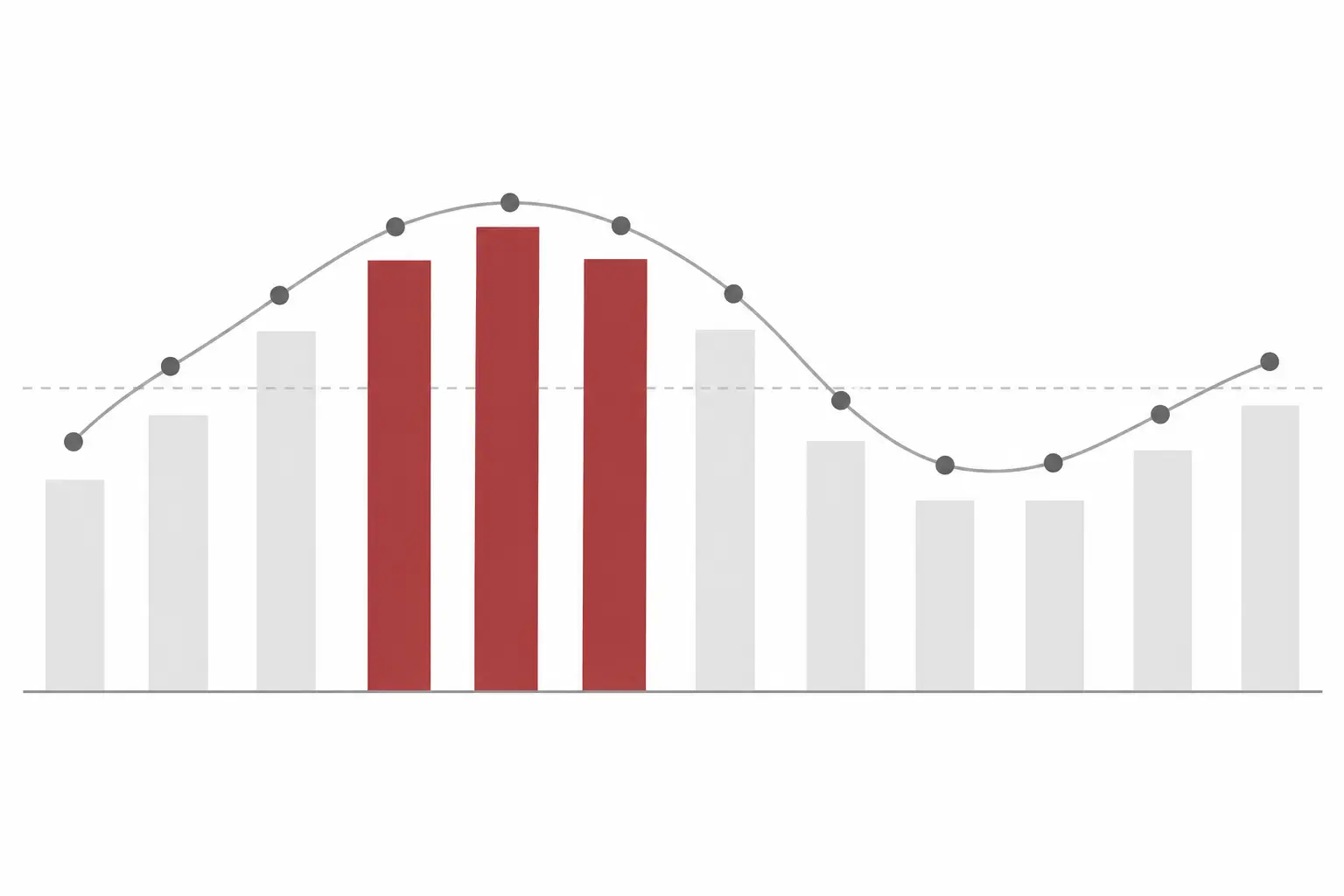
In Savannah and Coastal Georgia, mid-April through early June is typically the best window to sell, with May the single strongest month. Homes listed in the peak spring window sell for roughly 1.3% more than the average week of the year. But your equity, your micro-market (Pooler vs. Historic District vs. Tybee), and your reason for selling often matter more than the calendar month.
If you look only at national housing data, the picture is pretty clear.
Spring consistently produces the strongest buyer demand.
Research from the National Association of Realtors and seasonal market reports from Realtor.com Research show that buyer activity typically builds through March, reaches its strongest period from mid-April through early June, and gradually eases through the second half of summer.
Savannah generally follows that same pattern.
But only generally.
Our market has characteristics that make it different from many other cities.
Military relocations create year-round demand around Hunter Army Airfield and Fort Stewart. Coastal tourism influences buyer behavior near Tybee Island. Historic neighborhoods attract a different buyer than suburban Pooler. Then there’s hurricane season, which starts changing buyer psychology long before an actual storm ever develops.
Those local factors matter.
January and February
These months are often overlooked, but I don’t consider them weak selling months.
Inventory is usually lower. Serious buyers remain active. Corporate relocations and military transfers continue throughout winter, and buyers searching during January are often motivated rather than casually browsing.
Fewer showings don’t necessarily mean fewer offers.
Sometimes they simply mean higher-quality buyers.
March through early June
This is typically the strongest stretch of the year.
Families want to move before the next school year begins.
Military households receive new orders.
Weather improves.
More buyers become comfortable making offers.
Homes also photograph better. Landscaping begins to recover, outdoor living spaces become more inviting, and longer daylight hours make scheduling easier for both buyers and photographers.
This combination creates the strongest balance between buyer demand and seller leverage.
If I had to choose one selling window for most Savannah homeowners, it would almost always be somewhere between the middle of April and early June.
Late June and July
The market usually remains healthy.
The challenge isn’t buyer demand.
The challenge is competition.
As more homeowners decide they’ve waited long enough, inventory grows. Buyers suddenly have more choices. A home that would have received multiple offers six weeks earlier now competes against several similar properties.
That’s why pricing becomes much more important as summer progresses.
August and September
This is where Coastal Georgia separates itself from many inland markets.
According to the National Hurricane Center’s historical Atlantic hurricane data, August and September represent the most active period of Atlantic hurricane season.
Even when no storm is threatening Savannah, buyers become more cautious.
I hear questions like:
* Is the property in a flood zone?
* How old is the roof?
* What does flood insurance cost?
* Has the property experienced storm damage?
* What are the evacuation requirements?
* Are insurance premiums increasing?
Those questions don’t stop sales.
They simply make buyers more selective.
October through December
Fall and early winter are quieter, but they aren’t dead markets.
The buyers shopping during this period usually have a reason to move.
Job relocations.
Military transfers.
Retirement plans.
Year-end tax planning.
Holiday schedules reduce overall activity, but sellers also face fewer competing listings.
A properly priced home with strong presentation can still perform very well during this period.
The Savannah difference
One mistake I see all the time is homeowners assuming every neighborhood follows exactly the same seasonal pattern.
They don’t.
Pooler remains relatively consistent because military families, healthcare professionals, and new construction buyers create steady demand throughout the year.
Historic Savannah follows its own rhythm. Buyers often search specifically for historic architecture, walkability, or investment opportunities. They don’t always behave like traditional suburban buyers.
Tybee Island is different again.
Vacation-home buyers and investors often begin shopping earlier because they want time to prepare the property before peak rental season begins. That can shift buyer activity ahead of the broader Savannah market.
Bottom line, national statistics give you the general trend.
Your neighborhood determines how closely your home follows it.
Why mid-April to early June wins (and what it actually costs you to wait)
Every homeowner eventually asks the same question.
“Does selling at the right time really make that much difference?”
In many cases, yes.
Research published by Realtor.com has consistently shown that homes listed during the strongest spring window can sell for approximately 1.3% more than the average week of the year, while also attracting stronger buyer demand.
That sounds like a small number.
It isn’t.
A 1.3% difference on a $400,000 home equals roughly $5,200.
On a $600,000 property, it’s approximately $7,800.
On an $800,000 home, the difference approaches $10,400 before considering negotiation leverage, reduced carrying costs, or fewer price reductions.
That’s real money.
But here’s where many sellers misunderstand the data.
Timing alone doesn’t create that premium.
The premium comes from entering the market when motivated buyers outnumber comparable listings.
That’s an important distinction.
The right month gives you leverage.
It doesn’t replace good pricing.
When the calendar does NOT matter as much as people think
People love to ask, “What’s the best month to sell?”
I usually answer with another question.
Why are you selling?
Your reason for moving often matters more than the month on the calendar.
I’ve seen sellers delay for months trying to catch the “perfect” market while paying another six months of mortgage payments, taxes, insurance, utilities, and maintenance. By the time they finally listed, they had given back much of the extra money they hoped to gain.
Sometimes waiting helps.
Sometimes waiting becomes expensive.
Here are a few situations where I tell clients not to let the calendar control the decision.
PCS and military relocations
Around Hunter Army Airfield and Fort Stewart, PCS moves don’t wait for spring.
If you’ve received orders, your priority is usually certainty, not squeezing out one more percentage point.
Holding a home after you’ve relocated creates two households to manage. Vacant properties still require maintenance. Insurance costs continue. Lawn care doesn’t stop because you’ve moved.
A clean, well-priced listing today is often a better financial decision than hoping next spring produces a slightly stronger market.
Downsizing
Many homeowners planning to downsize spend months waiting for the “right” selling season.
Meanwhile, the home they’re hoping to buy may also become more expensive.
Remember, you’re participating in two markets.
You’re selling one home and buying another.
Sometimes selling during a slightly slower market also means purchasing your next home with less competition.
The math often works out better than people expect.
Inherited property
Inherited homes are rarely improved by sitting vacant.
Deferred maintenance grows.
Insurance requirements can change.
Small repairs become larger ones.
Utilities continue.
The emotional burden also grows with time.
Unless significant improvements are planned, delaying simply because it’s November instead of April usually isn’t the deciding factor.
Divorce or financial hardship
Life doesn’t always cooperate with the housing calendar.
When a sale is tied to legal deadlines or financial pressure, speed and certainty usually outweigh seasonal advantages.
The focus should be maximizing the net proceeds within the timeline you actually have.
Builder competition
I have an active example right now.
A seller in Port Wentworth is competing against new construction from a national builder nearby.
The home itself is excellent.
The challenge isn’t the calendar.
The challenge is that the builder can offer incentives such as rate buydowns, closing-cost assistance, and upgrade packages.
That’s a reminder that competition sometimes matters far more than the month.
Bottom line, don’t build your selling strategy around the calendar alone.
Build it around your goals.
The micro-market wrinkle: Pooler vs Historic District vs Tybee
| Month | Buyer demand | Inventory / competition | Seller leverage | What to know |
|---|---|---|---|---|
| January | Moderate | Low | Solid | Fewer showings but serious, motivated buyers; low competition. |
| February | Moderate, rising | Low | Solid | Relocations and military transfers continue through winter. |
| March | Strong | Building | Strong | Demand builds ahead of the spring peak; homes photograph better. |
| April | Very strong | Balanced | Highest | Mid-April opens the peak window: strong demand, balanced supply. |
| May | Peak | Balanced | Highest | Typically the single strongest month for net proceeds. |
| June (early) | Very strong | Rising | High | End of the prime window; competition starts to increase. |
| Late June–July | Healthy | High | Moderate | Demand holds, but more listings make pricing critical. |
| August–September | Moderate | Moderate | Moderate | Peak Atlantic hurricane season; buyers ask more insurance and flood questions. |
| October–December | Lower | Low | Moderate | Quieter but not dead; motivated relocation, retirement and tax-driven buyers, fewer competing listings. |
General seasonal pattern for Coastal Georgia based on National Association of Realtors and Realtor.com seasonal research; your neighborhood and pricing determine how closely your home follows it.
One of the biggest mistakes I see comes from treating Savannah as one housing market.
It isn’t.
There are dozens of smaller markets operating at the same time.
Each one has different buyers, different inventory levels, and different seasonal patterns.
Pooler
Pooler remains one of the steadiest markets in Coastal Georgia.
Military families, Gulfstream employees, healthcare workers, logistics professionals, and relocating buyers create demand throughout the year.
New construction also plays a major role.
Builders constantly introduce inventory, incentives, and financing promotions.
That means resale sellers have to compete with brand-new homes.
Timing helps.
Pricing helps even more.
Historic District
Historic Savannah has an entirely different buyer pool.
Many buyers aren’t simply looking for a house.
They’re looking for architecture.
Walkability.
Historic charm.
Income potential.
Lifestyle.
Those buyers often wait months for the right property.
Because inventory is limited, exceptional homes can perform well outside the traditional spring selling season.
The right buyer isn’t necessarily shopping in April.
They’re shopping when the right historic property becomes available.
Tybee Island
Tybee follows another rhythm altogether.
Vacation-home buyers and investors often begin their search earlier than primary-residence buyers.
Many want enough time to prepare the property before the strongest rental season.
Insurance costs, flood zones, rental regulations, and projected income all become major parts of the buying decision.
That means presentation alone isn’t enough.
Buyers want documentation.
They want answers.
They want certainty.
Midtown Savannah
Midtown usually behaves closer to the traditional residential cycle.
Families often drive demand.
School calendars matter.
Commute times matter.
Inventory changes have a noticeable impact on pricing.
This is where pricing strategy often determines whether a home receives immediate attention or sits for weeks waiting for reductions.
One city. Many markets.
People often ask me how the Savannah market is performing.
My answer is usually the same.
“Which Savannah market?”
Pooler isn’t Historic Savannah.
Historic Savannah isn’t Tybee.
Tybee isn’t Port Wentworth.
The broader market gives us direction.
Your neighborhood determines your strategy.
That’s why I encourage homeowners to review current Savannah home values before deciding when to list.
The pricing-strategy lesson: timing is a tool, not a wish
This is probably the biggest lesson I’ve learned over the years.
Timing helps.
Pricing sells.
I once worked with a sub-$400,000 Savannah seller who entered the market during an excellent seasonal window.
Everything looked right.
The timing.
The photography.
The marketing.
The home showed well.
The problem was price.
Buyer feedback was consistent from the first week.
Traffic slowed.
Showings decreased.
I recommended a planned price adjustment.
The seller wanted to wait.
A few more weeks passed.
Inventory increased.
The market gave us the same answer over and over.
Eventually, the seller agreed to follow the adjustment strategy.
The result?
The property went under contract in just two days.
Nothing magical happened.
The house didn’t suddenly become better.
The timing hadn’t changed.
The market simply responded once the price matched buyer expectations.
I’ve seen another version of this with a Midtown Savannah homeowner in roughly the $520,000 range.
They wanted to test the market above my recommended pricing strategy.
We received activity early, but buyers consistently viewed the home as overpriced.
Price reductions came later than they should have.
The property eventually sold.
The problem was what happened afterward.
The seller moved into South Carolina, but because the pricing strategy started too high, they walked away with less equity than they likely would have captured with stronger pricing discipline from the beginning.
That’s money that could have gone toward their next home.
Another current example involves a Port Wentworth listing competing directly against new construction.
The resale home is attractive.
The builder next door is offering financing incentives and closing-cost assistance.
Those incentives influence buyers immediately.
No calendar can overcome that.
Our response has to be pricing, positioning, and presentation.
That’s why I always say timing is a tool, not a wish.
The right month gives you an opportunity.
Your pricing strategy determines whether you capitalize on it.
If you’re unsure where your home fits in today’s market, start with an instant Savannah home value estimate, then compare that information with how to price your Savannah home in 2026 and should you sell your Savannah home in 2026 before deciding on your listing date.
Frequently Asked Questions
When is the best month to sell a house in Savannah Georgia?
For most homeowners, May is typically the strongest individual month, with the broader selling window running from mid-April through early June. Buyer demand is generally highest during this period, although neighborhood conditions, pricing, and inventory still play major roles.
Should I list my Savannah home in spring or summer?
Spring is usually the better choice because buyer demand is stronger while inventory remains relatively balanced. Summer can still be successful, but additional competing listings often make pricing strategy more important.
How much more do Savannah homes sell for in peak season?
National housing research has shown that homes listed during the strongest spring selling period may achieve approximately 1.3 percent higher sale prices than the average listing week. Actual results vary by neighborhood, condition, and pricing strategy.
Is fall a bad time to sell in Coastal Georgia?
No. Fall attracts a smaller but motivated group of buyers including relocations, retirees, and military families. Proper pricing and presentation remain the biggest factors for success.
Will hurricane season hurt my Savannah home sale?
Hurricane season can increase buyer questions regarding flood insurance, roof condition, and storm history, but it does not stop homes from selling. Preparation and documentation help reduce buyer concerns.
Should I wait for next spring if I am thinking about selling now?
Not necessarily. Waiting should be weighed against carrying costs, mortgage payments, insurance, taxes, maintenance, changing inventory levels, and mortgage rate trends. The right decision depends on your individual situation.
How quickly should I list once I decide to sell?
Begin preparing your home immediately after deciding to sell. Completing repairs, decluttering, staging, photography, and pricing analysis before peak season often produces stronger results.
Final thoughts
Every year, someone asks me what the perfect month is to sell a home.
My answer is always the same.
There isn’t one.
There is only the right strategy for your situation.
The homeowners who consistently achieve the strongest results aren’t chasing the calendar. They’re preparing early, pricing honestly, listening to market feedback, and making decisions based on facts instead of hope.
Timing can improve your outcome.
Preparation determines it.
If you’re wondering what your home could sell for today, start with my free Coastal Georgia home value calculator. Then let’s compare that estimate with a professional Comparative Market Analysis so you understand your true position in today’s market. If you’d like to talk through your timing, pricing strategy, or neighborhood trends, give me a call at 912-351-8935. I’d be happy to help you build a plan that fits your goals, whether you’re ready to list next month or next year.




Join The Discussion