

By Alex Rodino, U.S. Army veteran (Capt.) · Licensed GA REALTOR® #443565 · MRP
Published August 17, 2026 · Last updated August 17, 2026 · About 10 minutes
TL;DR: Closing costs in Georgia are paid by both sides, because the buyer and the seller each have their own set of line items. JVM Lending and Houzeo both put a Georgia buyer’s costs at roughly 2% to 5% of the purchase price, while the seller pays the agreed commissions, the Georgia real estate transfer tax, and their own payoff and settlement items. Every one of those lines is negotiable inside the purchase contract, so custom is only the starting point. Georgia is also an attorney closing state, so a licensed Georgia attorney runs the table and disburses the money.
Important: I am a licensed real estate agent, not a lender, attorney, or tax professional, and nothing here is financial, legal, or tax advice. Every figure below is a typical range or a published rate from the named source, not a quote for your deal. Your Loan Estimate and Closing Disclosure are the real numbers.
How closing costs work in Georgia (and why an attorney runs your closing)
Closing costs are the fees, taxes, insurance, and prepaid items due the day ownership changes hands, separate from the down payment. In Georgia they split across two settlement statements, one per side, and a licensed Georgia attorney sits in the middle and disburses the money. That attorney is not optional. In Formal Advisory Opinion 04-1, approved by the Supreme Court of Georgia in 2006, the court stated that “the closing of a real estate transaction in this State constitutes the practice of law, and, if performed by someone other than a duly-licensed Georgia attorney, results in the prohibited unlicensed practice of law.” That is why a Georgia attorney, not a title company employee, hands you the pen.
Federal rules set the timing. The Consumer Financial Protection Bureau says “the lender must provide you a Loan Estimate within three business days of receiving your application,” and that lenders are required to provide your Closing Disclosure three business days before your scheduled closing. The CFPB is also blunt about who carries the load: “When you are buying a home you generally pay all of the costs associated with that transaction.” The seller’s costs are real, but they come out of proceeds, which is why the two sides experience closing day so differently.
The line items: what buyers pay vs what sellers pay
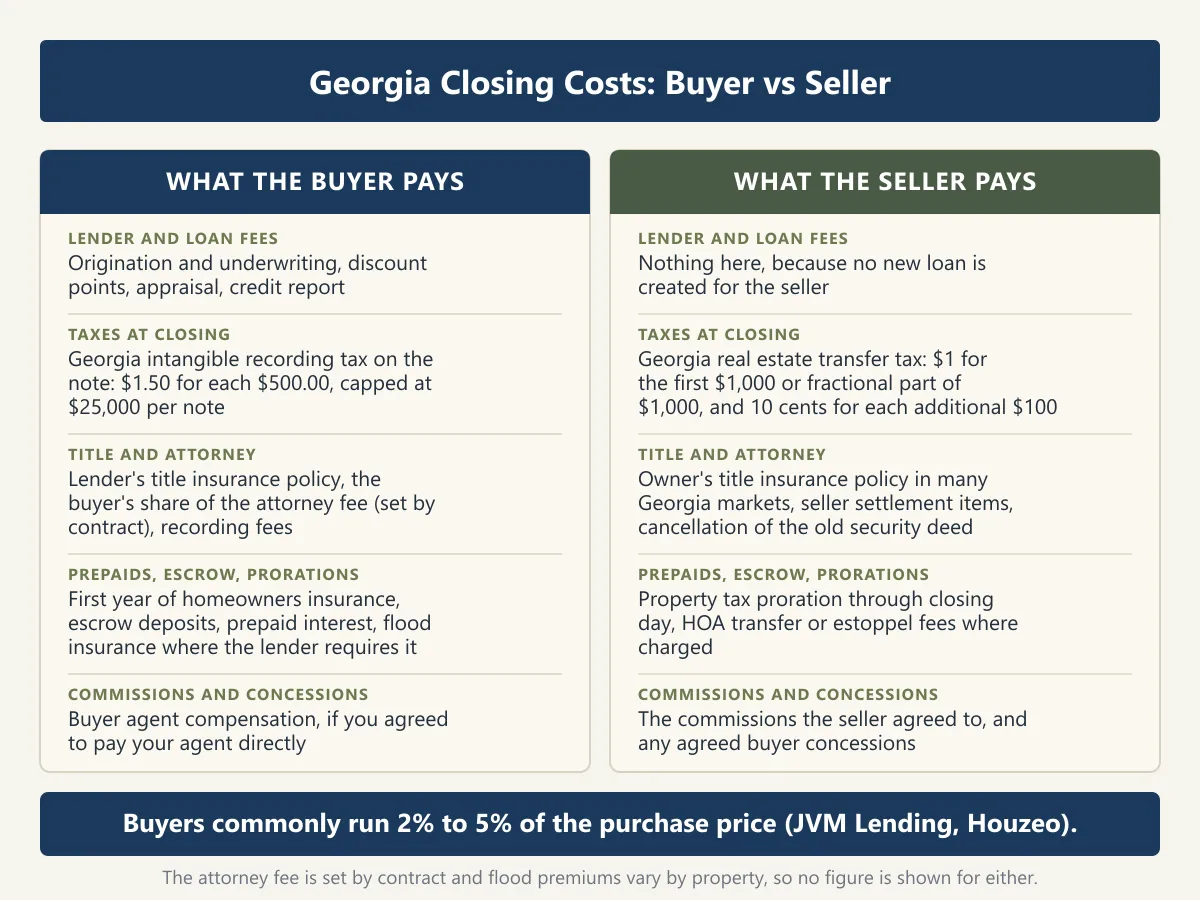
Buyers pay for the loan, the title work protecting that loan, and the money that has to sit in escrow before the first payment. Sellers pay the agreed commissions, the state transfer tax, their payoff, and their share of the year’s property taxes. Here is the whole board, grouped by which side each line lands on. One thing to settle first: some sources quote closing costs as a percent of purchase price and some as a percent of the loan, which is exactly why the numbers online never agree. Everything here is a percent of the purchase price.
| Group | What the buyer pays | What the seller pays |
|---|---|---|
| Lender and loan fees | Origination and underwriting (the cost of making the loan). Discount points, optional (cash to buy the rate down). Appraisal (the lender’s opinion of value). Credit report. | Nothing here, because no new loan is created for the seller. |
| Taxes at closing | Georgia intangible recording tax on the note. The Georgia Department of Revenue sets it at “$1.50 for each $500.00 or fractional part of the face amount of the note,” capped at $25,000 per note. Long-term notes only: under Department of Revenue Informational Bulletin 2025-02, that means principal falling due more than 62 months out. | Georgia real estate transfer tax. The Department of Revenue formula is “$1 for the first $1,000 or fractional part of $1,000 and at the rate of 10 cents for each additional $100.” The Department puts the legal liability on the seller, though contracts often shift it. |
| Title and attorney | Lender’s title insurance policy (protects the lender’s lien, not your equity). The buyer’s share of the attorney fee, set by contract. Recording fees: Georgia went flat on January 1, 2020 under HB 288, and county schedules such as Gwinnett County’s list $25.00 per instrument. | Owner’s title insurance policy in many Georgia markets. No law assigns it, so treat it as custom the contract can override. Seller settlement items such as deed preparation and payoff handling, plus recording the cancellation of the old security deed. |
| Prepaids, escrow, and prorations | First year of homeowners insurance. Escrow deposits for future taxes and insurance. Prepaid interest from closing day to the first payment. Flood insurance where the lender requires it: FEMA’s mandatory purchase rule covers buildings in a Special Flood Hazard Area with a federally backed loan, which reaches plenty of Chatham, Bryan, and Liberty county parcels. | Property tax proration through closing day. Chatham bills on a calendar year, so the seller credits the buyer for their share. HOA transfer or estoppel fees where charged. |
| Commissions and concessions | Buyer agent compensation, if you agreed to pay your agent directly and the seller is not covering it. Since the NAR settlement practice changes took effect August 17, 2024, a written buyer agreement is signed before your agent shows you a home. | The commissions the seller agreed to, negotiable and no longer published as offers of compensation in the MLS. Any agreed buyer concessions. |
Now the percentages, named source by named source, because they genuinely disagree. JVM Lending says Georgia “buyers generally pay 2 to 5% of the purchase price in closing costs,” and puts sellers at 1 to 3% excluding commissions, or 6 to 9% with them. Houzeo agrees on the buyer side and puts sellers at roughly 5% to 10% of the home’s value. Lower averages near 1.3% circulate too, but those studies typically strip out taxes, escrows, and commissions, and some are years old. Rocket Mortgage sits at the other end near 4.3% of sale price. The spread is a basket problem, not a math problem, and 2% to 5% of purchase price is the safe planning number.
Paying cash? You skip the lender fees, the lender’s title policy, and the intangible tax, because that tax attaches to the note. You still pay the attorney, title work, and recording.
Who pays what, and what is actually negotiable
The purchase contract decides who pays what in Georgia, and custom is only the opening position. The Department of Revenue puts legal liability for the transfer tax on the seller, the intangible tax rides with the loan onto the borrower’s statement, and the rest is negotiation. What limits that negotiation is your loan program, because lenders cap what a seller may pay toward your costs. Those caps have conditions attached:
- Conventional loans. Fannie Mae’s Selling Guide caps interested party contributions on a principal residence or second home at 3% when LTV or CLTV is above 90%, 6% between 75.01% and 90%, and 9% at 75% or less. Investment property is capped at 2%. The percentage runs on the lower of sales price or appraised value, not the loan amount.
- FHA loans. Seller contributions are limited to 6% of the sale price under HUD Handbook 4000.1. Anything above that reduces the sales price used to calculate the loan, dollar for dollar, and concession money can never become your down payment.
- VA loans. The VA Lender’s Handbook treats a seller concession above 4% of the established reasonable value as excessive. Standard closing costs the seller pays are not counted as concessions, so the practical total can exceed 4%.
“At the closing table I tell every first-time buyer the same thing: the concession you negotiate is only worth what your loan program lets the seller actually pay. I get that cap from the lender in writing before we write the offer, not after.”
Alex Rodino
Whether a concession is realistic depends on the listing, not the market. Around Savannah I have far more success asking on a home that has been sitting than on a fresh listing in Pooler or Richmond Hill with showings booked all weekend. The CFPB makes the tradeoff plain: a seller giving you a credit “will usually require you to pay a higher price for the home in order to cover the costs of this credit.” A concession is a financing tool, not free money.
A worked example at the Savannah median price
Here is the shape of the math on a median-priced Savannah home. Zillow’s Savannah market page reported a median sale price of $333,083 as of May 31, 2026. I am rounding to $335,000 so the arithmetic stays readable, and labeling every assumption.
Seller side at $335,000
The transfer tax is the one number I can calculate exactly, because the Department of Revenue publishes the formula: $1.00 for the first $1,000, then 10 cents per additional $100. On $335,000 that is $334,000 of additional value, or 3,340 increments, which is $334.00, plus the first dollar. Total Georgia transfer tax: $335.00. That is the honest version of the “about $1 per $1,000” shortcut.
Commissions are the seller’s biggest line, and they are negotiated, not set. A seller who agreed to a total of 5% across both sides would pay $16,750 here. That 5% is an illustration I picked for clean math, not a market rate and not my rate. Add the mortgage payoff, $25.00 to record the cancellation, seller settlement items, the owner’s title policy if the contract leaves it there, and the tax proration.
Buyer side at $335,000
Assume 10% down, so a loan of $301,500 on a 30 year note. The intangible recording tax is $1.50 per $500 of face amount: $301,500 divided by $500 is 603 increments, times $1.50, so $904.50. That is well under the $25,000 cap, and a 30 year note falls due far beyond 62 months, so it is long-term and the tax applies. Recording the security deed is another $25.00 flat.
Everything else on the buyer side is quoted, not calculated: origination, appraisal, credit report, the lender’s title policy, the attorney fee, the first year of insurance, escrow deposits, prepaid interest, and flood insurance in a Special Flood Hazard Area. At the 2% to 5% range JVM Lending and Houzeo both publish, that is roughly $6,700 to $16,750 on a $335,000 purchase. Your numbers will differ, and they should. This is the shape of the math, not a quote.
Selling instead of buying? What you want is the net, not the gross. Start with a real number for the home on my home value page, then read my breakdown of real estate commissions in Savannah after the NAR settlement, because commissions move your net far more than the transfer tax ever will.
How Savannah buyers can cut their closing costs
Three levers genuinely move a buyer’s cash to close in Georgia: shop the lender, negotiate a concession inside your program’s cap, and check whether you qualify for assistance. Everything else is noise.
Shop the lender. The Loan Estimate exists so you can compare offers side by side on the same form. Get two or three, and read the fees and the rate together rather than one at a time.
Negotiate a concession. Ask on the right listing, and keep the request inside the Fannie Mae, FHA, or VA limits above so it does not get cut back at underwriting.
Check the assistance programs. Georgia’s Department of Community Affairs runs Georgia Dream: 5% of the purchase price up to a maximum of $10,000 for standard borrowers, and 6% up to a maximum of $12,500 under the PEN track for public protectors, educators, healthcare workers, and active military, and under the Choice track for households with a family member living with a disability. Inside city limits, the City of Savannah’s Housing and Neighborhood Services Department runs Dream Maker, a deferred loan for down payment, closing costs, and gap financing. The city’s published brochure, last revised in 2019, sets tiers by location and income, so confirm current amounts with the department before you rely on them.
One more thing for military buyers at Fort Stewart and Hunter Army Airfield, veteran to veteran: your loan type changes both the concession cap and the fee structure, so bring the lender in before you write the offer.
Know your numbers before you sign
Buyers who get surprised at the closing table are almost never surprised by the big stuff. They budgeted the down payment and the commission conversation. What gets them is the prepaid block: a full year of homeowners insurance, months of taxes into escrow, and prepaid interest, all at once. I had a Pooler buyer last year who had the down payment nailed to the dollar and had not planned a cent of it.
Buying? Send me the neighborhood and the price range and I will walk you through the real cash to close before you offer. Selling? Want the net after every line item? Start with what your home is worth on my home value page and I will build the net sheet.
Call me at 912-351-8935 or text 912-210-8967. No pressure, and I usually respond the same day.
Not financial, legal, or tax advice: I am a real estate agent, not a lender, attorney, or tax professional. The figures above are typical ranges and published rates from the named sources, not a quote for your transaction. Your Loan Estimate and Closing Disclosure are the real numbers. Confirm every specific with your lender and your closing attorney before you sign.
Frequently asked questions
These are the questions I get at the closing table and on first calls.




Join The Discussion