

Last updated: June 30, 2026
TL;DR: Whether you should sell your Savannah or Coastal Georgia home in 2026 comes down to seven honest questions. Most are about your life. A couple are about the market. Walk through them in order. If five of seven point the same way, you have your answer. Free instant home-value estimate at the calculator below.
I’ve had hundreds of these first conversations. Same seven questions every time, in the same order. By question 5, most sellers already know what they want to do. Not because I pushed them. Because the answer was already sitting there. They just needed a clean way to see it. Selling a home in Savannah, Pooler, Richmond Hill, Wilmington Island, Tybee Island, Rincon, Port Wentworth, or Hinesville should start with options, not pressure.
The 7 questions I ask every Savannah seller
Question 1: What is your equity reality?
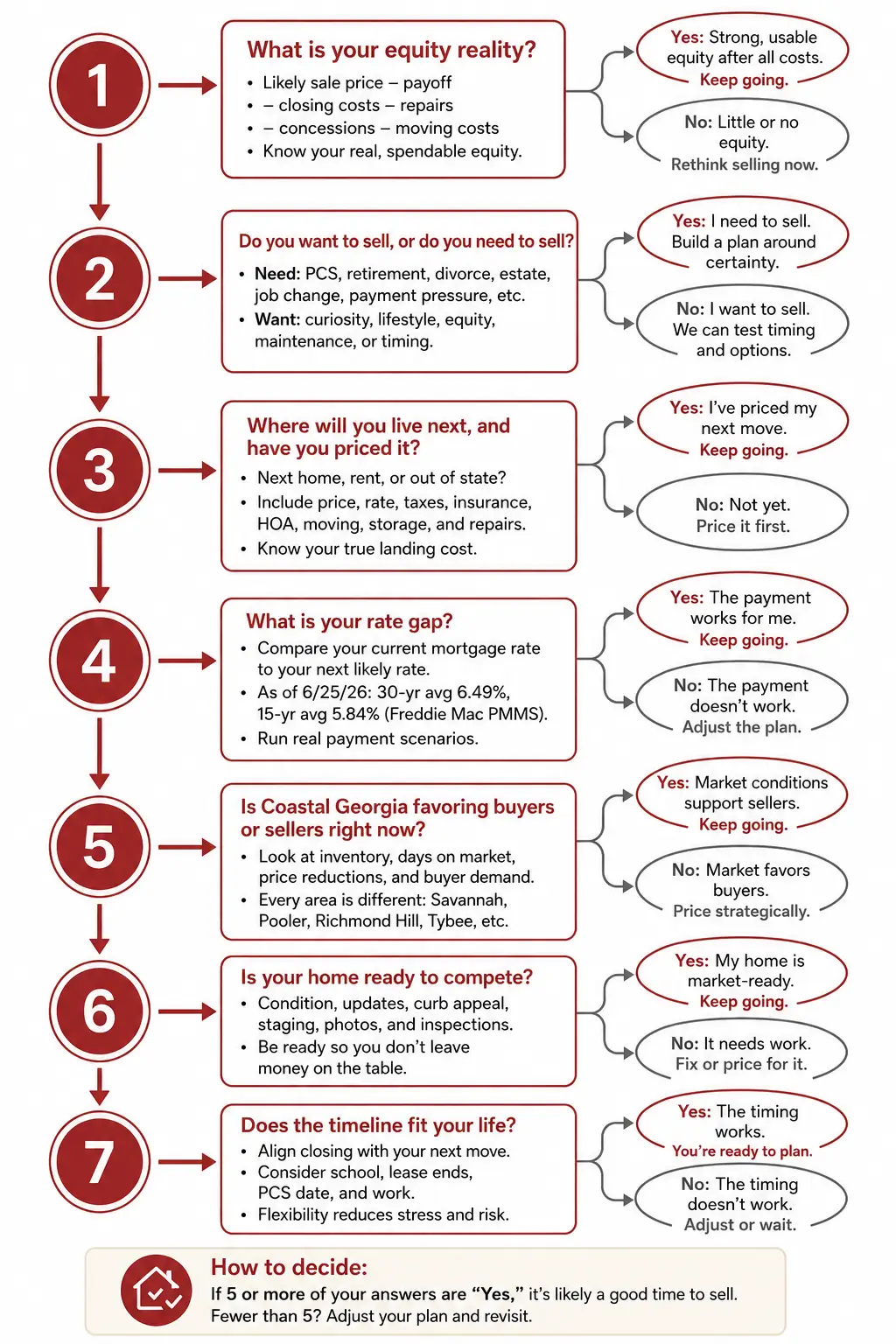
First thing, we look at equity. Not your Zestimate. Not what your neighbor says. Not what you need to make the next move feel good. Real equity is your likely sale price minus your payoff, closing costs, repairs, concessions, and moving costs. That number matters because it tells you whether selling gives you room to breathe or just moves stress from one address to another.
This is where a real CMA matters. The FRED Savannah MSA All-Transactions House Price Index is useful for broad price direction, but your street, condition, flood zone, school zone, insurance profile, and competing listings matter more. A house in Ardsley Park does not price like one in Port Wentworth. A home near new construction in Pooler has a different fight than a historic home downtown.
Bottom line, paper equity is not spendable equity. Get the real number first. You can also see what your Savannah home could sell for today before we build the deeper pricing picture.
Question 2: Do you want to sell, or do you need to sell?
Want and need are not the same thing. Need means a PCS, retirement, divorce, estate situation, job change, family care issue, payment pressure, or a house that no longer fits your life. Want means you are curious, tired of maintenance, tempted by equity, or wondering whether this is the right moment to make a move.
I ask this early because it changes the whole strategy. If you need to sell, we build around certainty. Clean timeline. Realistic pricing. Fewer surprises. If you want to sell, we can be more selective. We can test the number, improve the home, wait for a better season, or compare selling against renting.
I had a Coastal GA homeowner considering renting first. She thought the question was, “Should I sell?” After walking through the seven questions, the real question was, “Should I rent it and see how it feels?” That was the right frame. The right question gets you closer to the right answer.
Question 3: Where will you live next, and have you priced it?
This is where sellers get caught. They know what they might sell for, but they have not priced the next step. That next step could be another home in Savannah, a move to Richmond Hill, downsizing in Pooler, heading closer to family, renting for a year, or buying out of state. Whatever it is, price it before you list.
Do not just ask, “What can I sell for?” Ask, “What will it cost me to land well on the other side?” That includes the next purchase price, rent, mortgage rate, insurance, taxes, HOA dues, moving costs, storage, temporary housing, and repair money.
I worked with a repeat-client couple in Coastal Georgia who had already bought once, then had to decide whether renting suited their next chapter. We ran the same framework backwards. Renting did not fit them. Shortly after, they bought again. That is the point. The framework is not pro-selling. It is pro-clarity.
Question 4: What is your rate gap?
The rate gap is simple. What is your current mortgage rate, and what would your next rate likely be? If you have a low fixed rate from a few years ago, selling can feel expensive even when your home has gained value. That does not mean you should stay. It means the math needs to be honest.
As of June 25, 2026, Freddie Mac’s weekly Primary Mortgage Market Survey showed the average 30-year fixed mortgage rate at 6.49%, with the 15-year fixed rate at 5.84% on that release date, according to Freddie Mac PMMS weekly mortgage rate averages. Your personal rate will depend on credit, loan type, down payment, points, occupancy, and lender pricing.
Here is the tell. If selling improves your life but the new payment scares you, do not guess. Talk to a lender before you list. Get payment scenarios. Get cash-to-close estimates. Then decide. A good move can still be a bad move if the monthly payment does not work.
Question 5: Is Coastal Georgia favoring buyers or sellers right now?
This is the first market question, and it comes after the life questions on purpose. The market matters, but it should not outrank your actual life. Savannah is not one single market. It is a collection of small markets. Historic District, Midtown, Wilmington Island, Pooler, Richmond Hill, Rincon, Hinesville, and Tybee Island can all behave differently at the same time.
National contract activity gives us a temperature check. NAR’s Pending Home Sales Index measures signed contracts and generally leads closed sales by a month or two, according to the NAR Pending Home Sales Index latest release. But local leverage comes from active inventory, days on market, price reductions, builder competition, insurance friction, condition, and buyer demand at your price point.
A Port Wentworth seller competing with a builder next door needs a different plan than a well-kept Wilmington Island home with limited nearby competition. Same county, different leverage. That is why I pair market data with a street-level CMA and current Savannah home values.
Question 6: How long can you wait without losing leverage?
Time is leverage until it is not. If you can wait, you may have options. You can prep better, choose your listing window, fix obvious objections, watch competing inventory, and avoid rushing into a weak offer. If you cannot wait, the strategy changes. Then speed, certainty, and clean terms matter more.
This question is especially important for military families, estate sellers, retirees, and sellers moving for work. I had an active-duty retiree planning a move to South Carolina. The seven questions made the answer clear. He needed to list and time the transition around his orders. Waiting was not really leverage. Timing was.
Ask yourself what happens if the home does not sell in 30 days, 60 days, or 90 days. Can you carry it? Can you reduce the price if needed? Can you handle two payments? Can you keep the home show-ready? If the answer is no, price and prep need to be tight from day one.
Question 7: What is your tolerance for showings and moving stress?
Some sellers are ready for showings. Some are not. That is not a character flaw. It is a planning issue. Kids, pets, work-from-home schedules, elderly parents, tenants, military timing, repairs, and daily life all affect how realistic a listing process will feel.
Here are the tells. If you dread every showing before the house is even listed, we need a tighter showing plan. If the home needs work and you do not have the energy, we need to price that honestly. If you want top dollar but cannot keep the home clean or available, those goals conflict. You can want convenience or maximum exposure. Sometimes you can get both, but do not assume it.
A good listing plan respects real life. That may mean fewer showing windows, stronger pre-list prep, professional photos, clear showing instructions, temporary storage, or delaying the launch until the home can compete. Stress does not disappear because a sign goes in the yard. Plan for it.
When 5 to 7 questions point to “sell” (what to do next)
If five to seven questions point toward selling, do not jump straight to the sign in the yard. That is where sellers make expensive mistakes. The next move is not “list it.” The next move is to tighten the plan.
Start with a real CMA. Not a quick opinion. A real one. That means looking at recent sales, active competition, pending competition, price reductions, condition, floor plan, location, flood zone, insurance issues, and what buyers are currently choosing at your price point. This is also where you should review how to price your Savannah home in 2026. Pricing is not about being cheap. It is about being accurate enough to create leverage.
Second, consider a pre-listing inspection. You do not have to fix everything. But you should know what can spook a buyer before the buyer tells you. Roof age, HVAC condition, crawlspace moisture, wood rot, plumbing, electrical, drainage, and insurance-related issues all matter in Coastal Georgia. You cannot expect what you do not inspect.
Third, talk to your next-step lender if you are buying again. Do not list based on vibes. Confirm payment range, cash needed, loan type, rate assumptions, and timing. The NAR research and statistics hub is useful for broad buyer and seller behavior, but your move depends on your numbers.
Fourth, set a 90-day plan. That gives you time to prep, price, launch, negotiate, inspect, appraise, and close without turning the whole thing into a fire drill. Use the free Coastal Georgia home value calculator as your first checkpoint, then request a CMA if the number makes sense.
When 3 or more point to “wait” (alternatives that aren’t selling)
If three or more answers point toward waiting, that does not mean you failed the test. It means selling may not be the cleanest option right now. Good advice is not always “sell.” Sometimes the best move is to hold the asset, improve the asset, or give yourself a cleaner runway.
Option one is to refresh the home and re-evaluate. Paint, flooring, landscaping, light fixtures, deep cleaning, decluttering, minor repairs, and exterior touch-ups can change how a home competes. You do not need to renovate everything. You need to remove the obvious objections. Buyers forgive less when rates are higher and insurance is expensive. Small friction adds up.
Option two is refinance, if the math works. This depends on your current loan, equity, credit, and the rate environment. Do not refinance just because you are tired of the payment. Compare the total cost, new term, break-even point, and whether it actually solves the problem.
Option three is renting it out. That works for some sellers and backfires for others. Run the rent, vacancy, repairs, management, insurance, taxes, HOA restrictions, and stress load. A house can look like a good rental on paper and still be a poor fit for your life. If you are weighing that path, read the math on whether to sell or rent your Savannah home.
Option four is list later. Savannah and Coastal Georgia have seasonal windows, but the right window depends on your submarket and price point. Waiting with a plan is strategy. Waiting because you are avoiding the decision is just delay.
Why the order of the 7 questions matters

Most agents start with, “What do you want for it?” I think that is the wrong first question. Price matters, but price is not the starting line. Options are.
When I sit down with a seller in Savannah, Pooler, Richmond Hill, Wilmington Island, Tybee, Rincon, Port Wentworth, or Hinesville, I want to know what selling is supposed to solve. Are we solving for timing, cash, less maintenance, family, military orders, retirement, payment pressure, or a better lifestyle fit? Once we know that, the price conversation gets easier.
The order matters because each question filters the next one. Equity tells us whether selling gives you room. Want versus need tells us how flexible we can be. The next housing plan tells us whether the move is realistic. The rate gap tells us whether the new payment works. The market tells us how hard the house will have to compete. Timeline tells us how much leverage we have. Stress tolerance tells us how to structure the process.
That is options-first. It is no-pressure, but it is not passive. I will tell you when the math looks strong. I will also tell you when waiting is smarter. A fast yes is not the goal. A clear answer is the goal.
Homeowners also need to understand ownership patterns and local tenure. The Census ACS housing data for Chatham County can help frame how many households own versus rent, but your decision still comes down to your home, your next step, and your tolerance for risk. Data helps. Judgment finishes the job.
If you want the cleanest first step, get an instant Savannah home value estimate. Then we can pressure-test it against real comps, active competition, buyer demand, and your seven answers.
Frequently asked questions
Should I sell my Savannah home now or wait?
Sell now if your equity, timeline, next housing plan, rate math, and stress tolerance all line up. Wait if the move creates more pressure than it solves. I usually tell sellers to count their seven answers. If five or more point toward selling, it is worth building a real plan. If three or more point toward waiting, slow down and compare alternatives before listing.
Is Savannah a buyer's market or seller's market in 2026?
Savannah isn’t one market; it’s many. Pooler, Richmond Hill, the Historic District, and Tybee can favor buyers or sellers at the same time depending on inventory, days on market, and builder competition. Check active inventory and price reductions in your specific submarket rather than relying on a citywide label.
Will Coastal Georgia home prices drop in 2026?
No one can promise a direction, but local price movement depends on your submarket, inventory, mortgage rates, and insurance costs more than national headlines. Broad indexes like the FRED Savannah MSA series show the trend; your street, condition, and competition determine your actual price.
How quickly can I find out what my Savannah home is worth?
You can get an instant home-value estimate in under a minute using the free calculator on this page. That’s your starting number. A real CMA, which weighs comps, condition, flood zone, and active competition, gives you the accurate figure you’d actually list on.
How long does a typical Savannah home sale take?
From listing to closing, a well-priced, well-prepared Savannah home commonly takes around 30 to 60 days, plus roughly 30 days for the buyer’s financing to close. Pricing, condition, and your submarket’s demand can shorten or extend that, so speak with a local agent for a timeline on your specific home.
What if I don't have to sell, should I still consider it?
Maybe. If you only want to sell, you have room to be selective: test the number, improve the home, time the season, or compare selling against renting. Walk through all seven questions first. If three or more point toward waiting, holding or refinancing may serve you better than listing.
If you are thinking about selling in Savannah or anywhere across Coastal Georgia, start with the number. Use the free instant home-value calculator, then request a real CMA if the estimate makes sense. No pressure. Just clarity. You can also call 912-351-8935 and ask what your seven-question answer looks like.



Join The Discussion