

Selling a Parent’s House in Georgia After They Pass: A Step-by-Step Roadmap for Heirs

  • 10 hours ago
  • Blog
  • 0
Coastal Georgia inherited home with a Savannah-style front porch, representing the inherited property heirs may sell after a parent's death

Published May 19, 2026 · Last updated May 20, 2026

Quick answer for heirs: In most cases, selling a deceased parent’s house in Georgia requires probate through the county probate court (Chatham County for Savannah-area homes). The personal representative must obtain Letters Testamentary or Letters of Administration before signing for the property. A typical uncontested sale takes 6 to 9 months from filing to closing, with total costs to the estate usually running 8% to 15% of the sale price. Heirs generally choose among three paths: list as-is on the MLS, do a light fix-and-list, or accept a private off-market cash offer.

Losing a parent leaves you with a hundred small decisions on top of the one big loss. Somewhere on that list, usually further down than feels right, is the question of what to do with their house. Maybe it is the home you grew up in. Maybe it is a place they retired to that you barely know. Either way, it is now partially yours, and you did not ask for the responsibility.

This guide is written for adult children in Savannah, Pooler, Richmond Hill, Rincon, and the rest of Coastal Georgia who have just become responsible for a parent’s home. It walks through what Georgia law usually requires, what the Chatham County Probate Court process looks like in real time, what the sale may cost the estate, and what your real options are: listing it on the open market, doing a light fix-and-list, or accepting a private off-market offer when speed or privacy matters more than squeezing out the last few percent of sale price.

No legal jargon you do not need. No sales pitch. Just the roadmap a working Coastal Georgia broker would lay out for a friend over coffee.

If you are already deep in this process, our Private Options conversation is the fastest way to figure out what fits your family.

What has to happen before you can sell a parent’s house in Georgia?

Direct answer: Before you can sell, a personal representative (executor or administrator) must be granted legal authority by the Georgia probate court — usually in the form of Letters Testamentary or Letters of Administration — so the home’s title can be transferred or signed for at closing. The only exceptions are a revocable living trust, joint tenancy with right of survivorship, or a valid transfer-on-death deed properly recorded under O.C.G.A. § 44-17-2.

Before you can sell a deceased parent’s home in Georgia, someone needs the legal authority to sign for the property. In plain English, the title has to transfer correctly before a sale can close.

That does not always mean a full probate process, but it often does. The right path depends on how the home was titled, whether your parent had a will or trust, whether there are creditors, and whether all heirs agree.

When you do not need probate

Some homes can transfer outside of a standard probate administration.

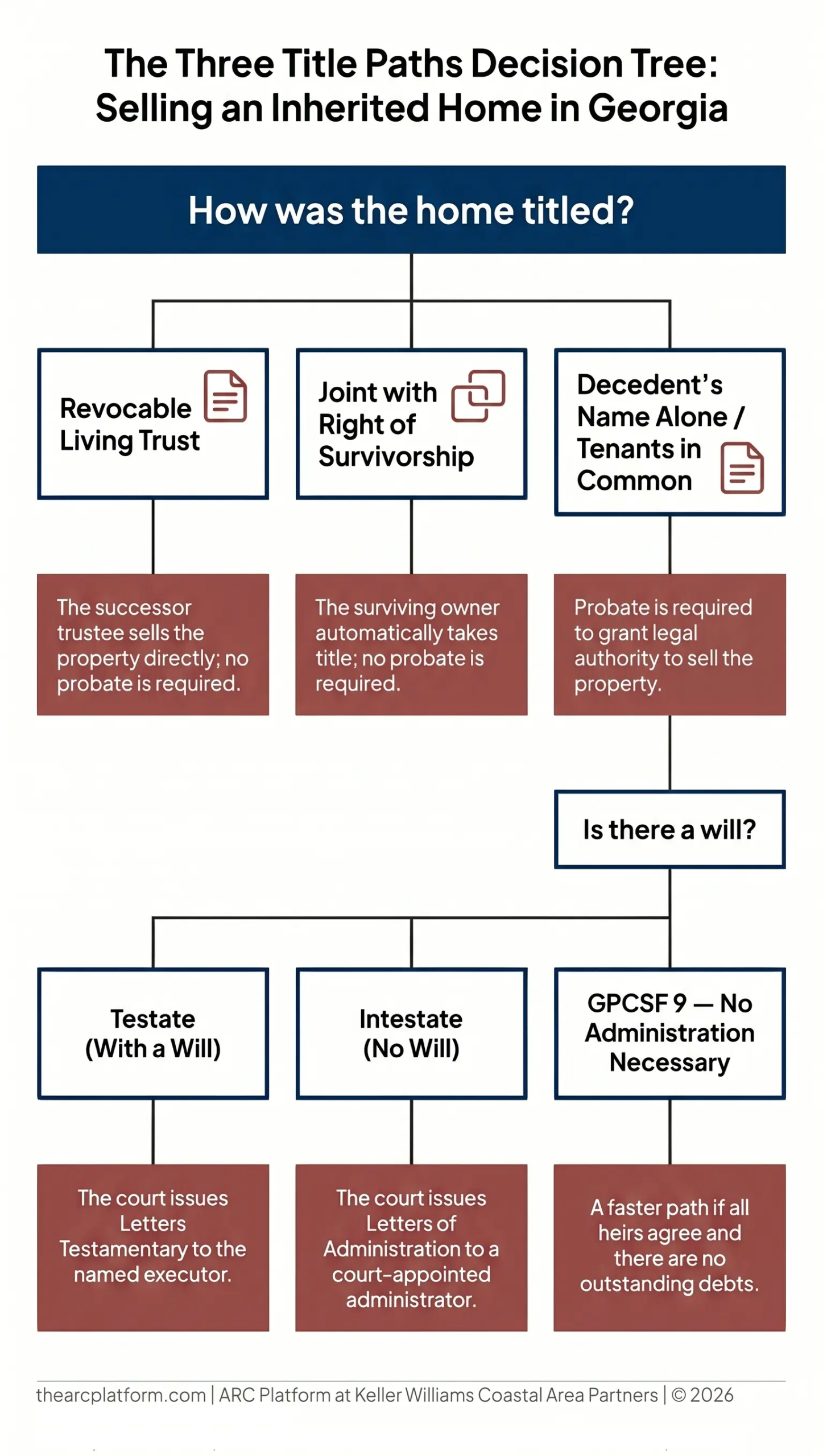
If the home was held in a revocable living trust, the successor trustee may be able to sell the home directly under the trust documents. If the home was held jointly with right of survivorship, the surviving co-owner usually receives ownership automatically.

Georgia also now allows transfer-on-death deeds for real estate. Under O.C.G.A. § 44-17-2, an interest in real estate may be titled in transfer-on-death form by recording a deed that names a designated beneficiary. For deaths occurring on or after July 1, 2024, the beneficiary must record the required affidavit and supporting documents with the superior court clerk in the county where the property is located within nine months of the owner’s death, or the interest reverts to the estate.

That last point matters because older national articles may still say Georgia does not recognize TOD deeds for real estate. That used to be true. It is no longer the current rule.

When probate is required, which is the common case

Probate is usually required when your parent owned the home in their name alone, or when they owned a partial interest as a tenant in common.

If your parent had a valid will, the court may appoint the named executor and issue Letters Testamentary. If your parent died without a will, or if the named executor cannot serve, the court may appoint an administrator and issue Letters of Administration.

For a Chatham County estate, filings are handled through Chatham County Probate Court at 133 Montgomery Street, Room 509, Savannah, GA 31401. The court accepts filings Monday through Friday, excluding holidays, from 8:00 a.m. to 4:30 p.m.

The “No Administration Necessary” option in Georgia

Georgia also has a faster probate path called “No Administration Necessary,” handled through Georgia Probate Court Standard Form 9 (often called GPCSF 9).

This path may apply when all heirs agree on how the estate should be divided and there are no debts, or all creditors consent. It can be used whether or not your parent left a will. In Chatham County, the Probate Court forms page lists the Petition for Order Declaring No Administration Necessary under GPCSF 9. Confirm current fees and notice requirements through the court before filing.

Decision tree infographic showing the three Georgia title transfer paths when selling an inherited home: revocable living trust (successor trustee sells, no probate), joint with right of survivorship (surviving owner takes title, no probate), and decedent's name alone or tenants in common (probate required)

The Chatham County probate timeline at a glance

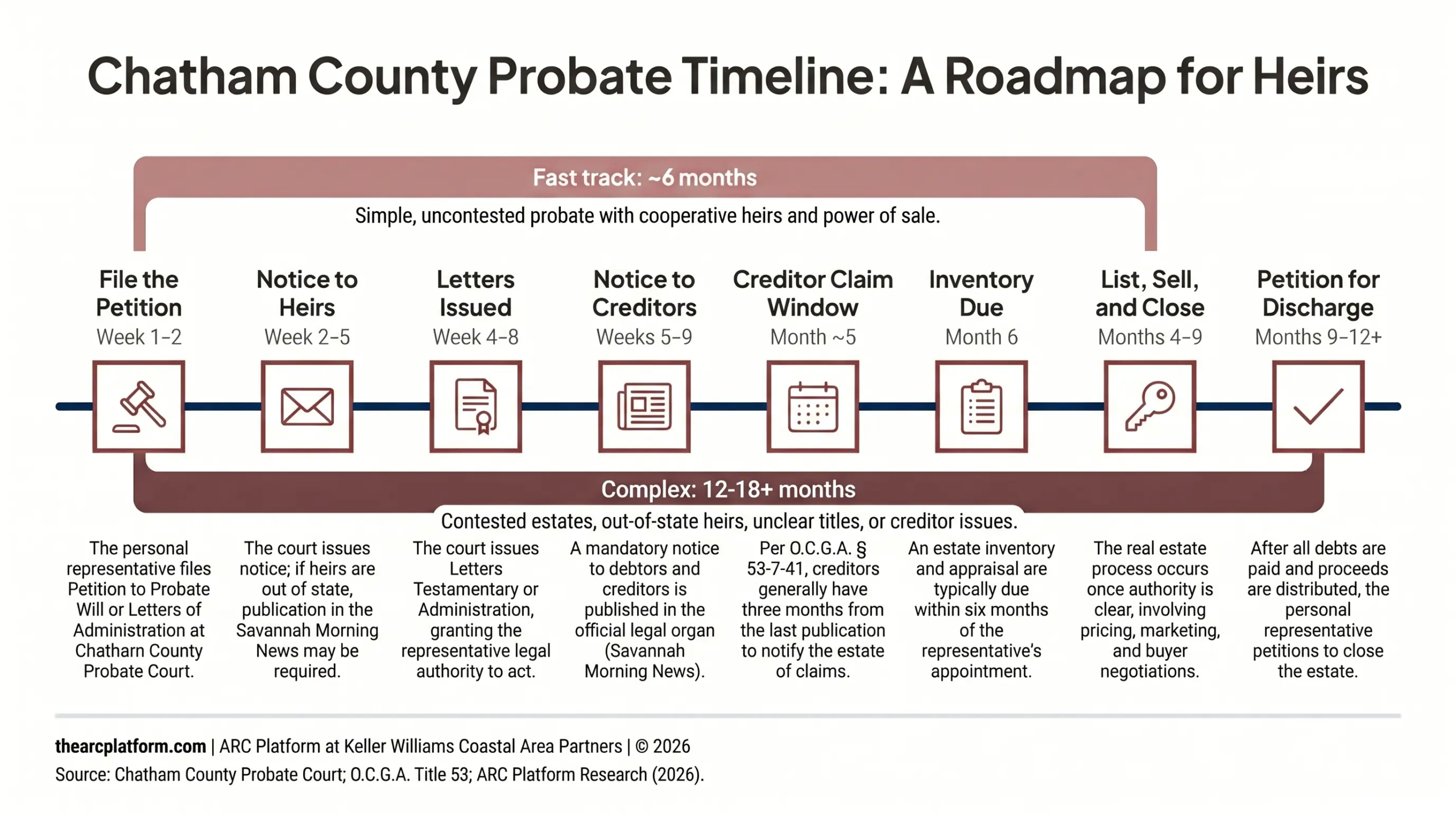
Direct answer: An uncontested Chatham County probate where the executor has express power of sale typically takes 6 to 9 months from filing to closing. Contested estates, multi-heir disputes, out-of-state heirs, or title issues can extend that to 12 to 18 months or longer.

The biggest mistake families make is assuming the home can be sold the same way it would be sold if the owner were still alive. Sometimes it can move quickly. Often, there are built-in waiting periods that shape the whole timeline.

Here is a practical Chatham County probate timeline for heirs selling a deceased parent’s house in Georgia.

Phase

Time

What happens

File the petition

Week 1 to 2

The personal representative files the Petition to Probate Will or Petition for Letters of Administration with Chatham County Probate Court at 133 Montgomery Street, Room 509, Savannah. Base filing fee is approximately $160 plus $2 per page (Chatham County, as of mid-2026).

Notice to heirs

Week 2 to 5

The court issues notice. If heirs are unknown, out of state, or addresses are unknown, publication in the Savannah Morning News (Chatham County’s official legal organ) may be required. Approximately $185 per publication, as of mid-2026.

Letters issued

Week 4 to 8

Once the court approves the petition, it issues Letters Testamentary or Letters of Administration. The personal representative now has authority to act. Certified copies of Letters are approximately $10 each.

Notice to creditors

Weeks 5 to 9

The personal representative publishes Notice to Debtors and Creditors in the Savannah Morning News. Approximately $185 per publication, as of mid-2026.

Creditor claim window

Plus 3 months

Under O.C.G.A. § 53-7-41, creditors generally have three months from the last publication of notice to notify the personal representative of claims.

Inventory due

Within 6 months

Estate inventory and appraisal are typically due within six months unless waived by the will or by proper court process.

List, sell, and close

Months 4 to 9

The real estate process depends on whether the executor has express power of sale or needs court approval. This is where ARC helps with pricing, condition strategy, MLS exposure, private options, and buyer negotiation.

Petition for discharge

Months 9 to 12+

After debts are paid, taxes are handled, and proceeds are distributed, the estate can move toward closing.

Realistic Chatham County timeline

A simple, uncontested Chatham County probate where the will gives the executor power of sale and there are only one or two cooperative heirs typically runs 6 to 9 months from filing to closing. A contested estate, an estate with multiple out-of-state heirs, unclear title, creditor issues, or no express power of sale can run 12 to 18 months or longer.

Before publishing, verify the latest fee and publication amounts through the Chatham County Probate Court forms page and the court’s filer resources. Probate fees and notice rates can change.

Chatham County Georgia probate timeline infographic for heirs selling a deceased parent's house, showing the fast-track 6-month uncontested path and the complex 12-18 month path, with phases for filing the petition, notice to heirs, letters issued, notice to creditors, creditor claim window, inventory due, list and sell, and petition for discharge

What do you need to do in the first 30 days?

Direct answer: The first 30 days are about protecting the property, finding the paperwork, and getting the right people involved — not pricing or listing. Focus on death certificates, the original will, securing the home, insurance, the property file, a probate attorney, and a local broker who understands probate sales. The first 30 days are not about choosing a list price. They are about protecting the property, finding the paperwork, and getting the right people involved before small problems become expensive ones. Start with these steps:
  • Order certified death certificates. Get more than you think you need. Ten certified copies is a practical starting point because banks, insurers, title companies, attorneys, and court filings may each require one.
  • Find the original will and any trust documents. Georgia probate usually requires the original will. A copy may create extra steps.
  • Secure the home. Change the locks, remove obvious valuables, forward mail to a trusted address, and make sure someone is checking the property regularly.
  • Call the homeowner’s insurance carrier. Do not assume the policy works the same way once the home is vacant. Many policies have vacancy or occupancy conditions that matter after 30 to 60 days.
  • Gather the property file. Pull the deed, mortgage statement, tax bill, utility accounts, HOA information, insurance policy, alarm codes, keys, leases, and any contractor records.
  • Contact a Georgia probate attorney. Even if the estate seems simple, a short early conversation can prevent months of delay.
  • Talk with a Coastal Georgia broker who understands probate sales. Our team can help you think through timing, condition, pricing, privacy, and whether it makes sense to list it on the MLS or consider an off-market option.
If the home is in Savannah, Pooler, Richmond Hill, Rincon, Garden City, Wilmington Island, Skidaway, or nearby, it may also help to compare the inherited property against local buyer demand. ARC’s neighborhood guides for Pooler, Richmond Hill, and Rincon can help heirs understand where the home fits in the current Coastal Georgia market.

What does selling a parent’s house in Georgia actually cost?

Direct answer: Selling a parent’s house in Coastal Georgia typically costs the estate 8% to 15% of the sale price once probate fees, legal publications, executor commission, attorney fees, real estate commission, transfer tax, and prep costs are added together. The estate, not the heirs personally, generally pays these costs out of sale proceeds. The estate usually pays the costs connected to probate, property preparation, sale, and closing. The exact number depends on the estate, the home, the county, the attorney, the condition of the property, and the sale strategy. Here is a practical cost breakdown for selling an inherited home in Savannah or Coastal Georgia, with typical ranges as of mid-2026.
Cost Typical amount Who pays
Probate filing fee ~$160 base + $2 per page (Chatham County, as of mid-2026) The estate
Savannah Morning News legal publications ~$185 per notice. Most estates require two publications (heirs notice and creditor notice), so plan on ~$370 total. The estate
Certified copies of Letters Testamentary or Administration ~$10 each. Most personal representatives need 5 to 10 copies. The estate
Probate attorney fees Typically $1,500 to $5,000 for an uncontested Coastal Georgia estate. Higher if contested or if the estate has unusual assets. The estate
Executor commission 2.5% of money received into the estate + 2.5% of money paid out, unless the will specifies otherwise (O.C.G.A. § 53-6-60). The estate (paid to the executor)
Real estate commission Negotiable. Recent Georgia market practice often lands around 4.5% to 6% combined, depending on listing terms and buyer-broker compensation strategy. The estate
Seller closing costs Georgia transfer tax of $1 per $1,000 of sale price, plus title work, attorney closing fees, prorations, payoff fees, and any negotiated buyer concessions. The estate
Cleanout, repairs, or staging $500 to $15,000+, depending on condition. The estate
The most important number is not the gross sale price. It is the net amount the estate keeps after probate costs, holding costs, repairs, commissions, closing costs, and time. That is why we usually run more than one scenario for heirs. A house that could sell for more after repairs may still net less if the repairs take four months, require out-of-state coordination, trigger family conflict, or expose serious defects. On the other hand, a home that looks rough may only need paint, landscaping, cleaning, and better presentation to unlock a much stronger sale. Use these numbers as typical Coastal Georgia planning ranges as of mid-2026. Before making a final decision, confirm current court fees through Chatham County Probate Court, confirm current publication requirements through the court’s Attorney and Pro Se Filer Resources, and confirm legal costs with your probate attorney.

Sell as-is, fix-and-list, or take a private cash offer?

Direct answer: There is no single right path. Sell as-is on the MLS when the home is in decent shape and time is not critical. Do a light fix-and-list when cosmetic work will materially improve the sale. Take a private cash offer when speed, privacy, distressed condition, or family stress matter more than squeezing out the last few percent of price. Once the legal authority is moving, the next question is practical: how should the estate sell the house? There is no one right answer. The right path depends on the home’s condition, the heirs’ timeline, whether anyone lives out of state, whether siblings agree, and whether the family wants privacy.
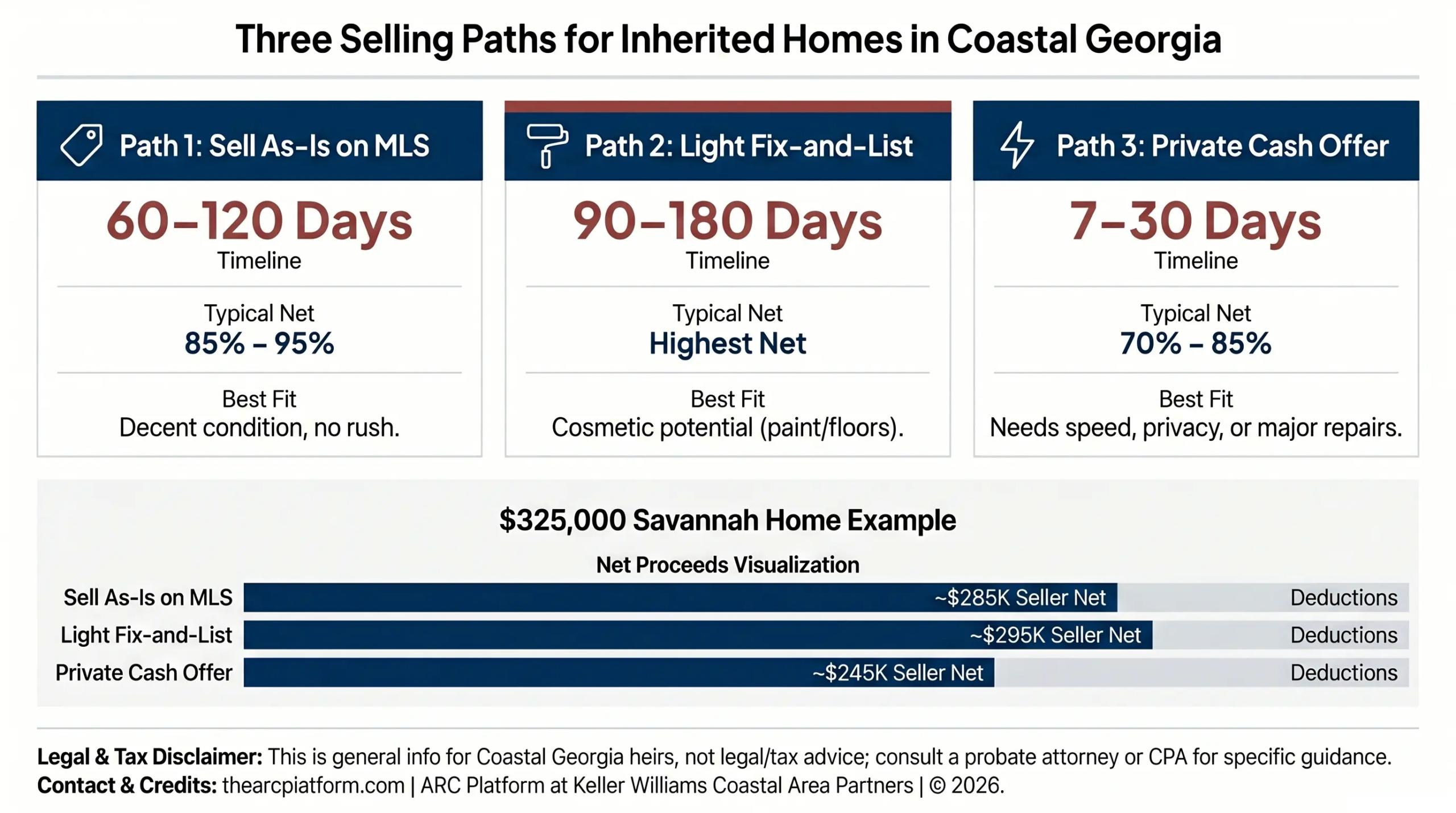
Option Time Typical net to estate Best fit when
Sell as-is on MLS 60 to 120 days 85% to 95% of market The property is in decent shape, heirs are not in a rush, and MLS exposure should create competitive offers.
Light fix-and-list 90 to 180 days Often the highest net The home needs cosmetic work like paint, floor refinishing, cleaning, landscaping, or minor repairs, but not major structural work.
Private cash offer or Private Options 7 to 30 days 70% to 85% of market Heirs need speed or privacy, the home is distressed, repairs are hard to manage, or the family wants to avoid repeated showings during grief.
Savannah’s current market should also shape the decision. For up-to-date median sale prices, see the Redfin Savannah housing market page or Georgia MLS data. These are planning numbers, not guarantees. The point is to compare net, speed, certainty, and stress side by side. Side-by-side comparison of three paths for selling an inherited home in Coastal Georgia: sell as-is on MLS (60-120 days, 85-95% of market), light fix-and-list (90-180 days, highest net), or private cash offer (7-30 days, 70-85% of market), with a $325,000 Savannah home worked example Private Options ARC negotiates both paths: MLS listings and private off-market sales. The recommendation is based on what fits your family, not on pushing one sale method. Most heirs who reach out start with a no-pressure conversation about the property, the timeline, the legal stage, and whether Private Options make sense. Talk to ARC about Private Options.

What if siblings or co-heirs disagree about selling?

Direct answer: Start by getting every heir the same set of facts — probate status, estimated value, mortgage balance, repair needs, and likely net proceeds — before anyone hires a lawyer. From there, the usual paths are a documented buyout, a written living arrangement if one heir stays in the home, or, as a last resort, a court-ordered partition under O.C.G.A. § 44-6-160. Most inherited-home situations involve at least one disagreement. One sibling may want to sell fast. Another may want to keep the home. Someone may live out of state. Someone else may be handling the cleanout alone. The first step is not court. The first step is getting everyone the same information: probate status, estimated value, mortgage balance, repair needs, holding costs, and likely net proceeds.

When one heir wants to keep the home

A buyout can work when one heir wants the home and the others want cash. The cleanest version usually includes an independent appraisal, written agreement through the probate attorney, refinance or cash payment, and a deed transfer after the legal authority is clear. ARC can help with the valuation side so the family is not arguing from guesses.

When one heir wants to live in the home long-term

If one heir wants to stay in the home, the arrangement should be documented. That may mean rent paid to the estate or to the other heirs, responsibility for utilities, responsibility for maintenance, insurance expectations, and a clear plan for future sale or buyout. Do not leave this as a handshake agreement. Have the probate attorney document it.

When mediation fails

Georgia law allows a common owner of land to petition the superior court for partition when two or more people own property together and there is no agreement on how it should be divided. The partition process is outlined under O.C.G.A. § 44-6-160. Partition is the last resort. It can be slow, expensive, public, and hard on family relationships. In many cases, the better path is a mediated sale, a buyout, or a structured listing plan that everyone signs before the home goes live.

What are the tax implications of selling an inherited home in Georgia?

Direct answer: For most inherited Georgia homes, taxable gain is calculated using the federal step-up in basis under Internal Revenue Code Section 1014 — meaning the basis resets to the home’s fair market value on the date of death, not what your parent originally paid. That usually makes the tax bill far smaller than heirs fear, but appreciation after the date of death may still be taxable. The tax issue heirs most often misunderstand is basis. ARC is not a CPA firm, and this article is not tax advice. But here is the plain-English version: inherited property often receives a “step-up” in basis.

How step-up in basis usually works

Under federal tax rules, property acquired from a decedent generally uses a basis tied to the estate tax valuation date, commonly the date of death unless an alternate valuation date applies. This rule is addressed in Internal Revenue Code Section 1014. That can be extremely valuable. For example, say your parent bought a Savannah home in 1982 for $40,000. At the date of death, the home is worth $385,000. If the estate sells it for $395,000, the taxable gain is usually based on the difference between the sale price and the date-of-death value, not the difference between the sale price and the 1982 purchase price. That does not mean there is never tax. It means the calculation may be much better than many heirs fear.

How long do you have to sell to qualify for step-up?

There is no simple “sell within X days or lose step-up” rule for most inherited property. The basis issue is tied to the value at death or the legally applicable valuation date. However, appreciation after the date of death can still matter. If the home keeps rising in value before sale, that post-death gain may become taxable. If the home declines, the estate may have a different tax conversation. For many heirs, selling within 12 months keeps the valuation cleaner, reduces carrying costs, and lowers the chance that the property becomes a long-term management problem.

1099-S and the closing attorney

In Georgia, real estate closings are typically handled through a closing attorney. The closing may generate a 1099-S for gross sale proceeds, but the estate or heirs handle the actual tax reporting with their CPA.
Required disclaimer This article is general information for Coastal Georgia heirs, not legal or tax advice. ARC Platform is a real estate brokerage. For probate guidance, contact a Georgia probate attorney. For tax guidance, contact a Georgia-licensed CPA. We can refer.

Key terms heirs should know

Probate vocabulary trips up most families. Here are the terms used in this guide, in plain English.

Personal representative
The person granted legal authority by the probate court to act on behalf of the estate. Called an executor if named in a will, or an administrator if appointed by the court when there is no will.
Letters Testamentary
The court document issued to an executor named in a valid will, granting authority to manage and transfer estate assets including real estate.
Letters of Administration
The court document issued to an administrator when the decedent left no will, or when the named executor cannot serve. Functionally equivalent to Letters Testamentary for real estate sale purposes.
GPCSF 9 (No Administration Necessary)
Georgia Probate Court Standard Form 9. A faster probate path that may apply when all heirs agree on division and there are no debts, or all creditors consent.
Power of sale
Express authority granted in a will (or by court order) that lets the personal representative sell real estate without an additional petition. Without it, a separate court order is usually required to sell.
Step-up in basis
A federal tax rule (Internal Revenue Code Section 1014) that resets the cost basis of inherited property to its fair market value on the date of death, usually reducing taxable gain on a later sale.
Transfer-on-death (TOD) deed
A deed that designates a beneficiary to receive real estate on the owner’s death without probate. Authorized in Georgia under O.C.G.A. § 44-17-2 for deaths on or after July 1, 2024.
Partition
A court-ordered division or forced sale of jointly owned property when co-owners cannot agree. In Georgia, governed by O.C.G.A. § 44-6-160.
1099-S
The IRS form a closing attorney typically issues for gross real estate sale proceeds. The estate or heirs reconcile the actual taxable gain with their CPA.

Sources and references

Georgia statutes, court resources, and external references used in this guide. Verify current fees and procedures directly with the court before filing.

About the author

Alex Rodino is the founder of the Alexander Rodino Collective (ARC), a Coastal Georgia real estate firm serving Savannah, Pooler, Richmond Hill, Rincon, Garden City, Wilmington Island, Skidaway, and nearby communities. Alex works with heirs, estate fiduciaries, divorcing homeowners, and owners of distressed properties who need a calm, options-first approach to selling Coastal Georgia real estate. His practice combines traditional MLS listings with private off-market negotiation when speed, privacy, or condition matters more than squeezing out the last few percent of price.

Georgia Real Estate License: #443565
LinkedIn: linkedin.com/in/alexander-rodino-b69021408
Brokerage: Alexander Rodino Collective at Keller Williams Coastal Area Partners

This article is general information for Coastal Georgia heirs. It is not legal or tax advice. For probate guidance, contact a Georgia probate attorney. For tax guidance, contact a Georgia-licensed CPA.


Frequently asked questions

Do you have to pay taxes when you sell your deceased parent's house in Georgia?

Usually only on appreciation that occurred after the date of death, because of the federal step-up in basis rule. Confirm with a Georgia CPA. Every estate is different.

Yes, but the home cannot be sold or its title transferred until the personal representative obtains legal authority through Georgia probate court — typically Letters Testamentary (when there is a will) or Letters of Administration (when there is no will). The only exceptions are when the home was held in a revocable living trust (the successor trustee transfers it), jointly with right of survivorship (the surviving co-owner takes ownership automatically), or under a properly recorded transfer-on-death deed under O.C.G.A. § 44-17-2.

An uncontested Chatham County probate where the executor has express power of sale typically takes 6 to 9 months from filing the petition to closing on the home. Contested estates, multiple out-of-state heirs, unclear title, creditor disputes, or estates where the executor lacks express power of sale can extend the process to 12 to 18 months or longer. Built-in waiting periods — including the three-month creditor claim window under O.C.G.A. § 53-7-41 — shape most of that timeline.

The “No Administration Necessary” option is a faster Georgia probate path handled through Georgia Probate Court Standard Form 9 (GPCSF 9). It may apply when all heirs agree on how the estate should be divided and there are no outstanding debts, or all creditors consent. It can be used whether or not your parent left a will. In Chatham County, the petition is filed with the Probate Court at 133 Montgomery Street, Room 509, Savannah. Always confirm current fees and notice requirements with the court before filing.

Sometimes — but only in three specific situations. You can avoid probate if the home was held in a revocable living trust (the successor trustee sells under the trust documents), if it was titled jointly with right of survivorship (the surviving co-owner inherits automatically), or if a valid transfer-on-death deed was recorded under O.C.G.A. § 44-17-2 with the beneficiary affidavit filed within nine months of death for deaths on or after July 1, 2024. In every other case — including a parent who owned the home solely in their own name — Georgia generally requires probate before the home can be sold.

Both are court orders that give a personal representative legal authority over a Georgia estate, but they come from different starting points. Letters Testamentary are issued when your parent left a valid will and the probate court appoints the executor named in that will. Letters of Administration are issued when your parent died without a will, or when the named executor cannot or will not serve, and the court appoints an administrator instead. Both documents allow the personal representative to sign for the property, marshal assets, pay creditors, and ultimately close the sale of the home.

There is no version of this process that is easy. There are versions that are calmer, faster, and clearer than others, and most of the difference comes down to good information arriving early.

If you take one thing from this guide, take this: you do not have to make every decision this week. Georgia probate has built-in waiting periods for a reason. Use that time to talk to a probate attorney, talk to a CPA about the step-up in basis, and talk to a Coastal Georgia broker who has walked other families through this. Decide on a path before you decide on a price. Decide on a price before you decide on a buyer. The decisions stack in that order for a reason.

When you are ready for that broker conversation, ARC is here. We list parents’ homes on the open market when that path nets the family the most. We negotiate private off-market offers when speed, privacy, or condition matters more. And often we just answer questions for a few weeks while the family figures out what they want, with no obligation and no pressure.
Whatever path you choose, you do not have to walk it alone. 

Need a no-pressure valuation for an inherited home in Coastal Georgia?

If your family is deciding what to do with a parent’s home in Savannah, Pooler, Richmond Hill, Rincon, Garden City, Wilmington Island, Skidaway, or nearby, ARC can help you compare the real options.

Request a home valuation, ask about Private Options, or contact our team directly.

Phone: +1-912-351-8935

Email: info@thearcplatform.com

Form link: Request a home valuation

Join The Discussion