


By Alex Rodino, Founder, Alexander Rodino Collective | Serving Savannah & Coastal Georgia
Published: May 2026 | Last updated: June 2026
Alex Rodino is a licensed Georgia real estate agent with Keller Williams Coastal Area Partners.
Editorial disclosure: This guide is general information, not legal, tax, or financial advice. Confirm specifics with a licensed Georgia family law attorney, a CPA, and a licensed real estate agent before making any decisions. Alex Rodino is a licensed Georgia real estate agent with Keller Williams Coastal Area Partners. This guide is written from a real estate coordination perspective, not as legal advice.
Most Savannah couples selling a house during divorce have four real paths: a cooperative sale, a one-spouse buyout, a court-ordered sale, or a pre-divorce sale. Which one protects your equity, your tax position, and your timeline depends on cooperation level, mortgage status, and how Chatham County Superior Court is likely to view your specific facts. Here is how each option actually works in Georgia.
TL;DR
- In Georgia, the marital home is usually handled under equitable distribution rules, meaning fair division, not automatically 50/50.
- Couples in Savannah usually have four practical options: a cooperative sale, one-spouse buyout, court-ordered sale, or pre-divorce sale.
- A voluntary divorce home sale in Georgia usually works best when both spouses agree on valuation, pricing, access, repairs, and proceeds.
- A buyout can work, but only if the keeping spouse can refinance or otherwise remove the other spouse from the mortgage.
- Tax timing matters. IRS home-sale rules allow up to $250,000 of gain exclusion for qualifying single filers and up to $500,000 for qualifying married joint filers.
Table of Contents
- How Georgia law treats the marital home in a divorce
- Your four real options for the marital home
- The cooperation problem and how to solve it
- How equity is actually split with real Savannah examples
- Tax consequences you cannot ignore
- A realistic timeline for a Savannah divorce house sale
- How to choose the right agent when you are both choosing together
- 6 common mistakes that cost Savannah divorcing couples money
- When a fast cash sale actually makes sense
- Frequently asked questions
How Georgia Law Treats the Marital Home in a Divorce
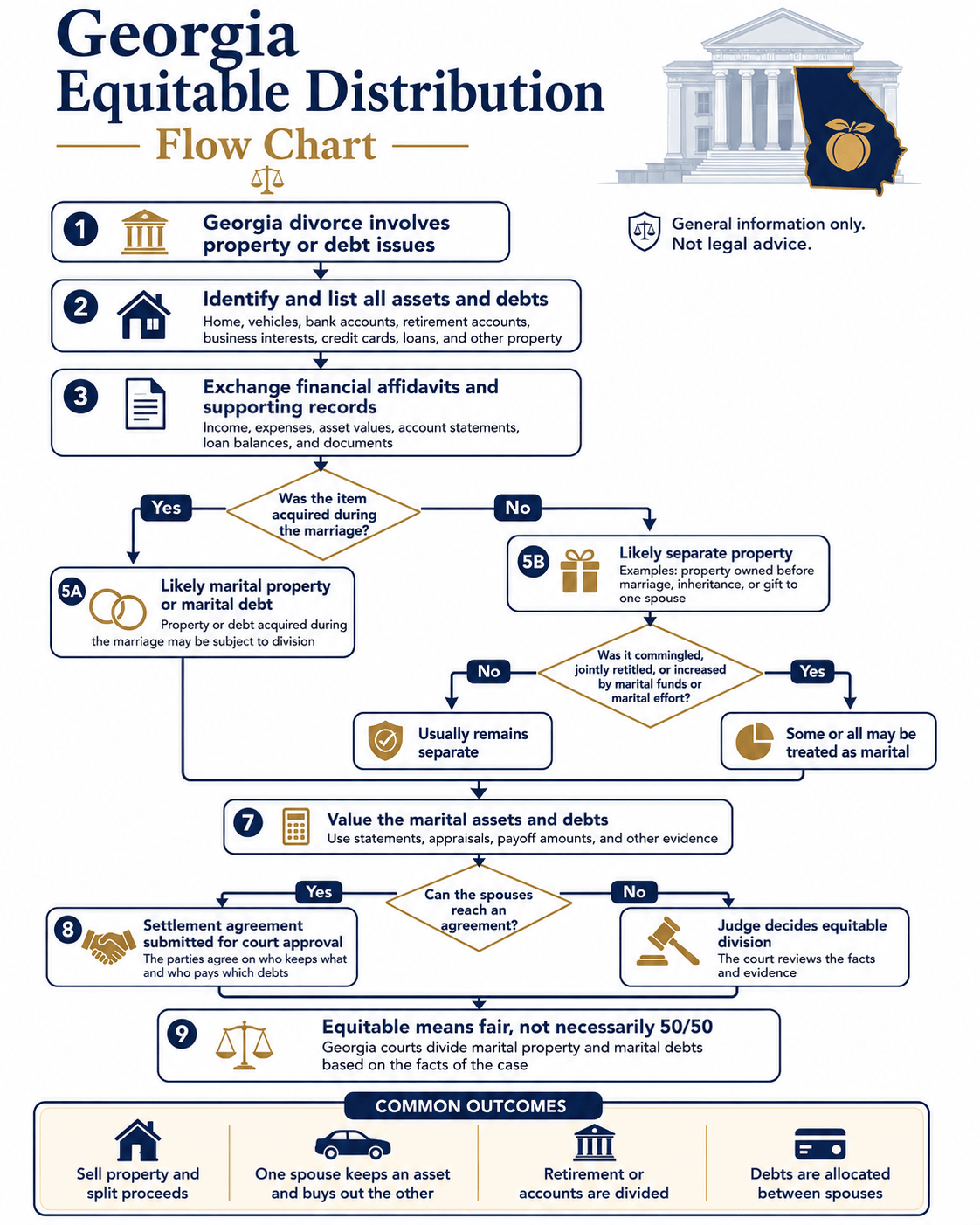
In Georgia, the marital home is generally handled through equitable distribution. That means the court looks for a fair division of marital property, not a guaranteed 50/50 split.
Equitable distribution explained simply
Georgia’s divorce property statute, O.C.G.A. § 19-5-13, says a property verdict in a divorce case can be carried out by judgment, decree, or the court’s equitable powers. In plain English, that gives the court a way to enforce a property division when spouses cannot resolve it themselves. (Justia Law)
What this actually means for you: the house is not automatically split down the middle just because you are divorcing in Savannah. A settlement, mediation agreement, or court order may divide the home equity equally, but the legal baseline is fairness based on the facts.
Marital property vs. separate property
A Savannah home may be marital property if it was bought during the marriage, paid for with marital income, improved with marital funds, or treated as a shared asset. A home may have separate-property components if one spouse owned it before the marriage, used premarital savings for the down payment, or received funds by inheritance or gift.
That does not make the issue simple. A house can be partly separate and partly marital. For example, one spouse may have owned a Wilmington Island home before marriage, but both spouses may have used marital income for mortgage principal, renovations, or major repairs during the marriage.
What “fair” actually means for a Chatham County judge
If the case is filed in Savannah, the divorce normally runs through Chatham County Superior Court’s Civil Division. Georgia.gov explains that divorce begins with the Clerk of the Superior Court in the county where either spouse has lived for at least six months. For Richmond Hill residents, that may mean Bryan County. For Rincon residents, it may mean Effingham County. (Georgia.gov)
A judge may consider financial contributions, non-financial contributions, child-related housing needs, separate-property claims, future financial needs, and whether one party can realistically afford the home after divorce. The same logic applies whether the property is in Pooler, Ardsley Park, Tybee Island, or another Savannah-area neighborhood.
Who can live in the home during the divorce
Unless there is an agreement or court order, the right to live in the marital home can become one of the first pressure points. Georgia court divorce forms include requests for temporary use and possession of the marital residence, which means possession can be addressed before the final decree in the right case. (georgiacourts.gov)
Most Savannah divorces never reach the point where a judge makes every call about the house. Couples settle, sometimes after difficult conversations. Knowing the default rules is what makes a practical settlement possible.
Talk to a licensed Georgia family law attorney about your specific situation. This guide is general information, not legal advice.
Your Four Real Options for the Marital Home
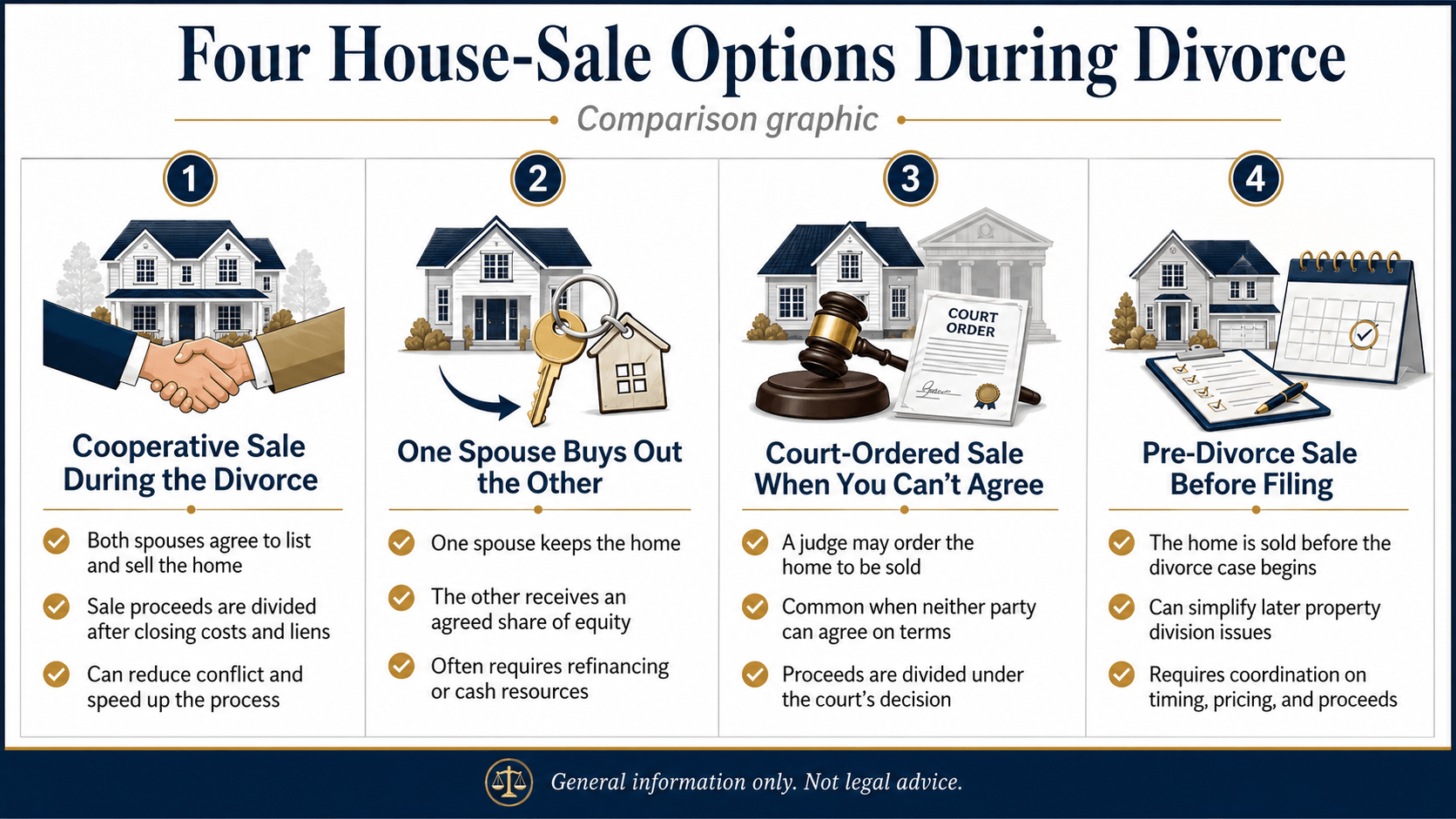
Most couples selling a house during divorce in Savannah have four real paths. Each path has different cooperation requirements, tax timing, sale proceeds, and emotional cost.
Option 1: Cooperative Sale During the Divorce
A cooperative sale means both spouses agree to list the home, prepare it for market, review offers, and divide net proceeds according to the settlement agreement or court-approved terms.
This usually makes sense when neither spouse wants to keep the property, neither can afford it alone, or both prefer a clean financial break. It can also work well when children are involved and the spouses want a predictable timeline before school, relocation, or custody schedules become harder to manage.
The mechanics are straightforward, but the communication plan matters. Both spouses usually sign the listing agreement. Showings must be coordinated if one spouse still lives there. Repairs, staging, pricing, offer responses, inspection negotiations, and closing decisions should be documented in writing.
In Savannah, a cooperative sale can often fit inside the divorce timeline. The listing may go live after temporary orders, after mediation, or once both attorneys approve the sale process. If you are comparing neighborhoods for a next move after the sale, ARC’s guide to Pooler, Richmond Hill, and Rincon compared for relocation may help both parties think through realistic next steps.
Option 2: One Spouse Buys Out the Other
A buyout means one spouse keeps the house and pays the other spouse their agreed share of the equity. This usually requires a refinance into the keeping spouse’s name alone, plus a deed transfer.
Here is the basic math. Assume a Pooler home is worth $400,000 and has a $250,000 mortgage. That creates $150,000 of gross equity before closing costs, repairs, or adjustments. If the spouses agree to a 50/50 split, the departing spouse’s share is $75,000. The keeping spouse needs to produce that $75,000 through refinance proceeds, cash, retirement offset, or another agreed asset.
The common failure point is financing. A dual-income household may qualify for a mortgage that one spouse cannot carry alone after separation. This is especially common in higher-payment situations where rates, insurance, taxes, and HOA fees have moved up since the original purchase.
This is where a neutral valuation matters. Before anyone argues over equity, both parties need a defensible market number. ARC can provide a free Home Value + Selling Plan for your specific property so the buyout conversation starts with the asset value, not assumptions.
Option 3: Court-Ordered Sale When You Can’t Agree
A court-ordered sale happens when the spouses cannot agree and the court orders the home sold. This may come after mediation fails, after temporary orders, or as part of the final decree.
In a Chatham County divorce house sale, the court may set terms for pricing, access, repairs, accepted offers, or who signs documents. In more difficult cases, a judge may appoint a neutral person to manage parts of the process. The more the court has to control, the less flexibility both spouses usually have.
Financially, this is often the least efficient path. Not because the court is trying to reduce value, but because urgency, conflict, delayed maintenance, limited showings, and reduced market preparation can all weaken the sale. Buyers can sense distress. Agents can lose momentum. Carrying costs continue while the dispute sits unresolved.
A neutral agent approach can help avoid this. If both spouses agree to one coordinator, one pricing plan, one showing protocol, and one communication lane, the home can still be marketed like a normal Savannah listing instead of a distressed legal problem.
Option 4: Pre-Divorce Sale Before Filing
A pre-divorce sale means the couple sells the home before either spouse files for divorce. This can work when both parties are still cooperative, the mortgage is becoming difficult, or neither person wants to carry the home through a long legal process.
The tax timing can matter. IRS Topic 701 says qualifying sellers may exclude up to $250,000 of gain, or up to $500,000 if married filing jointly. IRS Publication 523 explains that the maximum exclusion depends on ownership, use, and other eligibility tests. (IRS)
For higher-value Savannah properties, including Ardsley Park, Skidaway Island, waterfront Wilmington Island, or Tybee Island homes with large appreciation, that timing can change the conversation. A sale while still married may preserve a broader joint exclusion if the spouses qualify. A sale after divorce may leave each former spouse looking at separate $250,000 limits, depending on ownership, filing status, and eligibility.
There is also risk. If the sale is done without legal documentation, one spouse could later argue that the sale or distribution concealed assets or pressured a settlement. A pre-divorce sale should be coordinated with an attorney, and proceeds should be handled under a clear written agreement.
If repair condition or speed is part of the decision, read the cash buyer comparison guide we wrote for Savannah sellers before accepting a discount offer.
Talk to a licensed Georgia family law attorney about your specific situation. This guide is general information, not legal advice.
The Cooperation Problem And How to Solve It

The hardest part of a divorce home sale is often not valuation. It is cooperation. A strong process can reduce the number of decisions spouses have to make together.
What happens when one spouse refuses to sign the listing agreement
If both spouses are on title or both must approve the sale under the divorce process, one refusal can stall a voluntary listing. At that point, the next step is usually attorney communication, mediation, temporary orders, or a court request.
A real estate agent cannot override ownership rights or a court process. What an agent can do is provide a neutral market valuation, a written listing plan, and a clear estimate of what delay is costing both parties.
Temporary orders, exclusive possession, and the role of a Chatham County judge
Temporary orders can address who lives in the home, who pays the mortgage, who handles repairs, and whether the home can be listed while the divorce is pending. Georgia court forms recognize temporary use and possession of the marital residence as an issue that may be requested in a divorce case. (georgiacourts.gov)
For Savannah residents, those issues usually run through Chatham County Superior Court. Richmond Hill and Rincon residents may be dealing with Bryan County or Effingham County courts instead.
The neutral agent approach
“My agent versus their agent” usually costs both spouses money. Two competing agent relationships can create duplicate advice, mixed pricing strategies, slower decisions, and more emotional friction.
A neutral coordinator gives both parties the same information at the same time. That means shared valuation, shared showing feedback, shared offer summaries, and clear written next steps. It does not replace attorneys. It keeps the real estate part organized.
When mediation makes sense
Mediation makes sense when the spouses disagree but still have enough structure to negotiate. It may be less productive when one party refuses to participate, ignores deadlines, or is using the home as leverage instead of addressing the numbers.
If you and your spouse are not on speaking terms but both need this sale to go cleanly, ARC offers a private, neutral conversation with both parties, no listing pressure, no taking sides.
Talk to ARC Privately
How Equity Is Actually Split With Real Savannah Examples
Home equity is not the sale price. Equity is what remains after the mortgage payoff, selling costs, closing costs, concessions, repairs, and any agreed separate-property adjustments.
The basic math
Start with the likely sale price. Subtract the mortgage payoff. Then subtract commissions, seller concessions, repairs, taxes, HOA items, and closing costs. The remaining amount is the net equity available to divide.
That number is the one that matters in a Georgia divorce home-sale settlement. Not what the house was worth two years ago. Not what a neighbor got. Not what an online estimate says without condition, repairs, or timing.
When 50/50 is not fair
A 50/50 split may be reasonable for many Savannah couples, but it is not the only possible result. Separate-property claims can change the math.
Common examples include one spouse using premarriage savings for the down payment, one spouse paying major improvements from separate funds, or one spouse carrying the mortgage alone for a long period after separation. Retirement assets can also affect the real estate decision. If a 401(k), pension, or similar retirement plan is being divided, a Qualified Domestic Relations Order may be part of the larger settlement. The U.S. Department of Labor explains that a QDRO assigns a right to receive all or part of benefits under a retirement plan. (DOL)
Source-of-funds rule
Georgia case law recognizes a source-of-funds concept when separate and marital money are both tied to the same property. In simple terms, the source of the money used to acquire or improve the home can matter.
A worked example is still only an example. Actual settlements depend on documents, title history, mortgage history, contributions, appraisals, and legal strategy.
A worked Savannah example
This example is intentionally simple. A real Chatham County divorce house sale may include tax credits, missed payments, repair credits, HELOC balances, insurance proceeds, escrow shortages, or a retirement offset.
Want to know what your specific Savannah home would actually net under each of the four paths? ARC’s free Home Value + Selling Plan walks through the math for your address and timeline, discreetly.
Get My Home Value + Selling Plan
Talk to a licensed Georgia family law attorney about your specific situation. This guide is general information, not legal advice.
Tax Consequences You Cannot Ignore
Tax timing can change the net result of selling a house during divorce in Savannah. The right person to model that impact is a CPA, not a real estate agent.
The Section 121 capital gains exclusion
The IRS home-sale exclusion allows qualifying sellers to exclude up to $250,000 of gain, or up to $500,000 if married filing jointly. IRS Publication 523 explains that sellers must meet ownership, use, and eligibility rules. (IRS)
Why pre-divorce timing can matter
If a couple sells while still married and filing jointly, they may qualify for the larger exclusion. If the home is sold after the divorce is final, each former spouse may be working with a separate exclusion limit, subject to eligibility.
For high-appreciation Savannah homes, that can become a five-figure issue. This is one reason the sale date, divorce date, occupancy history, and filing status should be discussed before signing a listing agreement.
Transfer incident to divorce
A buyout is not the same as a third-party sale. IRS Publication 504 covers tax rules for divorced or separated individuals, including property settlements and transfers that occur because of divorce. (IRS)
That does not mean every buyout is tax-free in the long run. Basis, future gain, refinance structure, and later sale timing can still matter. Bring a CPA in early, especially for Ardsley Park, Tybee Island, Skidaway, or waterfront Wilmington Island homes with significant appreciation.
Talk to a licensed Georgia family law attorney and CPA about your specific situation. This guide is general information, not legal or tax advice.
A Realistic Timeline for a Savannah Divorce House Sale
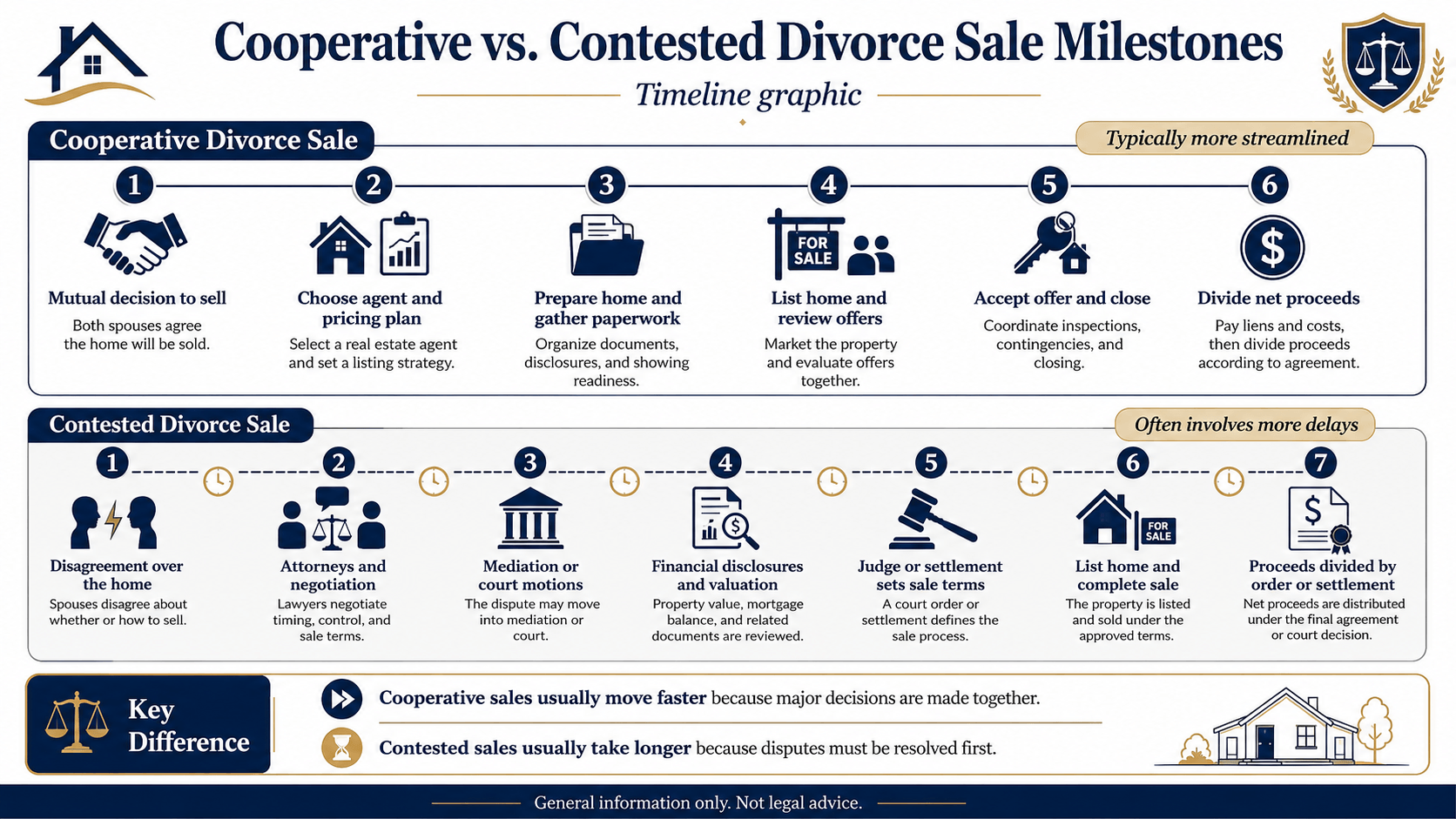
A cooperative Savannah divorce house sale may take two to three months from decision to closing. A contested or court-ordered path can take much longer because the listing is tied to legal approvals, access disputes, and decision deadlines.
The faster path is not always the better path. The goal is to choose the path that protects net proceeds, keeps the legal process clean, and gives both spouses realistic expectations.
For broader market context before choosing a listing strategy, review how Savannah home values are trending in 2026. FHFA/FRED data also tracks the Savannah MSA house price index, which helps show that local value trends should be checked with current market data instead of guessed. (FRED)
How to Choose the Right Agent When You’re Both Choosing Together
The right divorce real estate agent in Savannah is not just a strong marketer. The right agent can stay neutral, communicate cleanly, and keep both spouses working from the same facts.
Why “my agent vs. their agent” costs money
Two agents can turn a sale into a negotiation about loyalty instead of value. A divorce listing needs one pricing strategy, one calendar, one repair plan, one showing protocol, and one offer review system.
That does not mean both spouses stop getting independent legal advice. It means the real estate process has one coordinator.
Five questions to ask before signing
Ask any agent these questions before moving forward:
- Have you handled a divorce sale in Coastal Georgia before?
- How do you communicate with two clients who are not speaking?
- What is your protocol when one spouse changes their mind mid-process?
- Will you sign a neutral-agent acknowledgment?
- How do you handle proceeds disbursement at closing?
The answers should be specific. “We communicate well” is not enough. You want written expectations, shared updates, and a clear escalation plan when decisions stall.
ARC’s neutral-agent approach
ARC’s role is to be a neutral coordinator, not a referee. We help both spouses understand value, timing, likely net proceeds, prep work, buyer feedback, and offer terms. We do not replace attorneys, CPAs, mediators, or the court. We keep the house sale organized so the legal professionals can do their jobs with better information.
If the property is tied to financial pressure, deferred maintenance, inherited ownership, or another stressful situation, start with ARC’s Private Options service for stressful property situations.
6 Common Mistakes That Cost Savannah Divorcing Couples Money
Letting the home sit empty for months while you argue. Empty homes still create mortgage, tax, insurance, utility, lawn, and security costs. In Savannah’s humid climate, vacancy can also turn small maintenance issues into bigger repair problems.
Missing mortgage payments. A missed payment can hurt both spouses if both names are on the loan. CFPB explains that negative payment history can generally remain on a credit report for up to seven years. (Consumer Financial Protection Bureau)
Letting one spouse “keep” the house without refinancing. If both spouses stay on the mortgage, both may remain financially exposed. A quitclaim deed does not remove a borrower from a mortgage.
Hiring two separate agents. This often creates competing advice, inconsistent pricing, and slower decisions. One neutral real estate coordinator usually keeps more money in the shared equity pool.
Selling before getting a market valuation. You cannot divide equity responsibly if you do not know what the property is worth. This is especially true for neighborhood-sensitive homes in Ardsley Park, Wilmington Island, Pooler, Richmond Hill, and Tybee Island.
Forgetting the tax difference between pre-divorce and post-divorce timing. The Section 121 exclusion can be one of the largest tax issues in the sale. Do not wait until closing week to ask a CPA.
For related planning, especially when family property, probate, or title history overlaps with a divorce, read our guide to inherited homes in Savannah.
When a Fast Cash Sale Actually Makes Sense in a Savannah Divorce
A fast cash sale is not the best financial option for most Savannah divorces, but it can be the cleanest option in certain situations.
It may make sense when there is an active safety concern, a foreclosure deadline, a major repair issue neither spouse can fund, or a court-ordered sale involving a spouse who is unreachable. If safety is the issue, Georgia.gov explains that victims of violence can petition a judge for a protective order, and petitions are filed with the Clerk’s Office of the Superior Court in the county where the respondent resides. (Georgia.gov)
The tradeoff is price. Cash buyers usually want a discount because they are taking on speed, repairs, resale risk, or uncertainty. For many couples, a cooperative listing will net more. For some, certainty is worth the discount.
If children and relocation are part of the next step, ARC’s guide to family-friendly Savannah neighborhoods may help after the property decision is settled.
Frequently Asked Questions
Can one spouse force the sale of a house in Georgia?
One spouse usually cannot force a voluntary sale alone without agreement, title authority, or a court order. In Georgia, the general rule is that the divorce court can address property division when spouses cannot settle. If the home is part of the marital estate and the spouses are deadlocked, a judge may order sale terms through the divorce case. Talk to a licensed Georgia family law attorney about your specific situation.
Who pays the mortgage during a divorce in Georgia?
The spouses can agree who pays the mortgage, or the court can address temporary financial responsibility while the divorce is pending. The mortgage company is separate from the divorce case. If both spouses signed the loan, both may remain responsible to the lender even if one spouse is ordered to pay. Missed payments can affect both credit reports.
Can I sell the house before the divorce is final in Georgia?
Yes, a couple can often sell the house before the divorce is final if both spouses agree and the sale is properly documented. In a divorce home sale Georgia situation, the safest path is to involve attorneys before signing contracts or splitting proceeds. A written agreement can reduce later disputes over equity, repairs, costs, and sale timing.
How is house equity split in a Georgia divorce?
House equity is usually calculated as sale price minus mortgage payoff, selling costs, concessions, repairs, and other closing items. The remaining net equity is then divided by agreement, mediation, settlement, or court order. Georgia uses equitable distribution, so the split may be 50/50, but it does not have to be. Separate-property contributions can affect the final result.
What happens if my spouse refuses to sign the listing agreement?
If one spouse refuses to sign the listing agreement, the voluntary sale stalls and the next step is attorney-led mediation, a temporary order, or a court request. A real estate agent cannot force a signature, but a Chatham County judge can resolve the dispute through the divorce case, and a neutral valuation often helps by showing both parties exactly what the delay is costing.
Do both spouses need to be present at closing?
Not always. Many closings can be handled with separate signing appointments, mobile notaries, mail-away documents, or attorney-coordinated signatures. The title company and attorneys need clear instructions before closing. If both spouses must sign deed or closing documents, the logistics should be set early so one missed appointment does not delay funding.
How long does it take to sell a house during a divorce in Savannah?
A cooperative Savannah divorce house sale often takes two to three months from decision to closing. A contested sale can take four to eight months, and a court-ordered sale can take six to 12 months or more. The exact timeline depends on court orders, pricing, property condition, buyer financing, repairs, title work, and spouse cooperation.
Should we sell the house before or after the divorce is finalized?
It depends on cooperation, taxes, mortgage pressure, children, and legal strategy. Selling before the divorce is final may preserve more flexibility and may help some couples use the larger married filing jointly Section 121 exclusion if they qualify. Selling after divorce may make sense when settlement terms are not clear yet. Ask a Georgia family law attorney and CPA before deciding.
Divorce does not make the house less valuable. It makes the process more sensitive.
ARC can help you understand the four real paths, compare likely net proceeds, and choose a clear next step without pressure or taking sides.
No pressure, no listing obligation, just clarity.




Join The Discussion