At a glance
- Most “We Buy Houses” companies in Savannah are legitimate businesses, but legitimate does not mean their offer is fair.
- A typical Savannah cash offer runs 20% to 30% below what the home could net through a normal listed sale.
- Before signing, get an independent valuation so you can compare the cash offer to your true market net.
By Alex Rodino, US Military Veteran, licensed Georgia REALTOR® (#443565), and founder of the Alexander Rodino Collective (ARC Platform) at Keller Williams Coastal Area Partners. Last reviewed: July 3, 2026.
Quick answer: Yes, most “We Buy Houses” companies operating in Savannah in 2026 are legitimate businesses: real investors, flippers, wholesalers, and national franchises with real contracts and real money. But legitimate is not the same as fair. A typical Savannah cash offer runs 20% to 30% below what the same home could net through a normal listed sale. On a $325,000 home, that is a $40,000–$60,000 gap. This guide explains who these buyers are, when a cash offer is actually the right call, and the contract red flags worth pausing for, written by a licensed Coastal Georgia Realtor.
Key takeaways
- Most Savannah “We Buy Houses” companies are real businesses, not scams, but their offers are aggressive by design.
- Typical cash offers land 20–30% below open-market net, often a $40,000–$60,000 gap on a median-priced Savannah home (March 2026 median: $329,450 per Redfin).
- The cash path is the right answer when speed, certainty, privacy, or property condition matter more than top-dollar net.
- Before signing, get an independent broker price opinion and have a Georgia attorney review any cash-buyer contract.
Most sellers who get a cash offer in Savannah ask the same two questions: is this company real, and is the number they offered me fair? The first answer is usually yes. The second is almost always no, not because the buyer is dishonest, but because the business model requires a discount. Both can be true at the same time.
Are ‘We Buy Houses’ Companies Legit in Savannah? (A Realtor’s Honest Answer)
Yes, most “We Buy Houses” companies in Savannah are legitimate businesses. They are usually real investors, house flippers, local operators, national franchises, or wholesalers with real contracts and real money behind the offer.
But legitimate and lowball are not opposites.
Cash-buyer companies in Savannah operate on a business model that usually requires them to pay 20% to 30% below what the same home could net on the open market. That is not a glitch in the model. That is the model.
A perfectly legitimate cash buyer can offer you $230,000 on a home that might net $295,000 listed, sign a real contract, send real money, close in two weeks, and be doing exactly what the business is designed to do. The offer is real. The discount is also real.
This guide is the honest answer a working Coastal Georgia Realtor would give you in a 30-minute phone call. We will cover which kinds of cash buyers operate in Savannah, what “legitimate” actually means, when the cash path is the right answer, how to spot a true lowball or predatory contract, and what to do before you sign anything.
If you have already received a cash offer, the fastest sanity check is a 30-minute conversation with a working Realtor. ARC runs it free, with no obligation.
Are We Buy Houses companies in Savannah legitimate? The honest answer
Yes, the vast majority of “We Buy Houses” and cash-homebuyer companies operating in Savannah are legitimate businesses. They are usually registered investors, renovation buyers, wholesalers, or small real estate acquisition companies that buy properties, renovate them, and either resell or rent them.
They are usually not scams in the criminal-fraud sense.
What they are doing is offering less than your home could likely net through a normal market sale because they need room for repairs, closing costs, resale risk, holding costs, financing costs, and profit.
That is the part sellers need to understand clearly.
A legitimate cash buyer should follow through on the offer they make, close on the timeline they promise, and not steal from you. But that does not mean they will pay you what your home would net on the open market.
Both things can be true at the same time.
The three types of cash buyers operating in Savannah
- National franchise or brand-name buyers
These are larger brands with a broad footprint, established systems, and recognizable “We Buy Houses” marketing. They may be more polished and more process-driven. They may also be aggressive on price because their model depends on consistent margins. - Local Coastal Georgia investors
These are local or regional operators who buy in Savannah, Pooler, Garden City, Wilmington Island, Richmond Hill, Rincon, and nearby areas. Some are family-run. Some are small teams. Some are flexible on timing and terms. Quality varies, so verification matters. - Wholesalers and contract flippers
A wholesaler is not always the final buyer. They may put your home under contract, then assign that contract to another investor for a fee. This can be legal, but sellers should know what is happening. The person who signs the contract may not be the person who brings the money to closing.
What does “legitimate” actually mean in this industry?
“Legitimate” is a lower bar than many sellers think.
It means the business is real. It does not mean the offer is generous.
Before you sign, separate trust signals from trust illusions.
What legitimate does mean
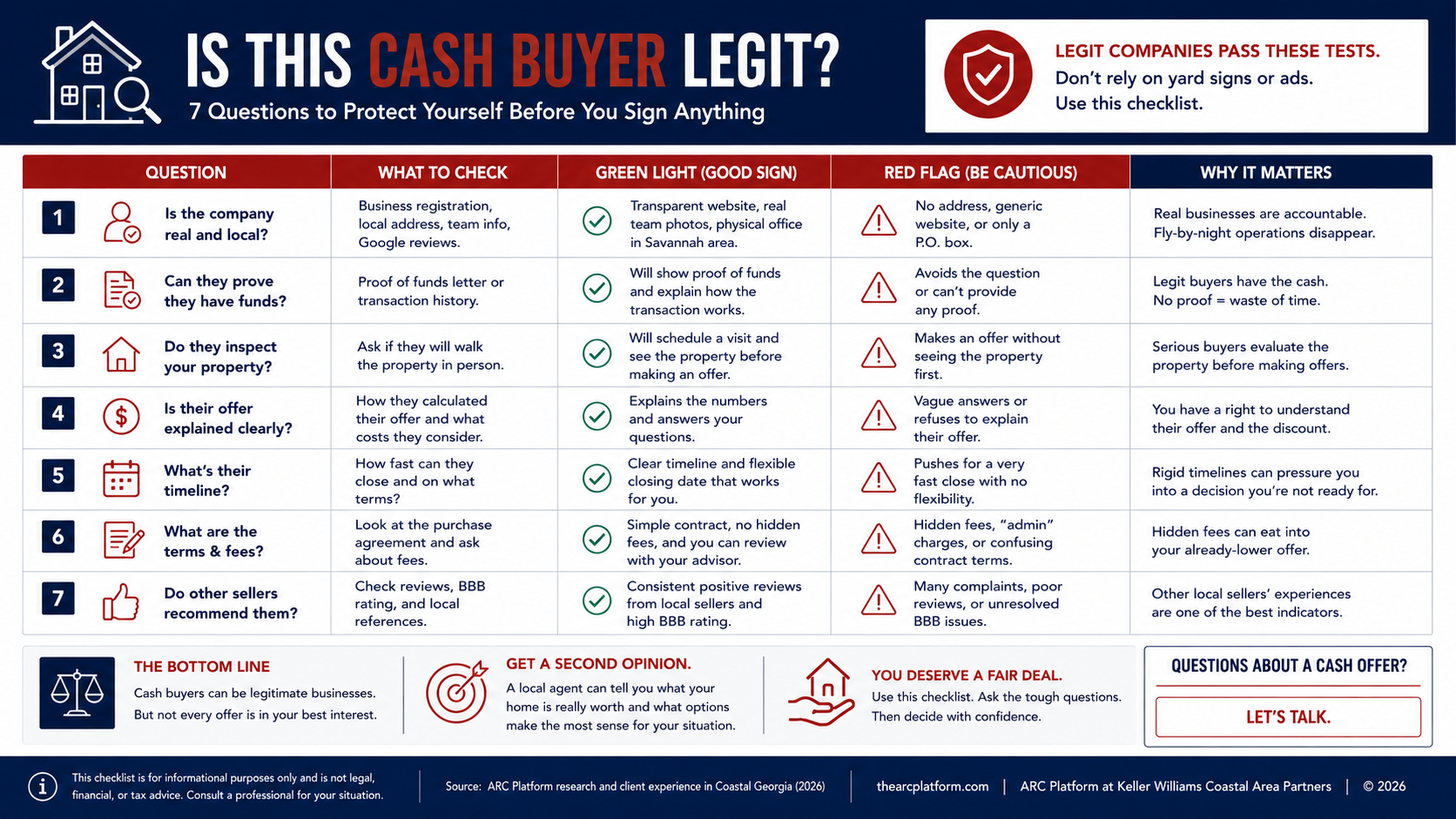
A legitimate Savannah cash buyer should be willing to let you verify basic details.
Look for these signs:
- The company exists as a real business entity.
Check the buyer’s entity name through the Georgia Secretary of State Corporations Division or the Georgia business search portal. The Secretary of State’s Corporations Division provides business search access for Georgia entities. (Georgia Secretary of State) - They have a verifiable business address.
A local office, registered agent address, or clear business presence is stronger than a vague P.O. box. - They will sign a written purchase agreement.
The terms should be clear: price, closing date, inspection period, earnest money, assignment rights, who pays closing costs, and what happens if either side cancels. - They provide proof of funds.
A serious cash buyer should be able to provide proof of funds or a credible funding source quickly. - They close through a real Georgia closing attorney.
You should know who is handling closing, where closing is happening, and who is preparing the settlement documents. - They have a review trail.
Check online reviews, BBB profiles, local references, and prior closings. The Better Business Bureau Savannah directory is one place to start when checking business reputation signals. (BBB)
What legitimate does not mean
Legitimate does not mean fair market value.
It does not mean the repair estimate is accurate.
It does not mean the buyer’s first offer is their best offer.
It does not mean you cannot negotiate.
It does not mean the company that signs the contract will be the company that closes.
And it definitely does not mean you should skip a second opinion.
A cash buyer can be fully legitimate and still offer you $50,000 less than a listed sale would likely net.
Is the offer they make actually fair? The 20% to 30% discount math
In brief: Most Savannah cash offers land 20% to 30% below what the same home could net on the open market, so the discount is the price you pay for speed and certainty.
A Savannah cash buyer’s offer is usually 20% to 30% below what the same home could net on the open market, sometimes more if the property needs major repairs.
That is the same basic math as the “70% to 80% of ARV” rule.
The difference is framing.
From the investor’s side, they may say they are paying 70% to 80% of After-Repair Value.
From the seller’s side, it feels like a 20% to 30% discount from what the home could have produced through a normal sale.
Both describe the same thing.
Using the current Savannah market as a planning anchor, Redfin’s Savannah housing market page shows a March 2026 median sale price of $329,450. A 20% to 30% discount from that kind of value can mean tens of thousands of dollars. (Redfin)
What that math looks like on a real Savannah home
Let’s use a simple Garden City example.
A 3-bed, 2-bath ranch has an After-Repair Value of about $290,000. A cash buyer using the 70% rule starts at $203,000, then subtracts a $25,000 repair estimate. That creates a cash offer around $178,000.
If the same home could be listed at $260,000, sell at $250,000, and net about $231,000 after commission and seller closing costs, the difference is roughly $53,000.
That is not a small difference.
It is also not unusual.
That $53,000 is what the seller is trading for speed, certainty, privacy, no repairs, no showings, and no financing risk.
For the full math breakdown, see ARC’s guide to how much cash home buyers pay in Savannah.
Why the spread exists
The spread exists because the buyer needs room for:
- Renovation costs
- Holding costs
- Insurance, utilities, taxes, and interest
- Closing costs on the purchase and resale
- Resale uncertainty
- Profit margin
- Unexpected repair risk
A cash buyer is not buying your house as a favor. They are buying it as an investment.
That does not make the offer bad. It makes the offer a trade.
What sellers actually say about Savannah cash buyers
In brief: Real Savannah sellers report fast, low-friction closings, but many also wish they had checked their true market net before signing.
If you spend time reading r/RealEstate, r/Wholesaling, or local Coastal Georgia threads, the seller-to-seller advice on “We Buy Houses” companies is remarkably consistent. People trust blunt answers when money is on the line, and the pattern that comes back is the same one a working Realtor would give you in a phone call.
The most common takeaways from real sellers who have been through a cash sale in Savannah and similar markets:
- Most cash buyers are real businesses, not scams. The offers are real, the closings are real, the money shows up.
- The offers are aggressive by design. Almost every seller who later got a broker valuation discovered the cash offer was 15–30% below what the home would have netted listed.
- If you have time, listing usually nets more. Even after commission and seller closing costs, the open-market path typically wins on net proceeds.
- If you do not have time, get more than one cash offer. Investors will compete. The first offer is rarely the best offer.
- Never sign a contract you do not understand. Especially watch for assignment clauses, long inspection windows, and one-way price-reduction language.
- Get a broker valuation before accepting. A 30-minute call costs you nothing and routinely uncovers $20,000–$60,000 in net proceeds the cash offer was leaving on the table.
That advice is not anti-cash-buyer. It is pro-information. And it is the same advice ARC gives every Savannah seller who calls us with a cash offer in hand. The question is never just “is this company legit?”; the better question is “what would my home realistically net if I did not take this offer?” A licensed Realtor can usually answer that in under 30 minutes by reviewing comparable sales, condition, neighborhood demand, repair exposure, and likely buyer pool. That single conversation gives you leverage. It also gives you peace of mind if the cash offer really is the right call.
When is the cash offer actually the right answer in Savannah?
In brief: A cash offer makes the most sense when speed, certainty, privacy, or a distressed property outweighs the 20% to 30% discount.
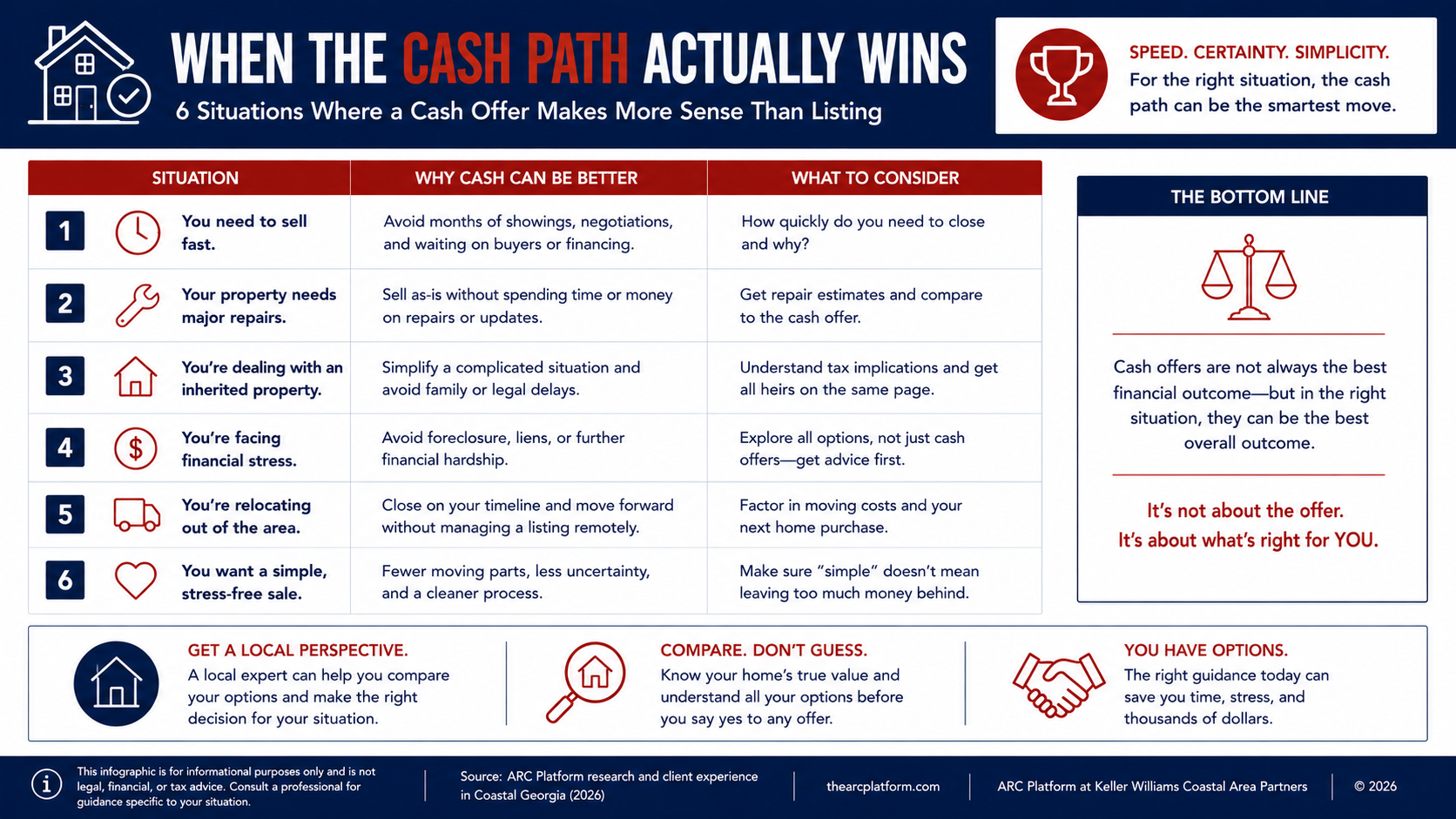
Sometimes the cash offer is the right answer.
Not because it pays the most. It usually does not.
It is the right answer when speed, certainty, privacy, or condition matters more than maximum sale price.
Cash may be the right path when:
You are an out-of-state heir.
If you are handling selling a parent’s home in Georgia from another state, managing repairs, utilities, contractors, cleanout, showings, and buyer negotiations can be exhausting.
The property is in severe condition.
Major foundation damage, fire damage, flood damage, roof failure, mold, failed septic, or major code issues can shrink the mortgage-eligible buyer pool.
You have a hard deadline.
PCS orders, divorce deadlines, foreclosure timelines, probate deadlines, medical costs, or job relocation can make a two-week close worth the discount. If you are moving on military orders, our Coastal Georgia military relocation help can walk you through the timeline before you accept any cash offer.
You need privacy.
Some sellers cannot tolerate public showings, online listing photos, open houses, or neighbors walking through the property.
The family wants closure.
Sometimes the emotional weight of the property matters more than the last dollar. That is real, and it deserves to be respected.
If two or more of these apply, the cash path may be worth serious consideration, even at a 20% to 30% discount.
When the cash path is actually the right answer for your family, ARC will tell you so directly and help you negotiate it. Our Private Options approach exists for exactly that situation.
How to spot a real lowball or scam attempt in Savannah
In brief: Watch for pressure tactics, one-way price-reduction clauses, and vague proof of funds; a Georgia attorney review of any buyer-supplied contract is cheap insurance.
Even inside the legitimate cash-buyer world, there is a wide range. Some buyers are direct, clear, and professional. Some are aggressive but still fair for the situation. Some are fishing for sellers who do not know their numbers. And some contract terms are bad enough that you should pause immediately.
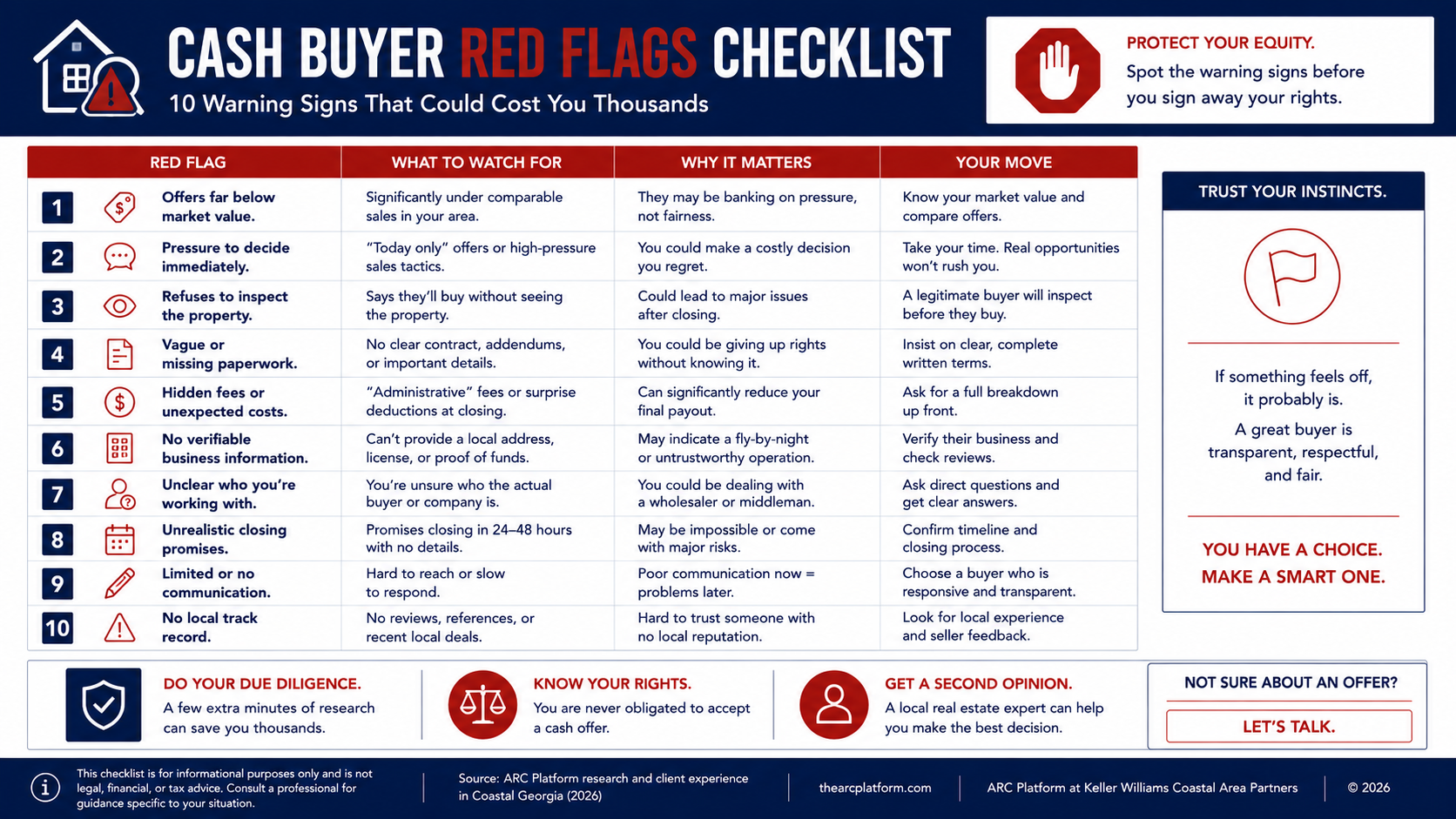
6 red flags during the offer conversation
- The offer is below 60% of ARV with no explanation. A very low offer can be justified if the property has major structural, title, or repair issues. But if the home is livable and the buyer cannot explain the number, pause.
- The buyer will not show comps or repair assumptions. They do not need to hand you their entire business plan, but they should be able to explain the resale value and repair deductions.
- The inspection period is long. A long inspection period can mean the buyer plans to renegotiate after locking the property up.
- They pressure you to sign in 24 to 48 hours. Real buyers can move quickly without forcing panic. Pressure is not proof of fraud, but it is a reason to slow down.
- Proof of funds is missing or vague. If someone says they can buy with cash, they should be able to show the ability to close.
- They want a closing setup you do not understand. If the buyer avoids a recognizable Georgia closing attorney or pushes a process that feels unclear, call your own attorney before signing.
4 red flags in the contract terms
- The contract is assignable without clear disclosure. Assignment can be legal, but the seller should know if the buyer plans to flip the contract to another investor.
- The earnest money deposit is tiny. A buyer offering $200 in earnest money while asking you to lock up a six-figure property is not taking much risk.
- There is a right of first refusal that survives the deal. That is not normal in a clean cash sale unless clearly explained by your attorney.
- The inspection language lets the buyer reduce the price at any time. Some contracts create a one-way door: the buyer can renegotiate, but the seller has limited options. Do not sign that without legal review.
When to call your own attorney
Any time the buyer provides their own purchase contract, have a Georgia real estate attorney review it before signing.
A short attorney review may cost a few hundred dollars. That is usually cheaper than discovering later that a contract clause cost you $20,000.
If the buyer claims to be licensed or if you believe a licensed real estate professional acted improperly, Georgia’s Secretary of State provides guidance on how to submit a licensing complaint. (Georgia Secretary of State)
Definitions: cash-buyer terms every Savannah seller should know
In brief: Knowing terms like ARV, assignment, and net proceeds lets you read a cash offer clearly and compare it to your true market net.
If you have a cash offer in hand, these are the terms that matter most. Knowing them before you read the contract is the single biggest negotiating advantage a seller has.
- ARV (After-Repair Value). The estimated market value of your home after a cash buyer makes their planned repairs and renovations. Most Savannah cash buyers target 70%–80% of ARV, minus repair costs, as their offer.
- Wholesaler. A buyer who puts your home under contract with the intention of assigning that contract to another investor for a fee, rather than closing on it themselves. Legal in Georgia, but the seller should always know if this is happening.
- Proof of funds. Documentation, usually a bank statement or letter from a lender or hard-money source, showing the buyer actually has the cash to close. A serious buyer can produce this within 24 hours.
- Assignable contract. A purchase agreement that allows the original buyer to transfer (assign) their rights and obligations to a different buyer before closing. The person who signs may not be the person who closes.
- Earnest money deposit. The cash a buyer puts up at contract signing to show they are serious. Tiny earnest money on a six-figure property is a red flag, it means the buyer has very little to lose by walking away.
- Right of first refusal. A contract clause that gives the buyer the right to match any future offer on the property. In a clean cash sale, this clause should not be present unless your attorney has approved it.
- 70% rule. The standard cash-buyer pricing formula: (ARV × 0.70) − repair costs = maximum cash offer. A more conservative variant uses 75% or 80%. This is why most Savannah cash offers land 20%–30% below open-market net.
Visible answers to every FAQ on this page
The accordion below repeats these in a collapsible format, but here are the same answers in full for anyone who prefers to scan them all at once.
Are We Buy Houses companies in Savannah legitimate?
Yes. Most We Buy Houses and cash-buyer companies operating in Savannah are legitimate businesses, usually registered investors, flippers, or wholesalers. They are usually not scams in the criminal-fraud sense. Their offers are aggressive by design and often run 20% to 30% below what the same home could net on the open market.
Is We Buy Houses a legit company?
“We Buy Houses” is a marketing phrase used by many independent investors, franchises, and wholesalers, not a single company. Most of the businesses using that phrase in Savannah are legitimate, but the offer you receive will still typically be 20% to 30% below open-market net. Verify the specific entity through the Georgia Secretary of State business search before signing.
Is selling your house for cash a good idea in Savannah?
It depends on what you need more: speed and certainty, or top-dollar net. A cash sale typically closes in two weeks with no repairs or showings but at a 20–30% discount. If you have time and the home is in decent condition, the open market usually nets more, even after commission and seller closing costs.
Why am I getting unsolicited offers to buy my house in Savannah?
You are on a public list. Investors mine the Chatham County tax assessor, MLS expireds, probate filings, code-violation notices, and absentee-owner records, then mail or call homeowners directly. Most of these solicitations are real businesses, but the offer is still an opening bid, always 15–30% below what a broker valuation would suggest.
How much less do We Buy Houses companies pay in Savannah?
Most Savannah cash buyers target 70% to 80% of After-Repair Value, then subtract repair costs. In practice this lands about 20% to 30% below what the same home would net through a normal listed sale. On a home that would list for $260,000 and net $231,000 after costs, a typical cash offer is in the $175,000 to $195,000 range.
How do I know if a Savannah cash buyer is reputable?
Check their entity through the Georgia Secretary of State, ask for proof of funds, require closing through a recognizable Georgia closing attorney, verify reviews and BBB profile, and never sign a contract you do not understand. A reputable buyer will not pressure you to sign within 24 to 48 hours.
Can I negotiate with a We Buy Houses company in Savannah?
Yes. The first offer is almost never the best offer. Ask the buyer to walk you through their ARV calculation and repair deductions, get a competing cash offer from at least one other investor, and obtain a 30-minute broker price opinion. Sellers who do these three steps routinely raise their cash offer by $10,000 to $30,000.
Frequently asked questions
Are We Buy Houses companies in Savannah legitimate?
Yes. Most We Buy Houses and cash-buyer companies operating in Savannah are legitimate businesses, usually registered investors, flippers, or wholesalers. They are usually not scams in the criminal-fraud sense. Their offers are aggressive by design and often run 20% to 30% below what the same home could net on the open market.
Is We Buy Houses a legit company?
We Buy Houses is a real cash-buyer franchise-style brand, but the specific local operator matters more than the national name. Always verify the actual business entity through the Georgia Secretary of State business search, check review history, request proof of funds, and ask who will actually close on the property.
Is selling your house for cash a good idea in Savannah?
Sometimes yes, often no. Selling for cash may be a good idea if you have a hard deadline, severe property-condition issues, privacy concerns, an out-of-state inherited property, or a family situation where speed matters more than maximum price. For most Savannah sellers in normal circumstances, choosing to list with a broker usually nets significantly more.
Why am I getting unsolicited offers to buy my house in Savannah?
Cash buyers and wholesalers use public property data to identify possible acquisition targets. They may look for out-of-state owners, inherited properties, absentee owners, older homes with equity, code issues, vacant homes, or properties that have not sold recently. Getting a postcard or call does not mean something is wrong with your home. It means someone thinks there may be an investment opportunity.
How much less do We Buy Houses companies pay in Savannah?
A typical cash-buyer offer is often 20% to 30% below what the same home could net through a market sale. On a $325,000 Savannah home, that can translate to roughly $50,000 to $80,000 less, depending on condition, repairs, neighborhood, closing costs, and how strong the open-market buyer pool is.
How do I know if a Savannah cash buyer is reputable?
Check the business entity, verify the business address, request proof of funds, review BBB and Google reputation signals, ask for references or past closings, and confirm the closing will happen through a Georgia closing attorney. Reputable buyers will not resist basic verification.
Can I negotiate with a We Buy Houses company in Savannah?
Closing thoughts and next steps
The We Buy Houses industry exists because there is real demand for what it sells: speed, certainty, no repairs, no showings, fewer contingencies, and closure in days instead of months.
For some Savannah sellers, those things are worth $50,000 or more. The math says they paid a premium for time, and they would do it again.
For other Savannah sellers, the math says they gave up $60,000 they did not need to give up, on a home that would have sold quickly on the open market with very little extra work.
The point is to know which seller you are before you sign.
When you are ready for that conversation, even just a 30-minute call to run the math on a specific property, ARC is here. We negotiate both paths, including the cash path when it is the right answer. We do not earn fees for telling you to sell to a cash buyer, so when we do recommend it, you can trust the recommendation.
And when we tell you the listing path is likely to net you more, we will show you the math.
Before you sign anything, get the math
If you already have a cash offer on a home in Savannah, Pooler, Garden City, Wilmington Island, Richmond Hill, Rincon, or nearby, do not guess.
Let ARC compare the cash offer against a realistic open-market net.
No pressure. No obligation. No broker pitch.
Start with a home valuation, ask about Private Options, or work with our team before you sign anything.
Phone: +1-912-351-8935
Email: info@thearcplatform.com
Start here: Get the math before you sign


Join The Discussion